Are you creating content, but still feel like you’re falling behind your competition? You publish blog posts, update your site, but it seems like everyone else is getting more traffic and ranking higher on Google.
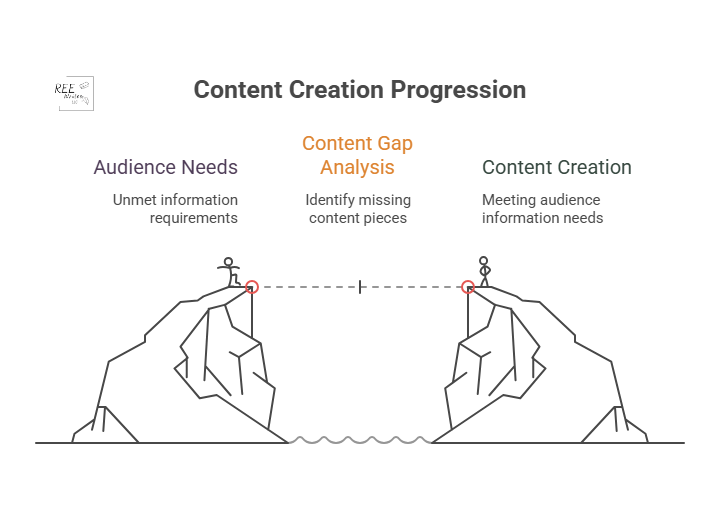
Do you know exactly what your audience is searching for, that you haven’t covered in your content? A content gap analysis is a powerful way to find those hidden opportunities as a clear roadmap to attract more visitors with your content.
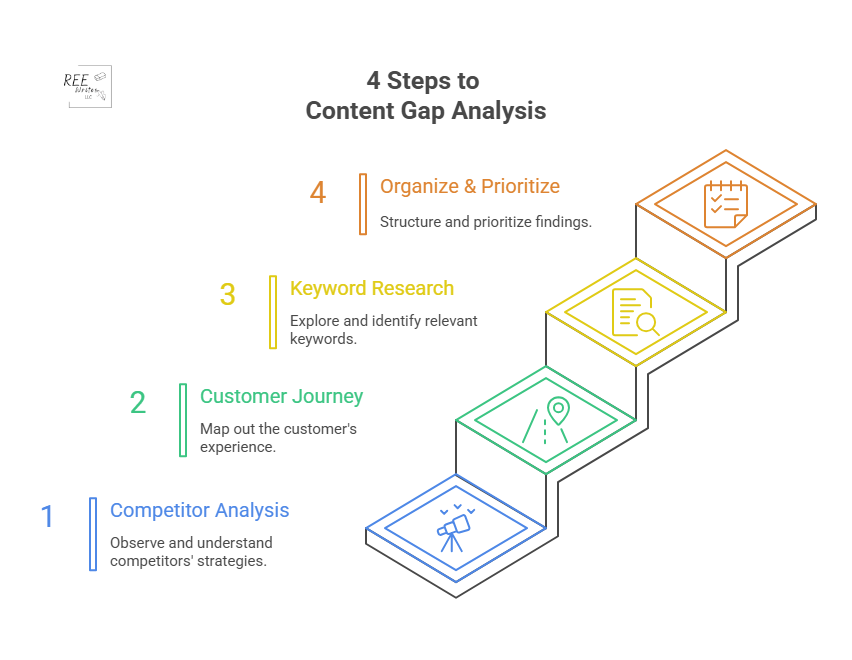
Let’s go over a 4-step process to find these gaps, fill them with valuable content, and grow your audience.
It’s a great question, and the answer is simpler than you might think. A content gap analysis is a powerful way to find opportunities for your business.
A content gap analysis finds topics and keywords important to your audience that your business doesn’t cover. It usually involves looking at the keywords your competitors rank for in search results that you don’t.
The goal is simple: identify holes in your content that your audience needs you to fill. Creating useful resources builds trust and authority with potential customers.
Think of it like a grocery store owner checking a rival’s aisles. If they see customers constantly buying a popular brand of organic granola that they don’t stock, they’re missing out on sales. That’s called a “product gap.”
You’re doing the same thing, but with information. You’re looking for information your audience wants, but they can’t find on your site.
Content strategies must be hyper-focused on customer needs to be effective. A content gap analysis is the most direct way to align your strategy with your audience’s needs.
Now that we’ve covered the basics, let’s look at how this can help your search engine optimization (SEO) and make your content work harder for you.
How Content Gap Analysis Affects Your SEO
Conducting a content gap analysis is a core part of a smart SEO and content strategy that delivers real results. It helps you stop creating content based on guesses and start making data-driven decisions that directly impact your growth. Here’s why it’s so important.
Find new keyword opportunities
Think you know all the important keywords for your industry? There’s always more to discover.
A content gap analysis uncovers valuable keywords your competitors are using to attract visitors—visitors that could be yours. These are often long-tail keywords or specific questions that show a user is further along in their buying journey.
Long-tail keywords (phrases of 3+ words) make up a significant portion of all Google searches. These less-competitive phrases often have higher conversion rates because the user’s search intent is much more specific. By finding gaps, you’ll also find these high-intent long-tail keywords.
Different types of content gaps
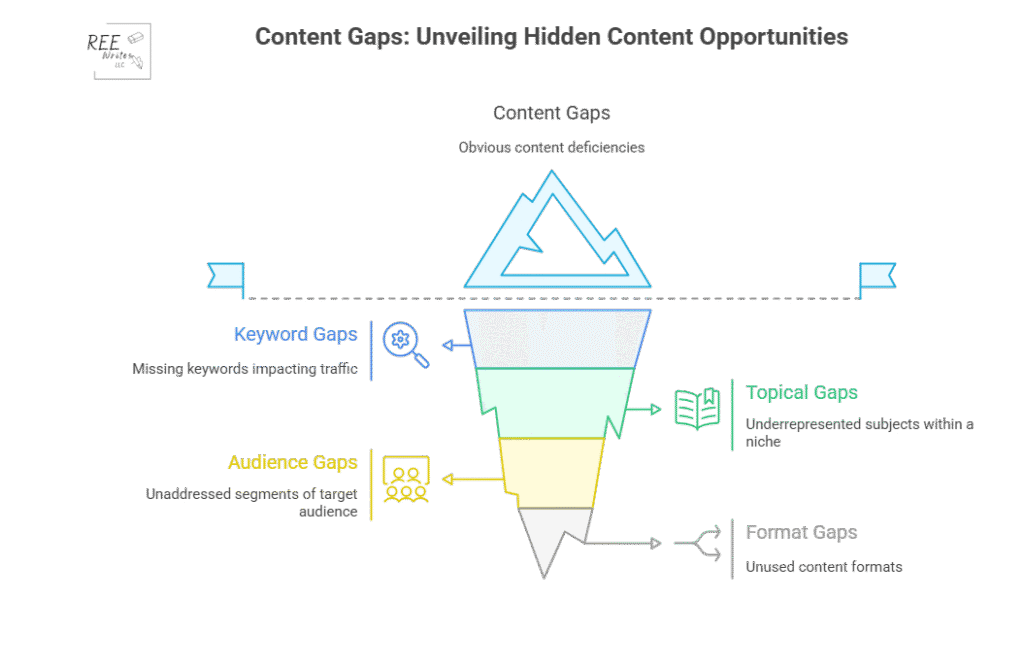
There are four types of content gaps you can address to be sure that your content strategy is thorough and promotes conversions:
Formats: Content types like videos, blogs, case studies and podcasts your audience likes, but you don’t have.
Understand your audience
What questions are your potential customers asking? What are their biggest problems? A content gap analysis helps you get a clearer picture of what your audience needs at every stage of their journey. By seeing what topics are popular on competitor sites, you get direct insight into the conversations happening in your industry. This allows you to create content that truly resonates and helps people.
Let’s say for example that you’re a B2B software company, and you see your main competitor has an entire section of their blog dedicated to “integrations with other software.” If you have no content on this topic, you could address this gap by creating a series of articles on how their product works with other popular tools, and get an increase in qualified leads from your blog within a few months.
Outperform competitors
To get ahead, you have to be better than your competitors and cover the topics they’ve missed.
You can systematically cover topics your competition already ranks for, but you can create more comprehensive, up-to-date, and helpful content to win the top spot on Google. You can also find the “gaps within the gaps”—topics that none of your competitors are adequately covering. This analysis gives you a strategic advantage.
Competitor analysis is an important piece of your marketing and content strategy. It’s the foundation for identifying opportunities to gain a competitive edge in search rankings.
Improve the customer journey
The customer journey isn’t a straight line. People move from being aware they have a problem, to considering different solutions, to making a final decision. You need content that supports them at every stage.
Source: Talkative
A content gap analysis helps you see if you’re missing content for a critical stage. For example, you might have great blog posts for the “awareness” stage, but no comparison guides for the “consideration” stage.
Ensuring a seamless customer journey with helpful information at each touchpoint can significantly increase customer satisfaction and conversion rates. Customers who receive helpful content throughout their journey are more likely to become loyal brand advocates. Filling your content gaps can help you do that.
4 Steps to Content Gap Analysis
Now that you understand why it’s so important, let’s get into the how. Here’s a four-step process to find and fill the gaps in your own content strategy.
Step 1: Analyze Your Competitor’s Content
What’s already working for others in your space? Let’s find out, using SEO tools to get a data-backed look at your competitors’ content performance.
First, identify your SEO competitors. These are websites that consistently show up on the first page of Google for the keywords you want to rank for.
Next, use an SEO tool to do the heavy lifting. Tools like Ahrefs, Semrush, and Moz have specific “gap analysis” features built for this exact purpose. These competitive analysis tools are essential for your digital marketing strategy, saving you hundreds of hours of manual research.
Source: Semrush
Here’s a typical workflow using Semrush’s Keyword Gap tool:
Enter the domains: Input your own website’s domain and the domains of up to four of your top SEO competitors.
Run the analysis: The tool will compare the keyword profiles of all the websites.
Find the gaps: Filter the results to show keywords where your competitors rank (e.g., in the top 10 results), but your site does not. Semrush has a “Missing” filter perfect for this.
This process will give you a spreadsheet full of valuable keywords and topic ideas that are already proven to attract visitors in your industry. This data-driven approach removes guesswork and gives you a clear starting point.
Step 2: Map the Customer Journey
A content gap can also exist within your own site. You might be missing content for crucial stages of the customer journey, leaving potential customers stuck.
Think about the journey in three simple stages:
Awareness Stage: The person knows they have a problem but doesn’t know the solution yet. They are looking for educational, top-level information. Examples: “Why is my skin so dry in the winter?” “How to improve team productivity.”
Consideration Stage: The person now understands their problem and is researching different solutions or methods to solve it. Examples: “Hyaluronic acid vs. glycerin for dry skin.” “Asana vs. Trello for project management.”
Decision Stage: The person has decided on a type of solution and is now comparing specific products or services to make a purchase. Examples: “CeraVe Moisturizing Cream review.” “Best price on Asana business plan.”
Now audit your existing content. To do a content audit, create a simple spreadsheet and categorize your current articles, guides, and landing pages into these three stages. You’ll quickly see where the gaps are. Do you have dozens of “awareness” blog posts but no “consideration” comparison guides? That’s a huge content gap you need to fill to guide users toward a purchase.
Step 3: Use Keyword Research to Find Questions
Sometimes the biggest opportunities lie in the specific questions people are asking. These questions are a goldmine for content ideas because they tell you exactly what’s on your audience’s mind.
Source: Swarm Digital
There are several free and easy ways to find these questions:
Google’s “People Also Ask” (PAA) Box: When you search for a keyword, Google often shows a box with related questions. This is a direct look into what other users are searching for. Click on a question, and more will appear.
AnswerThePublic: This free tool takes your keyword and generates a visualization of hundreds of questions related to it, broken down by who, what, where, when, why, and how.
Forums: Search for your topic on these sites like Reddit and Quora and look at the discussions. What are people confused about? What problems are they trying to solve? The language is natural, giving you raw insight into your audience’s pain points.
For example, if your main topic is “email marketing,” you might discover from the PAA box that people are asking, “How often should a small business send emails?” or “What are the best free email marketing tools?” These are perfect topics for new articles that address a very specific need.
Step 4: Organize and Prioritize Your Ideas
By now, you should have a long list of potential content ideas from your competitor analysis, customer journey mapping, and question research. The final step is to organize these ideas and decide what to work on first.
Create a master spreadsheet for your content ideas. For each idea, include these columns:
Topic Idea
Target/Focus Keyword
Stage of Customer Journey
Monthly Search Volume
Keyword Difficulty
Business Relevance (1 to 5)
How to Choose Project Management Software
choose project management software
Consideration
800
Medium
5
Asana vs. Trello
asana vs trello
Consideration
2,500
High
4
Best Free Email Marketing Tools
free email marketing tools
Decision
5,000
High
3
Use this data to prioritize. A good approach is to look for topics with a sweet spot of:
High business relevance
Decent search volume (100 to 1,000 searches per month minimum)
Manageable keyword difficulty (KD)
Then group related topics into topic clusters to build authority on a subject and improve your internal linking structure. This ensures you’re creating content that will not only attract traffic but attract the right leads who are likely to be interested in your products or services.
A content gap analysis takes the guesswork out of your content strategy. Instead of wondering what to write next, you’ll have a clear roadmap based on real data about your audience and competitors. Do a content gap analysis regularly to fill the holes in your content, meet your audience’s needs, and steadily grow your organic traffic.
References
Ahrefs. (2023). Ahrefs Keyword Explorer Data. Ahrefs Pte. Ltd. Retrieved from [https://ahrefs.com/keywords-explorer.
AirOps (2024). Content Gap Analysis: Types, Examples & Step-by-Step Guide. Retrieved from https://www.airops.com/blog/content-gap-analysis-examples
du Plessis, C. (2022). A Scoping Review of the Effect of Content Marketing on Online Consumer Behavior. SAGE Open, 12(2). https://doi.org/10.1177/21582440221093042
Search Engine Journal. (2025). The State of SEO: A 2025 Report. Retrieved from https://www.searchenginejournal.com/state-of-seo/
Are you tired of the website traffic rollercoaster? One month you’re up, the next you’re down. This feast-or-famine cycle can really slow down your business growth, especially as a solopreneur doing everything by yourself.
But what if there was a way to get a steady stream of visitors to your site, month after month?
There is! It’s called evergreen blog content. Unlike trending topics that quickly lose appeal, evergreen content keeps working for you months and YEARS after you hit publish.
Imagine a pine tree – it stays green all year round, right? Evergreen content is similar. It’s information that remains useful and relevant to your audience for a long time. This is different from timely content, like news about a current event, or a seasonal trend, which loses its importance quickly.
How to determine whether your content is evergreen
Your content will stay fresh over time if it:
Covers foundational topics in your field.
Answers common questions and/or solves your audience’s persistent problems.
Doesn’t become outdated quickly.
So if you’re a business coach, an evergreen topic could be “How to Set Realistic Business Goals.” This is something new and experienced entrepreneurs will always search for.
A time-sensitive topic, on the other hand, might be “Reacting to the Latest Social Media Algorithm Change.” While it’s a hot topic for a moment, it won’t be as relevant next year (or whenever the algorithm changes again).
Myths about evergreen content
Common misconceptions about evergreen content are:
You write it once and never touch it again. While it’s low-maintenance, occasional updates can keep it performing at its best.
Any long-form article or “ultimate guide” is automatically evergreen. But if the core topic isn’t timeless, even a detailed guide will lose relevance. The key is lasting value. You’ll have to maintain this type of content as well.
Why Solopreneurs Need an Evergreen Content Strategy
Running a business on your own comes with unique challenges. You’re often juggling everything–marketing, sales, and service–not to mention personal obligations and demands on your time. Unlike larger companies with big marketing teams, you probably don’t have the resources to constantly churn out new content just to stay visible on social media.
This is where using an evergreen content strategy becomes a game-changer.
Imagine publishing a helpful blog post today that continues to attract visitors and potential clients for months, or even years, with little extra effort from you. That’s how evergreen content creates passive marketing for your business. It’s like having a marketing assistant working 24/7, even while you sleep!
This consistent traffic generation can smooth out feast-or-famine cycles. But there are more benefits of evergreen content.
Evergreen content is great for SEO
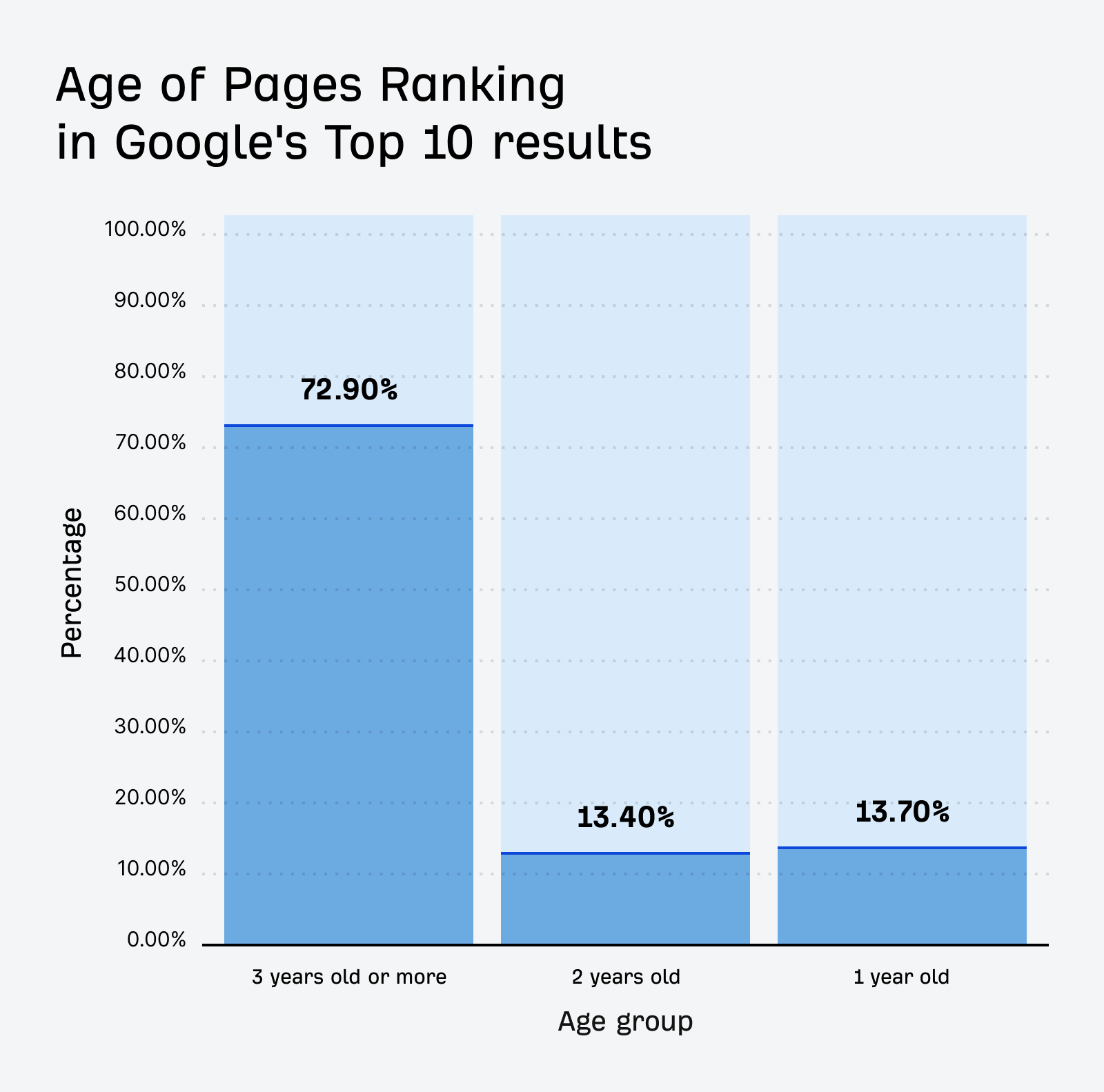
Source: Ahrefs
The SEO benefits of evergreen content grow over time.
Search engines like Google love high-quality content that thoroughly answers searchers’ questions. As your evergreen post gathers more views, shares, and backlinks from other sites, its authority (and yours) grows.
Older webpages tend to rank higher in SEO, and evergreen content is perfectly suited to become that aged, authoritative content. This means your posts are more likely to show up on the first page of search results, driving organic traffic to your website.
Evergreen content is cost-effective
Source: Search Engine Land
Creating content with long-term value is also very cost-effective.
Think about the time and energy you spend creating a blog post. With timely content, that effort yields results for a short period. With evergreen content, your initial investment continues to pay off for a much longer time.
This makes it a smart approach to content marketing for a small business, especially when you’re managing a tight budget. It’s about working smarter, not harder, to achieve sustainable business growth.
But what types of content offer this lasting power? Let’s look at some proven formats.
5 Types of Evergreen Blog Posts That Drive Consistent Traffic
Certain types of blog posts are naturally more suited to being evergreen. They address ongoing needs and questions. Here are five powerful formats you can use.
How-to guides and tutorials that solve common, persistent problems
These are classic evergreen pieces. People are always searching for instructions on how to do something. As a solopreneur, you have specific skills and knowledge, so share it!
For example, if you’re a web designer, “How to Choose the Right Colors for Your Brand Website” would be a great idea for an evergreen how-to guide.
Backlinko analyzed almost 1 billion blog posts, and found that “how-to” posts, listicles and infographics tend to receive a high number of backlinks, which is great for SEO and long-term traffic.
Resource lists and toolkits that remain useful year after year
Curated lists of valuable resources save your audience time and effort. These can become go-to references in your niche.
So for a virtual assistant, “The Top 10 Productivity Tools for Busy Solopreneurs” could be a highly valuable resource list.
Specific tools can change, but the categories of tools (project management, communication) often remain constant. You can update the specific tools every year or so to keep the list fresh.
“Ultimate” guides that cover foundational topics in your industry
These are comprehensive, in-depth pieces that aim to be the definitive resource on a particular subject, and build extensive authority.
Say you’re a financial planner for solopreneurs. You could write “The Ultimate Guide to Retirement Planning for the Self-Employed” and continue adding to it as one of your content pillars on your site.
Case studies of timeless principles applied to real situations
A piece showcasing how fundamental principles work in practice can be very insightful. If the principles are timeless, the case study will remain relevant.
So a marketing consultant might share something like: “Case Study: How a Local Bakery Tripled Its Online Orders Using Core Email Marketing Principles.” Even if the bakery is an older example, the core email principles likely still apply.
Focus on the “why” and “how” behind the success, linking it to enduring strategies instead of fleeting tactics.
FAQ posts that address universal questions in your niche
Every industry has questions that prospects and customers ask over and over again. Compiling these questions into a comprehensive FAQ post can be incredibly helpful and drive targeted traffic to your site continuously.
A business lawyer could create an FAQ post called, “Your Top 15 Questions Answered: Legal Basics for Starting Your Solo Business.”
Answering common questions directly can help your content appear in Google’s featured snippets and “People Also Ask” boxes and at the top and bottom (respectively) of search results, significantly boosting visibility for these FAQ posts.
These formats provide a great starting point for your evergreen blog content for solopreneurs. Next, let’s talk about making sure people can find these amazing posts.
Creating Evergreen Content That Ranks
Creating great evergreen content is one thing; making sure it gets found by search engines is another. You want your hard work to pay off with consistent organic traffic. Here’s how to create content that ranks.
Keyword research techniques for finding evergreen search terms
Source: Ahrefs
Keywords are the search terms people type into Google. For evergreen content, you need to find keywords that have steady search interest over time, not just seasonal spikes.
Focus: Look for “long-tail keywords,” which are long, specific phrases like “how to create a content plan for solo business” instead of just “content plan”. They often have less competition and attract a more targeted audience.
Tools: Use tools like Google Keyword Planner, AnswerThePublic, or Ahrefs’ Keywords Explorer to find terms people are searching for. Look for questions people ask related to your core topics. For instance, searching for “content ideas for solopreneurs” may reveal many related long-tail keywords.
The majority of searches are for long-tail keywords. Targeting these can be a smart SEO strategy for solopreneurs.
Tips for crafting headlines that attract clicks month after month
Your headline is the first thing people see. Here’s how to create a compelling headline they just have to click, now and in the future:
Be clear and specific: Tell the reader exactly what they will get. “5 Simple Steps to Writing Your First Evergreen Blog Post” is more specific than “Writing Blog Posts.”
Use numbers or questions: Headlines with numbers (like listicles) or that pose a question often perform well.
Include your target keyword: Your target keyword (also known as a primary keyword or focus keyword) helps search engines understand what your content is about.
How to structure content for both readability and SEO
Source: HardSplash Media
People online tend to scan content. Make your posts easy to read and digest. Search engines favor well-structured content with this formatting:
Properly-tagged headings and subheadings (H2, H3, H4): Break up your text and guide the reader.
Short paragraphs and sentences: Aim for clarity and conciseness.
Bullet points and numbered lists: Make information easy to skim.
Strategies to make your content comprehensive yet accessible
Evergreen content should be thorough, but not overwhelming. You want to be seen as an authority, but your audience (especially if you’re aiming for an 8th-grade reading level) needs to understand you. So be sure to:
Define jargon: If you must use industry-specific terms, explain them simply.
Provide examples: Illustrate your points with relatable scenarios. If you’re referencing a success story, focus on the enduring principles, not short-lived tactics.
Logical flow: Organize your content in a way that makes sense from start to finish.
Enhance content with timeless visuals
Visuals can make your content more engaging and easier to understand. Choose images and examples that won’t quickly look dated.
Use diagrams or simple charts: To explain complex ideas.
High-quality stock photos: Avoid overly trendy or cliché images.
Screenshots: Ensure they illustrate a process that isn’t likely to change drastically anytime soon.
By focusing on these elements, you can create evergreen blog posts that not only provide lasting value but also have a strong chance of ranking well in search results, becoming a cornerstone of your traffic-driving blog posts strategy.
But if your competitors are also creating evergreen content, how do you make yours stand out?
Making Your Evergreen Content Stand Out from Competitors
It’s likely your competitors are also trying to create lasting blog content. So, how do you ensure your evergreen pieces get noticed and become the go-to resource? You need to add that extra something special.
Research methods to find content gaps in your market
Source: SERPninja
A content gap is a topic your target audience is searching for, but there isn’t enough high-quality content available, or existing content is missing key information.
Analyze competitor content: Look at top-ranking posts for your target keywords. What questions are they not answering fully? What perspectives are missing? You can often find these content gaps by reading comments on their blogs or social media.
Use SEO tools: Tools like Semrush and Ahrefs have features to identify keywords your competitors rank for that you don’t, or where their content might be thin. This helps identify content creation opportunities.
Listen to your audience: What questions do your clients or social media followers ask you repeatedly? These are prime candidates for evergreen content that fills a real need.
Techniques to add unique insights and personal expertise
This is where being a solopreneur can be a real advantage. Your unique experiences, voice, and perspective are things no one else can replicate. This is key for personal branding through content.
Some ways to weave in your unique insights and perspectives:
Share personal anecdotes: Illustrate points with your own stories.
Offer a contrarian view: If everyone says “X,” but your experience shows “Y” can also work, explain that. This can create thought leadership content.
Develop your own frameworks or models: Simplify complex topics by breaking them down in a unique way.
A survey by Demand Gen Report cites that customers are increasingly looking for content that offers new perspectives, not just rehashed information.
How to incorporate original data or research when possible
Even small-scale original research can make your content stand out. A few ways to conduct research:
Survey your audience or network: Collect data on a topic relevant to your niche via a poll or survey, and share the findings.
Conduct mini-experiments: If applicable to your field, document a process and its results.
Analyze publicly available data uniquely: Find a new way to interpret existing industry reports or statistics.
Say you’re a productivity coach, you could survey 50 fellow solopreneurs about their biggest time-wasting activities and publish the results. This becomes unique, citable data.
Refresh your approach to common topics
Many evergreen topics have been covered extensively. Your goal is to bring a fresh angle:
Target a more specific niche within the topic: Instead of “Content Marketing Basics,” try “Content Marketing Basics for Handmade Business Owners.”
Focus on a different outcome or benefit: If most articles on “time management” focus on productivity, perhaps yours could focus on how it reduces stress for solopreneurs.
Use a unique format: Could you present the information as an interactive quiz, a detailed checklist, or a series of short videos embedded in the post?
By finding those content gaps and injecting your unique value, your evergreen content will not only rank but also resonate deeply with your audience, building your authority. Now, let’s explore a powerful platform to amplify that authority: LinkedIn.
Why LinkedIn Should Be Part of Your Evergreen Strategy
Source: Sprout Social
You’ve crafted some fantastic evergreen blog content for your website. But did you know that LinkedIn can be a powerful ally in your content strategy, especially for solopreneurs? It’s more than just a professional networking site.
LinkedIn’s SEO advantages for solopreneurs with new websites
LinkedIn is a massive website with very high domain authority (DA). This means content published there often gets indexed by Google quickly and can rank well in search results, sometimes even outranking content on newer, less authoritative personal blogs.
Benefit: If your own website is new and still building its SEO strength, publishing evergreen articles on LinkedIn can give your ideas visibility in search results much faster. This is a great way to drive organic traffic indirectly.
Case study: Many solopreneurs report that their LinkedIn articles appear in Google searches for their name or key topics they write about, often within days of publishing.
LinkedIn articles often rank faster than new blog content
Source: Oryn
As mentioned, LinkedIn’s authority helps its content get noticed by search engines quickly. Your brand-new blog might take weeks or months to get similar traction for a competitive keyword.
Think of LinkedIn articles as a way to “test” the ranking potential of certain evergreen topics or to gain initial visibility while your website’s SEO builds.
The unique algorithm benefits LinkedIn provides for individual creators
LinkedIn encourages creators to publish content directly on its platform. Its algorithm tends to favor native content, including articles.
Engagement signals: When your connections and followers engage with your LinkedIn article (by likes, comments, and shares), it signals to the algorithm that your content is valuable, potentially increasing its reach within the LinkedIn ecosystem.
LinkedIn’s “Creator Mode“: LinkedIn’s push for more original content means that individuals who consistently publish quality material, like evergreen thought leadership content, can see increased visibility on the platform.
Statistics showing LinkedIn’s content reach compared to personal blogs
Built-in network: When you publish an article, your connections are often notified, providing an immediate potential readership that a brand-new blog post might struggle to achieve without promotion.
Reach potential: According to data from Sprout Social (2023), LinkedIn is a top platform for B2B marketers, and well-crafted content can achieve significant organic reach among professionals, your likely target audience as a solopreneur. While your blog aims for global search reach, LinkedIn offers targeted professional reach.
Using LinkedIn as part of your evergreen content strategy doesn’t mean abandoning your blog. It’s about smart repurposing and leveraging LinkedIn’s strengths.
Anything can happen to a social media platform, but the content on your website is yours. So, how do you take your amazing blog posts and make them shine on LinkedIn?
Repurposing Evergreen Blog Content for LinkedIn Success
When you’ve got valuable evergreen blog posts on your website, don’t let them just sit there! Repurposing that content as LinkedIn articles can expand your reach and reinforce your expertise. Here’s how to adapt your content effectively.
Step-by-step process for adapting blog posts to LinkedIn articles
It’s not just a copy-paste job from your blog to LinkedIn—you need to tailor it.
Choose the right posts: Select evergreen blog posts that are highly relevant to a professional audience, and align them with your LinkedIn personal branding.
Condense and refocus: LinkedIn articles are often best when a bit shorter and more direct than a comprehensive blog post. Focus on the key takeaways or one core idea from your original post.
Rewrite the introduction: Hook the LinkedIn reader immediately by addressing a pain point or a professional aspiration relevant to them.
Adjust the body of the article: Keep paragraphs short. Use bullet points or numbered lists for readability.
Craft a LinkedIn-specific call to action(CTA): What do you want LinkedIn readers to do? Comment with their experiences? Connect with you? Visit your website for a related resource?
How to modify content structure for LinkedIn’s specific format
LinkedIn’s article editor has its own nuances:
Shorter paragraphs: Use for 2 to 4 sentences per paragraph on LinkedIn. This improves scannability on both desktop and mobile.
Use LinkedIn’s formatting: Add bolding, italics, blockquotes, and bullet points to break up text and highlight key information.
Consider “native” feel: Even though this isn’t an original article only for LinkedIn, make it feel like it was written for LinkedIn. This might mean a slightly more direct or professionally conversational tone.
Link back to your site: Create your own backlink for SEO by including a hyperlink to the article back to the original blog post on your website
For example, a 3,000-word “ultimate guide” blog post could be broken down into two or three focused LinkedIn articles, each tackling a specific sub-topic from the original guide. Or you could just use a portion of the blog to make an abridged version for LinkedIn.
Tips for creating LinkedIn-specific headlines that gain traction
Headlines are crucial on LinkedIn. They need to stop the scroll.
Lead with a benefit: “How Solopreneurs Can Triple Their Leads with Evergreen Content” is stronger than just “Evergreen Content Guide.”
Use numbers and keywords: Similar to blog headlines, but ensure the keywords resonate with a professional searcher on LinkedIn.
Intrigue or urgency: “The One Evergreen Content Mistake Most Solopreneurs Make.”
LinkedIn’s own publishing guidelines often emphasize the importance of clear, compelling headlines that promise value to the reader.
Ways to enhance engagement through LinkedIn-specific features
LinkedIn isn’t just a publishing platform, it’s a social one. So don’t just post and run:
Ask questions: End your article with a question (as a CTA) to encourage comments and discussions.
Tag relevant people/companies as appropriate: If you mention a tool or an influencer respectfully, tagging them might increase visibility.
Share your article as a post: After publishing the article, create a separate LinkedIn post linking to it, adding some personal commentary or a key takeaway to encourage clicks and engagement.
Engage with comments: Respond to comments on your article to keep the conversation going and show you’re active.
Repurposing your evergreen content for your LinkedIn content strategy extends its life and impact, helping you build authority and drive traffic from multiple sources.
Of course, even “evergreen” content needs a little care over time.
Maintaining and Refreshing Your Evergreen Content
The beauty of evergreen content is its longevity. But “long-lasting” doesn’t mean “set it and forget it forever.” To keep your best pieces performing well and staying truly relevant, occasional maintenance is key.
There’s no single magic number, but a good rule of thumb is to review your top-performing evergreen content at least once a year. For other pieces, every 18 to 24 months may be sufficient.
Also, set up Google alerts or regularly check if there’s been a significant industry change, a new major tool released, or if you notice a dip in traffic to a previously popular post.
According to Orbit Media Studios, bloggers who update older content are significantly more likely to report “strong results” from their content marketing.
Signs that your content needs refreshing
Source: Zeal Digital
Keep an eye out for these tell-tale signs:
Declining organic traffic: If a post that used to bring in steady visitors is slipping, it might be losing relevance or getting outranked.
Outdated information or statistics: Facts, figures, or examples that are clearly from years ago.
Broken links: Links to external resources or even internal pages that no longer work.
New, better competitor content: If others have published more comprehensive or up-to-date articles on the same topic.
Changes in your own offerings: If your services or products have evolved, your content should reflect that.
Simple updates that can boost existing content performance
Refreshing doesn’t always mean a complete rewrite. Often, small changes can make a big difference.
Update statistics and dates: Swap out old data for the latest available numbers.
Add new examples or case studies: Keep your illustrations fresh.
Improve readability: Break up long paragraphs, add more subheadings, or create bullet points.
Enhance visuals: Add new images, update screenshots, or create a simple infographic.
Expand a section: If a particular subtopic has gained more importance, add more detail.
Internal linking: Add links to newer relevant content on your site, and ensure older posts link to this refreshed piece. This helps with content with long-term value.
Tools to track content performance over time
You need data to know what’s working and what needs attention.
Google Analytics: Track page views, bounce rate, time on page, and traffic sources for each blog post.
Google Search Console: See which keywords your posts are ranking for, their click-through rates, and any crawl errors.
SEO software (Semrush, Ahrefs, Moz): Monitor your positions for target keywords using their rank tracking features.
When you review and refresh your evergreen content regularly, you ensure it continues to be a valuable asset for your solopreneur business, driving organic traffic and reinforcing your authority for years to come. This commitment to content refresh strategies is vital. (And of course, I’m available to help with that!)
Now, how do you fit this all into your busy schedule?
Creating a Content Calendar That Balances Evergreen and Timely Content
As a solopreneur, your time is precious. A content calendar is essential to manage your content creation effectively, and ensure you consistently publish valuable pieces without feeling overwhelmed. It also helps you balance foundational evergreen articles with more timely posts.
Ideal ratio of evergreen to timely content for solopreneurs
Source: Breeze
While it varies by industry and audience, a good starting point for many solopreneurs is an 80/20 rule of 80% evergreen content and 20% timely content.
Evergreen content provides a stable foundation for traffic and authority. Timely content (like industry news commentary, responses to current trends, or seasonal promotions) can create buzz and show you’re current, but its value fades faster.
This ratio isn’t set in stone. If a major industry event happens, you might temporarily shift to more timely content. The key is having a strategic content planning approach.
Planning techniques for consistent content creation
Consistency is more important than frequency when creating content, especially when you’re just starting. A few ideas to help keep you stay consistent:
Theme months or quarters: Focus your content around a specific theme for one time period such as a month or a quarter.
This can make brainstorming evergreen blog ideas easier and create a cohesive experience for your audience. For example, one quarter could focus on “Productivity for Solopreneurs,” with various how-to guides, resource lists, and FAQ posts on that theme.
Pillar content and topic clusters: Create a large, comprehensive evergreen “pillar post” on a broad topic, then create several smaller “cluster” posts that do a deep dive into specific subtopics, all linking back to the pillar post. This is great for SEO and provides a wealth of content ideas.
Brainstorming and outlining: Dedicate a few hours to brainstorm a list of evergreen topics and create rough outlines for several posts at once.
Research and writing: Set aside dedicated days for writing multiple first drafts.
Editing and visuals: Another block of time for editing those drafts, creating or sourcing images, and optimizing for SEO.
You could spend one Monday morning per month outlining four evergreen posts, then write one post each following Monday. This DIY content marketing approach makes the task less daunting.
Tips for managing content creation alongside other business tasks
Content creation is just one hat you wear as a solopreneur.
Time blocking: Schedule specific, non-negotiable time slots in your week for content creation, just like you would for client work.
Use a simple content calendar tool: Google Calendar, Trello, Asana, or even a spreadsheet can work. The goal is to have a visual plan.
Don’t aim for perfection immediately: Get the core ideas down. You can always refine and update later.
Repurpose aggressively: One evergreen blog post can become several social media updates, key points for a YouTube video, a LinkedIn article, and even part of an email newsletter. This maximizes your effort.
By strategically planning and batching your work, you can build a rich library of evergreen blog content without burning out. This content marketing approach is sustainable, supports long-term website traffic growth, and establishes you as a go-to expert.
Your Path to Lasting Online Presence
As a solopreneur, you need marketing strategies that work smarter, not harder. Evergreen blog content offers exactly that. It consistently attracts your ideal audience, builds your credibility, and generates leads long after you’ve hit the publish button. Think of it as building a valuable library of resources that works for your business around the clock.
Investing time in writing in high-quality, well-researched evergreen pieces has significant long-term traffic and authority benefits. These posts become foundational assets for your online presence, driving organic traffic and positioning you as a knowledgeable leader in your field. The effort you put in today continues to pay dividends for months—even years—creating a more stable and predictable flow of visitors to your website.
If you feel overwhelmed about where to start, begin with just one high-quality evergreen blog post that addresses a core need or question for your audience. Once it’s live on your blog, take the next step and repurpose its key insights into a LinkedIn article to expand its reach.
Your challenge this week? Start planning your evergreen content strategy. Identify some evergreen blog topics you can develop. You’ve got the knowledge; it’s time to share it in a way that brings enduring value to both your audience and your solo business.
Dean, B. (2019). We Analyzed 912 Million Blog Posts. Here’s What We Learned About Content Marketing. Backlinko. Retrieved from https://backlinko.com/content-study
Morkes, J & Nielsen, J. (1997). Concise, SCANNABLE, and Objective: How to Write for the Web. Nielsen Norman Group. Retrieved from https://www.nngroup.com/articles/concise-scannable-and-objective-how-to-write-for-the-web/