Contrarian Content Strategy: Stand Out in a Crowded Market

Contrarian Content Strategy: Stand Out in a Crowded Market

Content Marketing

Disclaimer: This article has affiliate links. If you sign up using my links, I may receive a small commission at no cost to you. Thanks for your support.

Are you tired of pouring your energy into creating content, only to hear crickets? You share your expertise, post consistently, and follow all the “best practices,” but your message still gets lost.

The market is oversaturated with low-quality thought leadership. More than half of your potential clients scroll past the very content designed to attract them.

It’s a sea of sameness out there, and most consultants and coaches are drowning in it.

Your expertise is valuable, but it’s ignored because it sounds just like everyone else’s.

In this article I’ll give you a clear framework for a contrarian content strategy that challenges assumptions, builds real authority, and helps you become the only choice for your ideal clients. Forget the generic playbook; it’s time to build a unique perspective that wins attention and converts followers into high-value clients.

Contents

Why Most Thought Leadership Fails to Connect

Before we build a new strategy, we need to understand why the old one is broken. Most content fails not because the author lacks expertise, but because the approach is flawed from the start. It blends in when it needs to stand out.

The sea of sameness

Most content from consultants sounds eerily similar. It’s a mix of recycled quotes, generic tips, and popular opinions that everyone else is already sharing. This creates an “authority gap,” or a space where you’re producing content, but it isn’t building any real authority or trust with your audience. Decision-makers are looking for sharp, original insights, but they are mostly finding bland, repetitive advice.

A 2023 study by Edelman and LinkedIn found that even though 85% of decision-makers believe thought leadership can be a critical tool for vetting a business, only 15% rate the quality of what they consume as “excellent” or “very good.”

This goes to show that clients want valuable insights but rarely find them. Your opportunity is to be part of that top 15%.

Fear of a unique point of view

Why does so much content sound the same? Often, it comes down to fear. Many professionals worry that having a strong, different opinion will alienate potential clients. They stick to safe, agreeable topics to avoid rocking the boat. They post platitudes like “consistency is key” or “culture matters” because no one can argue with them.

But here’s the truth: if no one can disagree with you, no one will remember you either. You want to stop the scroll after all. Playing it safe is the fastest way to become invisible. The very thing you’re afraid of—standing out—is exactly what you need to do to attract the right clients.

I learned this lesson the hard way.

My contrarian experience on LinkedIn

A few years ago, I was posting on LinkedIn multiple times a week, sharing the same productivity tips, the same “Monday motivation,” the same advice everyone else was recycling.

My engagement was dismal. I had 1,200 followers or so, and most of my posts got 8 to 12 likes from the same people.

Source: Dreamstime

Then I took a chance and wrote a post on the premise of, “Stop telling your team to ‘work smarter, not harder.’ It’s lazy advice that helps no one.” I was so nervous, I almost deleted it three times before publishing it.

But within 2 days, that post had 47 comments, where half of them agreed with me, and the other half were furious with me or trolling.

But you know what? I got four DMs from potential clients who said something to the effect of, “Finally, someone gets it.”

That uncomfortable post taught me something crucial: the content that scares you a little is often the content your ideal clients are desperate to find. Some people will be repelled from you, and some people will feel a connection and be more drawn to you, and that’s what you need! But you’ll never know if you keep hiding your contrarian views and unpopular opinions.

Is the customer always right for real?

Consider the marketing industry. For years, the mantra was “the customer is always right.” Bob Hoffman, a writer and speaker known as “The Ad Contrarian,” built his entire brand by challenging that idea. He argues that focusing solely on customer demands can lead to bad business decisions.

His provocative stance has earned him a massive following and established him as a key voice in advertising, proving that a strong viewpoint attracts a loyal tribe.

Don’t play it safe

I get it—taking a stand feels risky, especially when you’re trying to build your business. I once had a colleague tell me, “You’re going to alienate half your potential market.” My response? “Good. I only want to work with the half that thinks like I do.” You WANT people to take sides on your content, not just scroll past your ho-hum content.

What I’ve noticed after working with coaches and consultants is the ones who play it safe don’t just blend in—they actively repel clients. Decision-makers aren’t looking for someone who agrees with everyone. They’re looking for someone who has the confidence to tell them what they need to hear, not what they WANT to hear.

The irony? By trying not to offend anyone, you become forgettable to everyone.

The focus on tactics over substance

The final nail in the coffin for generic content is the obsession with tactics over substance. Social media platforms push new formats daily—carousels, polls, short-form videos—and consultants scramble to keep up. They spend hours designing a perfect-looking carousel but only minutes thinking about the core idea it communicates.

Source: Behance

The format is just the container; the idea is the magic. A weak idea in a fancy package is still a weak idea. A powerful, contrarian idea, even if it’s just plain text, can stop a person mid-scroll and make them think. You need to spend less time worrying about the how (the format) and more time on the what (the message).

According to the Content Marketing Institute’s 2024 report, the most successful B2B marketers are those who prioritize building an audience and providing valuable, substantive content over simply increasing brand awareness through tactical execution. They found that 78% of top performers focus on the audience’s informational needs first and foremost.

If the problem is generic, safe, and tactical content, the answer is to be original, brave, and strategic.

What is a “Contrarian” Content Strategy?

A contrarian strategy is about providing a genuinely unique and valuable perspective that challenges a common belief in your industry.

The core of a contrarian approach

Source: Express Writers

At its heart, a contrarian content strategy involves three simple steps:

  1. Identify a widely held belief in your field (a “sacred cow”).
  2. Present an opposing or different viewpoint based on your unique experience and expertise.
  3. Back up your new perspective with logic, data, stories, or evidence.

Instead of adding another voice to the chorus, you become the person who makes the audience pause and reconsider what they thought they knew. You lead the conversation instead of just participating in it.

Source: Artofit.org

Adam Grant, an organizational psychologist and bestselling author, exemplifies this. In his book Think Again (affiliate link), he champions the idea of “intellectual humility” and argues against the common wisdom of “sticking to your guns.”

His entire platform is built on the contrarian idea that the smartest people are those who are constantly questioning their own beliefs. This approach has made him one of the most influential thought leaders in his field.

The benefits of a differentiated position

When you bravely adopt a contrarian view, you immediately separate yourself from the competition. This differentiation comes with powerful business benefits that go far beyond just getting more likes on a post, because you:

  • Attract higher-quality clients: People who resonate with your unique perspective are more likely to be your ideal clients. They aren’t just looking for any service provider; they are looking for your specific approach.
  • Command higher fees: A unique point of view creates a category of one. When you’re the only person who does what you do in the way you do it, you’re no longer a commodity. This gives you pricing power.
  • Build a memorable brand: People forget generic advice. They remember bold ideas that challenge them. Your contrarian stance becomes your brand’s signature.

Customers don’t just buy a service; they buy a unique perspective and the results it promises.

A Framework to Build Your Contrarian Content

Developing your contrarian voice is a repeatable process. You don’t need to wait for a lightning bolt of inspiration. You just need a framework to help you mine your own expertise for the gold that’s already there.

Identify the industry’s sacred cows

Source: Inc.com

Every industry has “sacred cows,” or ideas that are repeated so often they are accepted as fact without question. Your first job is to find them. These are your greatest opportunities.

Ask yourself these questions to start brainstorming:

  • What common advice in my field do I secretly disagree with?
  • What are clients constantly told to do that rarely works?
  • What popular trend do I think is a complete waste of time?
  • What “best practice” is actually just a common practice, not the best one?

A leadership coach might write down: “The belief that leaders should always have an open-door policy.”

Make a list of at least 10 ideas, and don’t filter yourself—this is for your eyes only.

In the world of project management, the dominant belief for years was that detailed, long-term planning (the “waterfall” method) was the key to success. Then a group of software developers introduced the “Agile Manifesto,” a contrarian document that argued for flexibility, collaboration, and responding to change over following a rigid plan.

This contrarian view has since become a dominant methodology, creating an entire industry of Agile coaches and consultants.

Develop your unique perspective

Source: Six Catalysts

Once you have your sacred cow, your next step is to build the case against it. You can’t just say, “That’s wrong.” You have to explain why it’s wrong and present a better alternative to establish your credibility.

Let’s use our example: “The belief that leaders should always have an open-door policy is flawed”:

  • Your contrarian argument could be: “An always-open door policy destroys a leader’s productivity, encourages dependency in their team, and prevents them from doing the deep strategic work they were hired to do.”
  • Your better alternative: “I propose a ‘structured access’ policy, where leaders schedule specific, predictable office hours. This respects the leader’s time while still ensuring the team feels supported.”

Your argument must be backed by evidence. Use your own client stories, data you’ve collected, or industry statistics to support your new way of thinking.

The University of California in Irvine found that it takes an average of 23 minutes and 15 seconds to get back on track after being interrupted.

Turn burnout into reclaimed time

Source: Eroppa

I developed my version of this framework after watching a executive coaching client burn out. She was brilliant, but her open-door policy meant she was managing everyone else’s crises instead of leading them.

When I suggested that she limit her access to scheduled time blocks, she was horrified. “Won’t my team think I don’t care?”

But we went ahead and tested it for a month. And you know what? Her team didn’t just survive—they thrived. They started solving problems on their own, and she reclaimed 15 hours a week for strategic thinking. Six months later, she got promoted. I’m really proud of her “glow up.”

That experience taught me that most sacred cows exist because no one bothered to question them with data.

Your job isn’t to be controversial for controversy’s sake—it’s to share what you’ve actually seen work in the real world.

A leader with a constantly open door is living in a state of perpetual interruption, which directly harms their effectiveness. You can use data like this to give your argument weight.

Create your content pillars

Source: Elevated Education

One contrarian idea is powerful, but it shouldn’t be a one-off post. You can turn your core contrarian viewpoint into three to five content pillars, which are the main themes you’ll talk about over and over again from a different angle each time.

Let’s stick with our “open-door policy” example. Your content pillars could be:

  • Pillar 1: The Myth of Constant Accessibility (productivity, deep work, and the role of a leader).
  • Pillar 2: Fostering Team Independence (empowerment, delegation, and building self-sufficient teams).
  • Pillar 3: The Structured Access Framework (explaining your specific methodology, office hours, and communication protocols).

Content pillars give your content strategy structure and consistency. Your audience will begin to associate you with this big idea, and you’ll never run out of things to say.

HubSpot, a leader in content marketing, built its empire on this pillar strategy. Their core idea was “Inbound Marketing,” a contrarian alternative to interruptive “Outbound Marketing.” All of their content, including blogs, videos, and courses, is organized around pillars that support this central theme (SEO, blogging, and social media).

With a solid framework in place, it’s time to take your message to the world.

Put Your Strategy Into Action on LinkedIn

Source: Dripify

LinkedIn is the perfect platform for this strategy. It’s a professional network where decision-makers are actively looking for insightful ideas that can help them solve their problems.

How to structure a contrarian post

Your post needs to grab attention and guide the reader through your logic quickly. Here is a simple, effective structure you can use as a template:

  • The Hook (Challenge the Norm): Start by stating the common belief.
    Example: “Everyone says leaders need an open-door policy.”
  • The Turn (Introduce Your View): State your contrarian opinion directly.
    Example: “I think that’s terrible advice. Here’s why.”
  • The Reasoning (Explain Your ‘Why’): Use 2 to 3 bullet points or short paragraphs to explain your logic, and back it up with a quick story, data point, or personal experience.
    Example: “It kills your productivity, creates a dependent team, and stops you from thinking strategically.”
  • The New Way (Offer Your Solution): Briefly present your alternative.
    Example: “Instead, I teach my clients the ‘structured access’ method…”
  • The CTA (Engage Your Audience): End with a question to encourage discussion.
    Example: “What’s your take? Is the open-door policy overrated?”

Using this structure will help you stop the scroll and start a conversation.

How I figured out this structure

My first contrarian post followed this structure by accident. I was just frustrated and ranting. But when I look back at which posts drove the most meaningful conversations and client inquiries, they all followed this pattern without me realizing it.

The key is the turning point—that moment where you challenge conventional wisdom. It should feel a little uncomfortable to write. If you’re typing it and thinking, “Can I really say this?,” then that’s usually a sign you’re onto something valuable.

The role of storytelling

Source: Telemark

Data and logic are important, but stories are what make your ideas stick.

People connect with people. When you share a personal experience or a client case study that demonstrates your contrarian point, you make your argument more relatable and trustworthy.

Instead of just saying that an open-door policy harms productivity, tell a short story about a client who was working 70-hour weeks, felt constantly behind, and was on the verge of burnout. Then explain how implementing your structured method or framework helped them cut their workweek by 20 hours while their team became more effective.

When you wrap your contrarian idea in a compelling narrative, you’re not just making a point; you’re making it unforgettable.

How to handle disagreement, push back, and build authority with discussion

Source: Elora Consulting

When you take a strong stand, you will get some pushback. This is a good thing! It means people are paying attention.

Disagreement is not a threat; it’s an opportunity to deepen the conversation and further establish your expertise. Here’s how to manage it:

  • Acknowledge and Validate: Start by showing you understand their point. (“That’s a great point,” or “I can see why you’d think that.”)
  • Reinforce Your Position Calmly: Don’t get defensive. Restate your perspective and explain your reasoning again, perhaps in a slightly different way.
  • Ask Questions: Turn the discussion back to them. (“What has your experience been with this?”)

By handling disagreements with grace, you show that you’re a confident, thoughtful leader, not a troublemaker trying to provoke arguments. This builds tremendous trust with everyone who’s watching (even LinkedIn lurkers).

Your Contrarian Content Action Plan

Source: Fractal Enlightenment

You now understand why a contrarian strategy works and what it looks like. But understanding something and doing it are two different things.

This section gives you the roadmap you need to implement your contrarian content strategy in the next 30 days. Let’s go!

Your first week: Finding your contrarian angle

So many coaches and consultants make the mistake of trying to find the “perfect” contrarian idea before they start.

Perfect doesn’t exist. Done beats perfect every time. (And I’m a perfectionist saying this!)

Source: Vecteezy

Days 1 and 2: The Sacred Cow Brainstorm

Set a timer for 15 minutes and complete these prompts without editing yourself:

  • “Everyone in my industry says ________, but I actually believe ________.”
  • “Clients come to me believing ________, and I have to undo that thinking.”
  • “The advice that makes me roll my eyes is ________.”
  • “If I could change one thing about how my industry operates, it would be ________.”

You should have at least 10 ideas. But don’t overthink this—write down everything, even if it feels obvious or small.

Day 3: The Validation Test

Look at your list and ask these three questions about each idea:

Source: ESIC University
  1. Do I have evidence? (client stories, data, personal experience)
  2. Would someone disagree with me? (if everyone would nod along, it’s not contrarian enough)
  3. Does this connect to a real problem my clients face? (intellectual debates don’t build businesses)

Circle the 2 to 3 ideas that get “yes” to all three questions.

Days 4 and 5: Build Your Argument

Pick your strongest idea and write out:

  • The conventional wisdom: “Most people believe…”
  • Why it’s wrong: “Here’s the problem with that…”
  • Your alternative: “Instead, I recommend…”
  • The proof: “I’ve seen this work when…” (specific story or data)

Don’t write a polished post yet—just get your thinking on paper. This is your foundation.

If you need help refining your overall content approach, my article on creating a content strategy as a solopreneur walks through how your contrarian angle fits into your broader positioning.

Days 6 and 7: Draft Your First Post

Use the structure from earlier in this article: LINK TO How to structure a contrarian post

  • Hook: State the common belief (2-3 sentences)
  • Turn: Challenge it directly (1 sentence)
  • Reasoning: Explain why with 2-3 points (3-5 sentences)
  • New Way: Present your alternative (2-3 sentences)
  • CTA: Ask a question to engage readers

Keep it under 300 words for your first attempt. You can always expand later.

Week 2 through 4: Publishing and refining your approach

Source: Pngtree

Week 2: Publish and Learn

Post your contrarian content on LinkedIn on a day when you can monitor comments for the first 2 to 3 hours after publishing. (Early engagement signals to LinkedIn’s algorithm that your post is valuable.)

When people comment—especially when they disagree—respond within the first hour if possible. Use the framework from earlier: Acknowledge → Reinforce → Ask.

Track what happens:

  • How many comments? (Any post with 10+ comments is winning)
  • How many shares or DMs?
  • What specific objections came up?
  • Did anyone say “I needed to hear this” or similar?

These answers tell you if you’ve struck a nerve.

Week 3: Develop Your Content Pillars

Once you’ve validated your core contrarian idea with your first post, expand it into 3-5 content pillars (see the framework section earlier). Each pillar should be a sub-theme you can explore in multiple posts.

For detailed guidance on building content pillars that showcase your expertise, see my article on making your invisible expertise tangible.

Week 4: Build Your Content Calendar

Here’s the realistic approach I recommend for busy consultants:

  • 2 posts per week: Make one contrarian/thought-provoking, one educational/helpful.
  • 1 engagement day per week: Spend 30 minutes commenting thoughtfully on others’ posts in your field.
  • 1 monthly deep-dive: Turn your contrarian idea into a longer article or newsletter.

This cadence is sustainable and effective. For more on maintaining consistency without burning out, check out my article on why 99% of coaches and consultants fail at content consistency.

What success actually looks like (and when to expect it)

Source: Motion

Let’s set realistic expectations. Contrarian content works, but not overnight. Consistency matters.

In your first month, look for:

  • Engagement quality over quantity: A post with 15 thoughtful comments is more valuable than a post with 100 generic or AI-driven “great post!” comments.
  • The right kind of disagreement: If people are engaging with your ideas, even to disagree, you’re creating conversation.
  • Direct messages: When people send you DMs like “this resonates with me” or “I’ve been thinking the same thing,” you’re attracting your tribe.
  • Profile views: Check if more people are clicking through to learn about you after reading your contrarian posts

In months 2 to 3, expect:

  • Recognition: People start associating you with your specific viewpoint.
  • Invitations: Speaking opportunities, podcast interviews, or collaboration requests based on your unique angle.
  • Client conversations: Prospects mention your content in discovery calls (“I saw your post about X and thought…”).
  • Less effort, more impact: Your contrarian angle becomes second nature because you’re not forcing it.

The main metrics you should care about:

Forget vanity metrics like follower count or total likes. Focus on:

  • Inbound inquiries from ideal clients
  • Meeting requests or DMs asking for advice
  • Content attribution in sales calls (“I’ve been following your content and…”)
  • Speaking/writing opportunities based on your specific viewpoint

Consider amplifying your contrarian content through a LinkedIn newsletter. My guide on lead generation using LinkedIn newsletters shows you how to build a subscriber base around your unique perspective.

Common questions (and honest answers)

Source: Marin County Management Employee’s Association (MCMEA)

“What if my contrarian view is wrong?”

First, if you have evidence (client results, personal experience, data), it’s not “wrong”—it’s your informed perspective. Second, being willing to say “I was wrong” or “I’ve updated my thinking” actually builds credibility. Adam Grant built his entire brand on intellectual humility and changing his mind based on new evidence.

The only truly wrong approach is pretending to have all the answers and never evolving.

“What if I lose potential clients by having a strong opinion?”

You will, and that’s the point.

I’ve had people unfollow me after reading my content. I’ve had prospects tell me they went with someone else because they “didn’t agree with my approach.” But I’m not mad at that, because every single time, it saved both of us from wasting time in a bad-fit engagement.

Meanwhile, the clients who do hire you will already trust your methods before a sales conversation. The close rate will be higher, the projects will be smoother, and the relationships will last longer because they already know where you stand.

“How controversial should I be?”

There’s a difference between contrarian and combative. Your goal is to challenge ideas, not attack people. Ask yourself:

  • Am I trying to help my audience think differently, or am I just trying to get attention?
  • Can I defend this position with evidence and experience?
  • Am I being respectfully provocative or needlessly offensive?

If your contrarian stance comes from genuine expertise and a desire to serve your clients better, you’re in the right place.

“What if no one engages with my contrarian content?”

It happens, especially early on. Here’s what to check:

  • Is it actually contrarian? If everyone nods along, it’s not challenging enough.
  • Is it relevant? Contrarian for its own sake doesn’t work; it must connect to a problem your audience faces.
  • Are you engaging? LinkedIn rewards accounts that engage with others. Spend 15 minutes before and after posting commenting on others’ content.
  • Did you post at a dead time? Tuesday to Thursday, 7 to 9 AM or 12 to 1 PM in your timezone typically perform better.

Wait until you publish at least 5 to 7 posts before judging whether the approach is working. The first few are about finding your voice and testing what resonates.

“Can I mix contrarian content with other types of posts?”

Absolutely, and you should! A feed that’s 100% controversial gets exhausting. I recommend a variety of types:

  • 60% educational/helpful posts where you give value (tactical advice, how-tos, frameworks)
  • 30% contrarian/thought-provoking (challenging assumptions, offering new perspectives)
  • 10% personal (stories, behind-the-scenes, failures and lessons)

This mix builds trust while keeping your unique perspective front and center. For a comprehensive approach to content variety and quality, see my article on creating consistent high-quality content.

Your content creation process (start here)

Here’s a workflow you can adapt that takes about 90 minutes per week.

Monday morning (30 minutes):

  • Review which of my content pillars I haven’t posted about recently
  • Choose one specific angle or story
  • Draft a rough outline (Hook, Turn, Reasoning, New Way, CTA)

Tuesday morning (30 minutes):

  • Write the full post
  • Read it out loud (if it sounds stiff, simplify)
  • Edit ruthlessly—cut at least 20%

Wednesday morning (10 minutes):

  • Final review and post
  • Respond to early comments immediately

Wednesday afternoon and Thursday (20 minutes):

  • Continue engaging with comments
  • Share interesting discussion points in new comments

This method is sustainable, repeatable, and effective.


It’s Time to Change the Conversation

Source: Dreamstime

A contrarian content strategy is the way to move to your next level of growth and impact. So stop contributing to the noise. The most successful consultants and coaches don’t add to the conversation—they change it.

When you challenge the status quo with a well-reasoned, unique perspective, you build true authority, attract your ideal clients, and create a brand that is impossible to ignore. You stop being just another option, and become the only logical choice.

So, which common belief in your industry are you ready to challenge first? Your audience is waiting for your unique point of view.


References

Beck, K., et al. (2001). Manifesto for Agile Software Development. Agile Alliance. Retrieved from https://agilemanifesto.org/

Dishman, L. (2024). If you’re struggling to find focus after vacation, read this. Fast Company. Retrieved from https://www.fastcompany.com/91146223/if-youre-struggling-to-find-focus-after-vacation-read-this

Edelman & LinkedIn. (2024). LinkedIn B2BThought Leadership Impact Report. Edelman. Retrieved from https://www.edelman.com/expertise/Business-Marketing/2024-b2b-thought-leadership-report/

Hoffman, B. (2021). How Adtech Helped To Radicalize the US. The Ad Contrarian. Retrieved from https://adcontrarian.blogspot.com/

HubSpot. (n.d.). “What Is Inbound Marketing?” Retrieved from https://www.hubspot.com/inbound-marketing

Stahl, S. (2024). B2B Content Marketing Benchmarks, Budgets, and Trends: Insights for 2025. Content Marketing Institute. Retrieved from https://contentmarketinginstitute.com/b2b-research/b2b-content-marketing-trends-research

Why 99% of Coaches and Consultants Fail at Content Consistency, and How to Fix It

Content Marketing

Disclaimer: This article has affiliate links. If you sign up using my links, I may receive a small commission at no cost to you. Thanks for your support.

Out of over 260 million monthly active users on LinkedIn, only 3 million share content every week.

That means only 1% of LinkedIn users post content weekly.

Coaches and consultants know content matters, but they treat content creation like a side project instead of a core business function.

But you don’t need to be a content machine. You need a system.

This guide breaks down why most consultants fail at content consistency and provides actionable strategies to build a sustainable content calendar that actually works for your business.

Contents

The 99% on LinkedIn

There’s a massive gap between content consumers and content creators on social platforms. According to recent LinkedIn data, approximately 1% of users create content regularly, while the remaining 99% primarily consume without contributing.

This pattern is true across most social platforms, but it’s especially pronounced on LinkedIn, where professionals often hesitate to share publicly.

Most start strong, posting daily for a week or two, then vanish for months. But this pattern kills momentum, confuses your audience, and wastes the effort you already invested.

The consumption vs. creation gap on social platforms

Source: Web FX

Think about how you use LinkedIn. How many posts do you read versus how many you actually publish? If you’re like most consultants and coaches, you probably scroll through dozens of posts each week, but only share something once a month—if that. So you’re a lurker.

While 99% scroll, consume, and disappear into the feed, a tiny fraction actually shows up consistently. For consultants and coaches, this isn’t just a social media statistic—it’s a business survival issue. Without consistent content, you’re invisible. Without visibility, you have no pipeline.

A massive opportunity for solopreneurs who commit to consistency

Your competition isn’t posting either. When you commit to showing up consistently, you automatically stand out. You become the visible expert in your field while your competitors remain invisible. 80% of B2B leads generated on social media come from LinkedIn, making it a critical platform for consultants seeking new business.

Let’s take the example of a leadership coach who increased her inbound consultation requests by 340% after committing to posting 3 times a week for 6 months.

She didn’t go viral, but she didn’t need to. Just by staying consistent, she became the go-to expert in her niche of helping tech executives improve team communication.

The compounding effect of being in the visible 1% over time

Source: Startup Talky

Content works like compound interest:

  • Your first post might reach 200 people.
  • Your 10th post reaches those same 200 people plus new connections.
  • By post #50, your network has expanded, and past posts continue generating conversations.

The LinkedIn algorithm rewards this behavior by showing your content to more people over time.

Creators who post at least once per week for 20 weeks or more achieve engagement rates that are 4.5 times higher per post compared to those who post less consistently, according to 2025 social media marketing research.

Why Consultants and Coaches Struggle With Content Creation

Source: Dion Marketing

You know content matters. So why is it so hard to actually do it? The barriers facing consultants and coaches are both practical and psychological.

The “expert’s curse”: waiting for perfect insights instead of sharing practical value

As a consultant or coach, you’ve spent years building expertise. This expertise becomes a trap when you believe every post needs to be groundbreaking. You think, “Everyone already knows this” or “This isn’t profound enough to share.”

Wrong. Your audience doesn’t need groundbreaking info, they need useful info.

That simple framework you use with every client? Your audience hasn’t heard it.

That basic mistake you see prospects make repeatedly? Worth sharing.

Time scarcity and prioritizing client work over business development

Source: Motion

You spend all your time serving current clients, leaving no time to attract future clients. It feels responsible. You’re honoring your commitments. But you’re also starving your pipeline.

Business professionals often struggle with time allocation, particularly around non-billable tasks that may include content creation.

The time exists. The prioritization doesn’t.

Fear of judgment from peers and potential clients

What will other consultants in your field think? What if a prospect sees your post and thinks it’s basic? What if you’re wrong about something? These fears paralyze otherwise confident professionals.

Career coach Dhairya Gangwani built an audience of over 100,000 followers on LinkedIn by consistently sharing straightforward career advice. She posts encouraging content and relatable stories that make an instant connection with her audience of other professionals seeking career guidance. Her consistent posting schedule helped her transform over 10,000 careers through her coaching practice.

Don’t worry about sounding “stupid.” Your peers aren’t your target audience, so it doesn’t matter what they think.

Lack of a clear content strategy or messaging framework

You sit down to write a post and stare at a blank screen. What should you talk about? Who are you even writing for? Without a clear content strategy, every post becomes an existential crisis.

A 2025 Content Marketing Institute study found that 58% of B2B marketers rate their content strategy as merely “moderately effective,” with nearly half saying their strategy struggles because they lack clear goals.

The Real Business Cost of Content Inconsistency

Inconsistent posting doesn’t just mean fewer likes. No content equals no inbound opportunities.

Irregular posting confuses your audience about your expertise

Woman checking her fitness watch
Source: Styled Stock Society

Imagine hiring a fitness coach who posts workout tips for two weeks, disappears for a month, returns with nutrition advice, vanishes again, then suddenly shares posts about mindfulness. It makes you wonder, ‘What does this person actually do?’

Your audience faces the same confusion when your content lacks consistency.

You lose trust and credibility when you disappear for weeks or longer

Trust requires consistency. When you post regularly for a few weeks then disappear, your audience questions your reliability. If you can’t maintain a simple posting schedule, how will you handle their complex business challenges?

Research examining over 100,000 social media users found that the most consistent posters received 5x more engagement—likes, comments, and shares—per post than users who posted inconsistently.

This applies equally to personal brands built by consultants and coaches.

It’s simple math. If each post reaches 500 people and generates one meaningful conversation, posting once per month gives you 12 conversations per year. Posting three times per week gives you 156 conversations per year. Which scenario builds a better business?

Build a Sustainable Content Calendar System

Source: Holly Bray

Systems beat motivation every time. You need a content calendar that works with your schedule, not against it.

The batch creation method: produce multiple posts in single-focused sessions

Stop trying to create content daily. Batch creation means sitting down once or twice per month to create weeks of content at once. This approach reduces decision fatigue and improves quality because you’re creating in a focused, creative state rather than squeezing posts between client calls.

Content batching saves time and mental energy by allowing creators to set aside dedicated blocks of time to create bulk content instead of spending hours every day brainstorming and producing individual pieces.

Example: A leadership consultant who dedicates every second Friday afternoon to content creation can create 15 to 20 posts within three hours. He schedules them throughout the month and rarely thinks about content between those sessions. This system is a great way to maintain consistency.

How to identify your core content pillars based on client problems

Source: Brew Interactive

Your content pillars should mirror the problems you solve for clients:

  • Sales coaches: prospecting, objection handling, closing techniques, and sales mindset.
  • Productivity consultants: time management, focus strategies, systems thinking, and leadership efficiency.

Start by listing the 5 most common problems your clients hire you to solve. These become your content pillars. Every post should fit into one of these buckets. This framework eliminates the “what should I post about” paralysis.

Weekly versus monthly planning

Monthly planning works best for batch creators who want to front-load their content work. Weekly planning suits consultants with unpredictable schedules who prefer shorter planning sessions. There’s no wrong choice—only what you’ll actually stick with.

Consider a career coach who tried monthly planning and found it overwhelming at first. Then she switched to Sunday afternoon planning sessions where she outlines 3 posts for the week.

This kind of commitment can reduce your anxiety and improve consistency.

Time-blocking strategies to protect content creation hours

Content creation won’t happen in your “spare time” because spare time doesn’t exist. Block specific hours in your calendar and treat them like client appointments. During these blocks, close email, silence your phone, and focus only on creating.

People who use time-blocking techniques complete creative tasks more efficiently than those who try to “fit them in” throughout the day, with focused time producing both higher quality and greater efficiency.

Batch Content Creation Strategies That Actually Work

Knowing you should batch create and actually doing it effectively are two different things. Here’s how to make batching work.

The power of dedicated creation days vs. only posting when you feel like it

Source: Planly

Choose one day per month as your content creation day. Clear your calendar. Go to a coffee shop or library if your office has too many distractions. Bring your content pillar list and a simple template. Spend 3-4 hours creating.

If you need to get away from distractions, consider doing your content creation as part of a mini-retreat. Just book a hotel conference room or a study room at the library once a month, and batch-create a month’s worth of content in a single session.

Generate 30 days of content ideas in one planning session

Use this simple exercise:

  1. List your five content pillars across the top of a page.
  2. Under each pillar, write three common client questions. That’s 15 post ideas.
  3. Now add three mistakes you see prospects make. That’s 30 ideas total.

This exercise takes 20 minutes and gives you a month of content.

Another variation on this is to:

  1. Review the past month’s client calls (you should record them or take notes).
  2. Pinpoint one lesson from each session.
  3. Use those insights to make the next month’s content.

Voice-to-text methods for consultants who hate writing

Source: Nordic APIs

Hate writing? Stop writing, and talk instead.

Use your phone’s voice-to-text feature to record your thoughts as if you’re explaining a concept to a client. Clean up the transcript, and you have a post.

You could record 10-minute voice memos during your morning routine, say, when you’re on a walk. Speak about one topic per recording, send the audio to a transcription app (like Otter.ai), and later you can edit the transcript into 3 or 4 posts. That’s a week’s content during your daily routine.

Repurpose client conversations into valuable content pieces

Source: Styled Stock Society

Your client conversations are content goldmines. After a coaching session where you helped a client work through a challenge, write a post about the general principle you applied (without identifying details). The problem was real, your solution worked, and now you have authentic content.

Keep a “content journal” with notes about interesting client situations immediately after their calls:

  • Record the problem
  • Your approach
  • The outcome

This journal can provide 5 to 10 post ideas per week based on real consulting work.

Use frameworks and templates to maintain quality AND increase speed

Templates provide structure without limiting creativity.

Create 3 to 5 post templates and cycle through them. One template might be “Problem → Insight → Solution.” Another could be “3 mistakes [target audience] make with [topic].”

You could do Monday posts using a “client win story” template. Wednesday posts could be about a “common objection breakdown” using another specific template. Friday posts could follow a “tactical tip” format.

This structure makes creation faster while keeping content varied.

Overcome the Psychological Barriers to Posting

Your biggest content barrier isn’t time or skill. It’s the voice in your head saying your content isn’t good enough.

Reframe “No One Cares” thoughts into reality checks

Source: Styled Stock Society

When you think “no one cares about this,” you’re usually wrong. That thought reflects your fear, not reality. Reframe it: “Some people will find this valuable, and I’m sharing it for them, not for everyone.”

The compound interest of content: early posts build future success

Your 10th post won’t go viral, and that’s fine. Your 100th post benefits from the foundation your first ninety posts created.

Think long-term. Each post is a brick in your visible expert foundation.

Separate self-worth from post-performance metrics

Source: Blue Space Consulting

A post with 5 likes isn’t a failure. A post with 500 likes isn’t a success. The only metrics that matter for your business are conversations started and clients acquired. Everything else is noise.

Imagine an executive coach who received only 8 likes on a post about meeting management. Three of those likes led to DM conversations. One conversation led to a $45,000 coaching contract.

Wouldn’t you rather make a “low-performing” post that generates business, instead of just likes?

Reduce perfectionism and ship imperfect content

Done is better than perfect. Your audience doesn’t expect perfection. They expect authenticity and value. Give yourself permission to publish “good enough” content. You can always refine your approach based on what resonates.

Measure What Matters in Your Content Strategy

Tracking the right metrics tells you what’s working. Tracking the wrong metrics wastes time and creates false anxiety.

Move beyond vanity metrics like likes and follows

Source: Vecteezy

Likes feel good but don’t pay bills. Focus on leading indicators of business growth: profile views, connection requests from ideal clients, direct messages, consultation requests, and actual revenue from content-driven relationships.

Track consultation requests and meaningful conversations

Source: Templates.net

Create a simple spreadsheet with columns for date, post topic, meaningful conversations started, and consultation requests received. Review this monthly. You’ll quickly identify which content types drive business results versus which generate empty engagement.

Example: A business coach tracked her posts and saw that her “unpopular” tactical how-to posts generated 3X more consultation requests than her “popular” inspirational posts. This data completely changed her content strategy and doubled her client acquisition rate.

Monitor which content types drive actual business results

Not all content serves the same purpose:

  • Educational content builds trust.
  • Storytelling content builds connection.
  • Opinion content builds authority.
  • Case studies drives decisions and share social proof.

B2B decision-makers are more likely to engage with educational content than promotional content, while case study content is significantly more likely to lead to direct outreach.

Track which types move people toward working with you.

Use LinkedIn analytics to understand your audience better

LinkedIn provides free analytics showing who views your content, when they’re most active, and what topics resonate. Check your analytics monthly. Look for patterns in which posts reach your target audience versus posts that reach random connections.

The 90-day consistency test: commit before judging results

Judging results after a few weeks or even a month is premature.

Commit to 90 days of consistent posting before evaluating whether content “works” for your business. This timeframe allows the algorithm to recognize your consistency, your audience to grow, and compound effects to materialize.

Tools and Resources to Maintain Consistency

The right tools remove friction from content creation and scheduling.

Content scheduling platforms that save time and mental energy

Tools like Buffer, Hootsuite, or LinkedIn’s native scheduler let you create content once and schedule it for optimal posting times. This separation between creation and publishing reduces daily content stress.

AI assistance for ideation without sacrificing authenticity

AI logos with optimized QA page online

Most marketers use generative AI for social media content creation, with adoption rates climbing significantly compared to previous years. However, 55% of consumers say they’re more likely to trust brands that are committed to publishing content created by humans versus AI.

Here’s an example:

  • You could use AI to generate 5 topic ideas based on your content pillars.
  • Pick one idea, record a voice memo with your perspective, and use AI again to structure her thoughts into a post.
  • This hybrid approach speeds up creation while preserving her authentic voice.

AI tools can help generate topic ideas, create first drafts, or reframe your thoughts. Use AI as a starting point, not a replacement for your voice. Your unique insights and client experiences are what make your content valuable.

Note-taking apps to capture ideas throughout your week

Ideas strike at random times. Use a note-taking app like Notion, Evernote, or Apple Notes to capture content ideas whenever they occur.

Tag them by content pillar, or record a quick voice note. Then when it’s time to batch create your content, you’ll have a library of ideas ready.

Simple spreadsheet systems for tracking your content calendar

A basic spreadsheet with columns for date, topic, content pillar, and status (drafted/scheduled/posted) keeps you organized. Add columns for engagement metrics and business outcomes if you want deeper tracking.

Join the 1% Who Show Up Consistently

99% of consultants and coaches treat content as an afterthought, but you can choose to be in the 1% who show up consistently. The difference between consultants who struggle and those who thrive often comes down to visibility. Consistent content creates that visibility.

You don’t need complicated funnels or viral ads. You need a system that fits your life, protects your time, and delivers valuable insights to your audience week after week.

Start simple: pick two days per week to post. Batch create content in focused sessions. Use templates to speed up production. Track what drives real conversations, not just vanity metrics.

The consultants and coaches winning in today’s market aren’t necessarily smarter or more talented. They’re simply more consistent.

Life coach Dipanshu Rawal built a six-figure coaching business and grew to nearly 30,000 LinkedIn followers through consistent, authentic content creation. His engaging posts, relatable stories, and fun-to-read “About” section helped him impact thousands of coaches and clients. He helps coaches grow their businesses and posts encouraging content that creates instant connections with his audience.

Join the 1%. Your future clients are waiting for you to show up.


References

Aslam, S. (2024). 90 LinkedIn Statistics You Need to Know in 2025. Omnicore Agency. Retrieved from https://www.omnicoreagency.com/linkedin-statistics/

Bellani, S. (2025). LinkedIn Marketing Strategy for Coaches 101. Simply.Coach. Retrieved from https://simply.coach/blog/linkedin-marketing-for-coaches-101/

Content Marketing Institute. (2025). B2B Content Marketing Benchmarks, Budgets, and Trends: Outlook for 2025. Retrieved from https://contentmarketinginstitute.com/b2b-research/b2b-content-marketing-trends-research

Hofstedt, M. (2025). How social media consistency builds unstoppable results. Storykit. Retrieved from https://storykit.io/blog/social-media-consistency

Karl. (2025). 130+ Social Media Marketing Statistics for 2025. DreamGrow. Retrieved from https://www.dreamgrow.com/21-social-media-marketing-statistics/

Osman, M. (2025). Mind-Blowing LinkedIn Statistics and Facts. Kinsta. Retrieved from https://kinsta.com/blog/linkedin-statistics/

Schieren, M. (2025). The state of social media in 2025: Data from Sprout’s latest pulse surveys. Sprout Social. Retrieved from https://sproutsocial.com/insights/the-state-of-social-media/

Simply.Coach. (2025). Effective LinkedIn Marketing Strategies for Your Coaching Business. Retrieved from https://simply.coach/blog/linkedin-marketing-strategies-for-coaching-business/

Lead Generation Using LinkedIn Newsletters for Solopreneurs

Lead Generation Using LinkedIn Newsletters for Solopreneurs

Content Marketing Copywriting

How do you build trust and credibility when you’re a one-person show?

LinkedIn newsletters may be one way– they get 3 times more engagement than regular posts. That’s huge for solopreneurs who need every advantage to stand out.

But how do you use a LinkedIn newsletter for lead generation? And SHOULD it be a part of your content strategy?

It’s worth finding out. We’ll discuss how you can use a LinkedIn newsletter as a powerful tool to build your solo business by:

  • helping you attract high-quality clients
  • establishing thought leadership
  • growing your business without a marketing team

Contents

LinkedIn Newsletters vs. Articles

What’s the difference between LinkedIn newsletters and articles?

LinkedIn’s newsletters and articles are different, and they serve different purposes in your marketing toolkit:

  • Newsletter: a regular publication LinkedIn sends directly to your subscribers’ inboxes. They also get a LinkedIn notification every time you publish.
  • Article: a long-form piece of content that sits on your LinkedIn profile. This distinction matters more than you might think for your business growth. Articles sit on your profile with no built-in audience or automatic reach in the feed (although they’re excellent for SEO).

Source: Trevisan Consulting

How Creator Mode affects your content distribution options

LinkedIn’s quietly ended “Creator Mode” in 2024, but its features are still available to amplify your content reach.

When you enable it, your primary profile button switches from ‘Connect’ to ‘Follow’, making it easier for people to follow your content without needing your approval. You’ll also get enhanced analytics that show content performance up to a year prior, plus insights into your best-performing posts and follower growth patterns.

When to use newsletters versus articles for maximum impact

Use newsletters when you want to build a loyal, engaged audience that expects regular content from you. They’re perfect for sharing:

  • weekly business insights
  • industry updates
  • personal entrepreneurship stories

The consistent delivery of newsletters builds trust and keeps you top-of-mind with potential clients.

Articles work better for thought leadership pieces that you want to rank in search results, and serve as evergreen content on your profile. They’re ideal for:

  • in-depth case studies
  • comprehensive guides
  • content that showcases your expertise to new visitors discovering your profile

Engagement patterns show newsletters outperform articles for audience building

Newsletter subscribers are more likely to read and interact with your content, because they’ve actively chosen to receive it. The notification system ensures your content reaches people directly, bypassing the LinkedIn algorithm that limits visibility. This engagement advantage makes newsletters particularly valuable for solopreneurs who need consistent client touchpoints.

LinkedIn Newsletters vs Traditional Email: The Trade-offs

The ownership problem

Source: Thematic

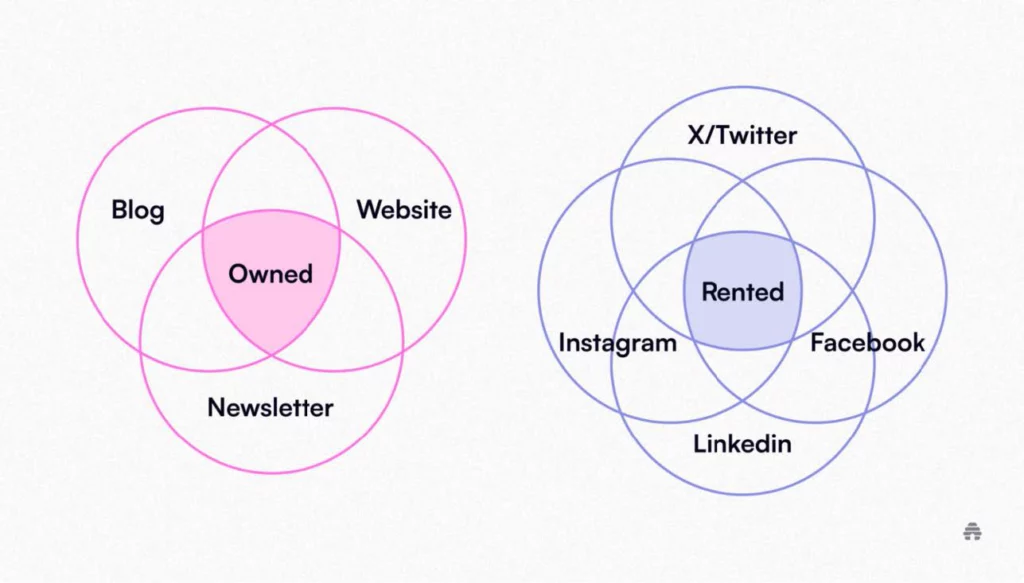
You don’t own your LinkedIn subscriber list. LinkedIn controls the platform, and if they change how newsletters work or remove this feature entirely, you could lose access to all your subscribers in an instant. This platform dependency makes traditional email newsletters more secure for long-term business building.

Email newsletters give you complete control over your audience, with no algorithm standing between you and your readers. There’s no risk of platform changes affecting your ability to reach subscribers, making email a more reliable foundation for your marketing efforts.

Benefits of LinkedIn’s built-in audience provide immediate reach advantages

LinkedIn newsletters offer easy and instant distribution to your entire network when you publish your first edition. This immediate reach gives you a major head start that’s difficult to match with traditional email marketing, where you start with zero subscribers and must build from scratch.

The platform also provides automatic discoverability. Your newsletters get indexed by Google, helping people find your content without using LinkedIn.

Long-term business implications favor owned email lists for sustainability

While LinkedIn newsletters offer easier setup and immediate reach, email marketing provides better long-term security for your business. The analytics limitations on LinkedIn restrict your ability to deeply understand your audience, compared to standard email platforms that offer detailed subscriber insights.

However, in 2025, LinkedIn added two metrics for newsletters: email sends, and open rate.

Why LinkedIn Newsletters Still Work for Solopreneurs

Smart solopreneurs use both strategically—LinkedIn newsletters for reach and visibility, and email newsletters for owned audience development and deeper subscriber relationships. Here’s why you may want to follow suit.

Source: Orbit Media Studios

Direct access to your audience’s inbox creates consistent touchpoints

LinkedIn newsletters land directly in subscribers’ LinkedIn inboxes and trigger notifications, ensuring your content gets attention.

This direct access means you’re not competing with the LinkedIn algorithm that buries your regular posts in a feed among hundreds of other updates. You’re a trusted voice they choose to hear from regularly.

The notification system keeps you visible to your audience between their regular LinkedIn sessions, extending your reach beyond when people are actively browsing the platform. Newsletters are public for everyone to see.

Higher engagement rates compared to regular posts drive better business results

Source: Styled Stock Society

Subscribers who receive your newsletter are already interested in your content, leading to higher engagement rates than typical LinkedIn posts. This engaged audience is more likely to comment, share, and inquire about your services.

A consistent delivery schedule also trains your audience to expect and look for your content, building anticipation that regular posts can’t match.

Cost-effective marketing requires no additional tools or subscriptions

Unlike email marketing platforms that charge monthly fees, LinkedIn newsletters are completely free to use. You don’t need to learn new software, set up integrations, or manage technical aspects, because everything works within the LinkedIn interface you already know.

This zero-cost approach makes newsletters attractive for solopreneurs with tight marketing budgets while building their businesses.

Who Should Use LinkedIn Newsletters?

Source: Styled Stock Society

Consultants and freelancers benefit most from regular client touchpoints

If you’re a consultant or freelancer, newsletters help you stay visible to past, current, and potential clients. Delivering content regularly keeps your expertise front-of-mind when clients need services or referrals.

Service-based entrepreneurs can showcase expertise effectively

Coaches, trainers, and other service providers can use newsletters to demonstrate their knowledge and build trust with prospects. Sharing success stories, tips, and insights through newsletters positions you as an expert while nurturing potential client relationships.

B2B solo entrepreneurs find their ideal audience on LinkedIn

Source: Social Media Examiner (via David Moceri)

LinkedIn’s professional user base is perfect for business-to-business (B2B) solopreneurs who target other businesses. Whether you’re selling software, marketing services, or business consulting, your ideal clients are already active on the platform and receptive to business-focused content.

Can You Build Your Email List with LinkedIn Newsletters?

Of course you can, and it’s a great content strategy. You can balance LinkedIn engagement with list-building goals by providing value on LinkedIn, while encouraging deeper engagement through your owned channels. Here’s how.

Create lead magnets that work across both platforms for maximum impact

Source: Impulse Digital

Use your LinkedIn newsletter to promote valuable lead magnets that encourage email subscriptions. Embed links to relevant resources, guides, or tools that require email signup. This strategy lets you leverage LinkedIn’s reach while building your own email list simultaneously.

Be sure to also add your lead magnet to the Featured section of your LinkedIn profile (select the three dots on the top right, and click Feature on top of profile).

Drive newsletter readers to owned audiences

For long-term security, include calls-to-action (CTAs) in your LinkedIn newsletters that direct readers to your email list or website. This creates a funnel from LinkedIn’s platform to your owned channels, reducing platform dependency over time.

How to Set Up Your LinkedIn Newsletter for Business Growth

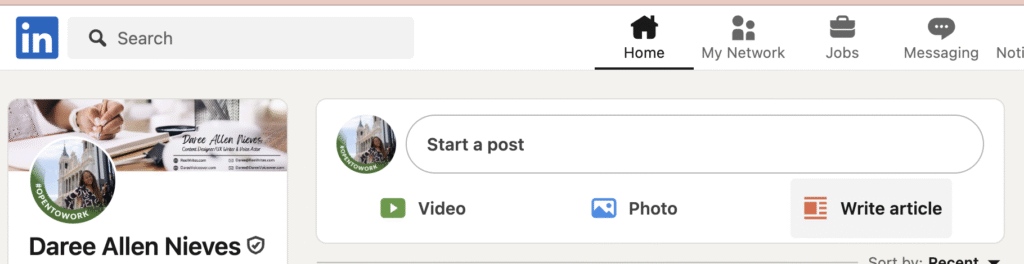
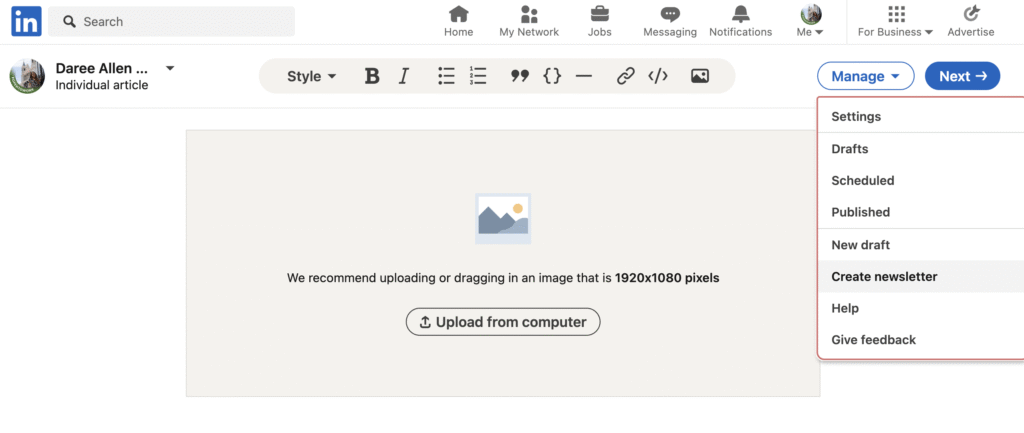
To create a LinkedIn newsletter, go to your feed and select Write article.

Then click Manage > Create newsletter.

Choose a business-focused name that clearly communicates value

Give your newsletter a descriptive name that immediately tells people what they’ll get. Avoid clever or branded names in favor of clear, specific titles that communicate obvious value. You only get 30 characters, so make them count.

Examples of effective newsletter names include “Digital Marketing Tips” rather than something clever but vague. Clear beats clever every time when it comes to subscriber conversion, because when you confuse them, you lose them.

Write a compelling description that attracts your ideal clients

Use your 120-character description to tell readers exactly why they should subscribe to your content. List the specific topics you’ll cover and the value they’ll receive. Be direct about who your content serves and what problems you’ll help solve.

Focus on benefits rather than features. Instead of using a generic phrase like “weekly newsletter,” explain “weekly strategies to grow your consulting business” or “actionable marketing tips for solopreneurs.”

LinkedIn doesn’t make it easy to find newsletters on the platform. So be sure to pin it to the Featured section of your profile.

Set a realistic publishing schedule you can maintain

Choose a daily, weekly, bi-weekly, or monthly publishing schedule. As a solopreneur, weekly or bi-weekly often works best, because it’s frequent enough to stay visible without overwhelming your content creation capacity.

Consistency matters more than frequency. It’s better to publish bi-weekly content reliably than to start weekly and burn out after a month.

Content Strategy for Solopreneur Newsletters

Balance personal stories with business insights to build connection

Share your entrepreneurship journey along with business tips and behind-the-scenes (BTS) content to create authentic connections with your audience. People want to work with solopreneurs they know, like and trust, and personal stories help build that relationship:

  • Challenges you’ve overcome
  • Lessons learned from client work
  • Insights and frameworks from building your business

Provide actionable tips that show your expertise

Each newsletter should include practical advice readers can implement immediately. This demonstrates your knowledge while providing real value that keeps subscribers engaged and looking forward to your next edition.

Focus on specific, tactical advice rather than high-level concepts. Readers should finish your newsletter with clear next steps they can take to improve their business or solve a problem.

Comment on industry developments through your unique lens as a solopreneur. This positions you as a thought leader while helping subscribers understand how broader trends affect their specific situations.

Your individual perspective as a solo business owner provides value that large companies can’t match. So leverage this authenticity in your content strategy.

Growing Your Newsletter Audience as a Solopreneur

Leverage existing client relationships for initial subscriber growth

Source: Styled Stock Society

Your current and past clients make ideal initial subscribers since they already know and trust your expertise. Personally invite them to subscribe, and ask for their feedback on early editions.

Use your existing network strategically. Reach out to colleagues, partners, and professional contacts who might find your content valuable and be willing to share it with their networks.

Cross-promote through your other marketing channels consistently

Every touchpoint should mention your newsletter as a way for people to stay connected with your expertise. Promote your LinkedIn newsletter:

  • in your email signature
  • on your website
  • on your other social media profiles
  • during networking conversations

Include newsletter subscription CTAs in your LinkedIn posts, comments, and direct messages when appropriate and valuable to the recipient.

Content Ideas That Convert Prospects to Clients

Here are a few content ideas for your newsletters.

Weekly business tips establish your expertise and provide ongoing value

Share practical advice that helps your ideal clients solve common problems. This positions you as a valuable resource while demonstrating the depth of your knowledge and experience.

Focus on tips that relate directly to services you offer, creating natural opportunities for readers to see how you might help them with bigger challenges. For more ideas, check out my guide to creating evergreen content.

Client success stories build credibility and showcase results

Source: Styled Stock Society

Share case studies that highlight challenges you’ve helped clients overcome. This social proof demonstrates your capabilities while giving prospects insight into how you work.

Include specific results when possible, showing the tangible value you provide to clients.

Tool reviews position you as a knowledgeable industry resource

Review software, books, or resources relevant to your audience. This type of content provides value, showing that you stay current with industry developments and can guide others to make smart choices in that space.

Measuring ROI and Business Impact

Track newsletter metrics that connect to actual business growth

It’s important to monitor metrics like subscriber growth, open rates, and engagement levels, but you should also track how newsletter content leads to client inquiries and business opportunities. Look for patterns in which content types generate the most business interest.

LinkedIn’s analytics show basic engagement data, but you’ll need to track business outcomes separately to understand your newsletter’s true ROI. Keep simple records of which newsletter topics or formats generate the most business inquiries to refine your content strategy over time.

Connect newsletter engagement to client acquisition for clearer ROI

Take note when newsletter subscribers reach out about services, mention your content in sales conversations, or refer others to your business. This connection between content and revenue helps justify the time investment in newsletter creation.

Wrap-up

LinkedIn newsletters offer solo entrepreneurs a unique opportunity to build relationships, showcase expertise, and grow their business organically. However, they shouldn’t be your only marketing strategy. The biggest limitation is that you don’t own your subscriber list, which creates platform dependency risks.

The smart approach? Use LinkedIn newsletters to build authority and attract your ideal clients, while simultaneously driving readers to your owned email list. This gives you the best of both worlds: LinkedIn’s built-in audience and discovery power, plus the security of an owned audience you can reach anytime.

Start with one LinkedIn newsletter focused on your ideal client’s biggest challenges. Share your knowledge generously, tell your story authentically, and always include gentle CTAs that move people to your owned platforms. Your expertise deserves to be heard. LinkedIn newsletters give you the platform to make that happen, while email marketing ensures you keep that audience long-term.

References

Crestodina, A. (2023). How to Start Your Own LinkedIn Newsletter: 10 Best Practices. LinkedIn. Retrieved from https://www.linkedin.com/pulse/how-start-your-own-linkedin-newsletter-10-best-andy-crestodina/

Difference between LinkedIn newsletter, article and post. (2023). Manifest Infotech Pvt. Ltd. Retrieved from https://www.linkedin.com/pulse/difference-between-linkedin-newsletter-article-post/

Eeckhout, J. (2024). Why I Shut Down My LinkedIn Newsletter to Focus on Email. Retrieved from https://www.thesciencemarketer.com/linkedin-newsletter-pros-cons/

Granger, J. (2024). LinkedIn newsletters: are they what they are cracked up to be? Marten Publishing Ltd. Retrieved from https://www.journalism.co.uk/news/linkedin-newsletters-are-they-all-they-are-cracked-up-to-be-/s2/a1165074/

Ingram, L. (2024). You Can’t Activate Creator Mode on LinkedIn Anymore – Here’s What You Can Do Instead. Guiding Tech. Retrieved from https://www.guidingtech.com/you-cant-activate-creator-mode-on-linkedin-anymore-heres-what-you-can-do-instead/

LinkedIn Help. (2025). Newsletter analytics. Retrieved from https://www.linkedin.com/help/linkedin/answer/a1658525

Horvat, T. (2024). LinkedIn Newsletter vs Email Newsletter: Which is Better? THM Agency. Retrieved from https://tomislavhorvat.com/linkedin-newsletter-vs-email-newsletter-which-is-better/

Hutchinson, A. (2025). LinkedIn Rolls Out New Newsletter Metrics. SocialMediaToday. Retrieved from https://www.socialmediatoday.com/news/linkedin-adds-more-newsletter-metrics/740594/

Martinez, D. (2025). LinkedIn vs. Email Newsletters: Which Should You Choose (and Why Not Both)? Solid Digital. Retrieved from https://www.soliddigital.com/blog/linkedin-vs-email-newsletters-which-should-you-choose-and-why-not-both

Oddy, S. (2025). How to Build an Email List from LinkedIn Connections. ScoreApp. Retrieved from https://www.scoreapp.com/build-email-list-linkedin-connections/

Get Search Traffic Year-Round with Evergreen Blog Posts

Get Search Traffic Year-Round with Evergreen Blog Posts

Content Marketing Copywriting SEO UX

Are you tired of the website traffic rollercoaster? One month you’re up, the next you’re down. This feast-or-famine cycle can really slow down your business growth, especially as a solopreneur doing everything by yourself.

But what if there was a way to get a steady stream of visitors to your site, month after month?

There is! It’s called evergreen blog content. Unlike trending topics that quickly lose appeal, evergreen content keeps working for you months and YEARS after you hit publish.

Contents

What Makes Content Truly “Evergreen”?

So, what exactly is “evergreen” content?

Imagine a pine tree – it stays green all year round, right? Evergreen content is similar. It’s information that remains useful and relevant to your audience for a long time. This is different from timely content, like news about a current event, or a seasonal trend, which loses its importance quickly.

How to determine whether your content is evergreen

Your content will stay fresh over time if it:

  • Covers foundational topics in your field.
  • Answers common questions and/or solves your audience’s persistent problems.
  • Doesn’t become outdated quickly.

So if you’re a business coach, an evergreen topic could be “How to Set Realistic Business Goals.” This is something new and experienced entrepreneurs will always search for.

A time-sensitive topic, on the other hand, might be “Reacting to the Latest Social Media Algorithm Change.” While it’s a hot topic for a moment, it won’t be as relevant next year (or whenever the algorithm changes again).

Myths about evergreen content

Common misconceptions about evergreen content are:

  • You write it once and never touch it again.
    While it’s low-maintenance, occasional updates can keep it performing at its best.
  • Any long-form article or “ultimate guide” is automatically evergreen.
    But if the core topic isn’t timeless, even a detailed guide will lose relevance. The key is lasting value. You’ll have to maintain this type of content as well.

Why Solopreneurs Need an Evergreen Content Strategy

Running a business on your own comes with unique challenges. You’re often juggling everything–marketing, sales, and service–not to mention personal obligations and demands on your time. Unlike larger companies with big marketing teams, you probably don’t have the resources to constantly churn out new content just to stay visible on social media.

This is where using an evergreen content strategy becomes a game-changer.

Imagine publishing a helpful blog post today that continues to attract visitors and potential clients for months, or even years, with little extra effort from you. That’s how evergreen content creates passive marketing for your business. It’s like having a marketing assistant working 24/7, even while you sleep!

This consistent traffic generation can smooth out feast-or-famine cycles. But there are more benefits of evergreen content.

Evergreen content is great for SEO

Source: Ahrefs

The SEO benefits of evergreen content grow over time.

Search engines like Google love high-quality content that thoroughly answers searchers’ questions. As your evergreen post gathers more views, shares, and backlinks from other sites, its authority (and yours) grows.

Older webpages tend to rank higher in SEO, and evergreen content is perfectly suited to become that aged, authoritative content. This means your posts are more likely to show up on the first page of search results, driving organic traffic to your website.

Evergreen content is cost-effective

Source: Search Engine Land

Creating content with long-term value is also very cost-effective.

Think about the time and energy you spend creating a blog post. With timely content, that effort yields results for a short period. With evergreen content, your initial investment continues to pay off for a much longer time.

This makes it a smart approach to content marketing for a small business, especially when you’re managing a tight budget. It’s about working smarter, not harder, to achieve sustainable business growth.

But what types of content offer this lasting power? Let’s look at some proven formats.

5 Types of Evergreen Blog Posts That Drive Consistent Traffic

Certain types of blog posts are naturally more suited to being evergreen. They address ongoing needs and questions. Here are five powerful formats you can use.

How-to guides and tutorials that solve common, persistent problems

Woman reading tablet search engine bot in the corner with a thumbs up

These are classic evergreen pieces. People are always searching for instructions on how to do something. As a solopreneur, you have specific skills and knowledge, so share it!

For example, if you’re a web designer, “How to Choose the Right Colors for Your Brand Website” would be a great idea for an evergreen how-to guide.

Backlinko analyzed almost 1 billion blog posts, and found that “how-to” posts, listicles and infographics tend to receive a high number of backlinks, which is great for SEO and long-term traffic.

Resource lists and toolkits that remain useful year after year

Curated lists of valuable resources save your audience time and effort. These can become go-to references in your niche.

So for a virtual assistant, “The Top 10 Productivity Tools for Busy Solopreneurs” could be a highly valuable resource list.

Specific tools can change, but the categories of tools (project management, communication) often remain constant. You can update the specific tools every year or so to keep the list fresh.

Ultimate” guides that cover foundational topics in your industry

These are comprehensive, in-depth pieces that aim to be the definitive resource on a particular subject, and build extensive authority.

Say you’re a financial planner for solopreneurs. You could write “The Ultimate Guide to Retirement Planning for the Self-Employed” and continue adding to it as one of your content pillars on your site.

Orbit Media Studios’ annual blogging survey often highlights that bloggers who write longer, more in-depth content tend to report stronger results.

Ultimate guides fit this description perfectly.

Case studies of timeless principles applied to real situations

Colorful case study graphic on desk

A piece showcasing how fundamental principles work in practice can be very insightful. If the principles are timeless, the case study will remain relevant.

So a marketing consultant might share something like: “Case Study: How a Local Bakery Tripled Its Online Orders Using Core Email Marketing Principles.” Even if the bakery is an older example, the core email principles likely still apply.

Focus on the “why” and “how” behind the success, linking it to enduring strategies instead of fleeting tactics.

FAQ posts that address universal questions in your niche

Woman thinking at her desk and holding a pen

Every industry has questions that prospects and customers ask over and over again. Compiling these questions into a comprehensive FAQ post can be incredibly helpful and drive targeted traffic to your site continuously.

A business lawyer could create an FAQ post called, “Your Top 15 Questions Answered: Legal Basics for Starting Your Solo Business.”

Answering common questions directly can help your content appear in Google’s featured snippets and “People Also Ask” boxes and at the top and bottom (respectively) of search results, significantly boosting visibility for these FAQ posts.

These formats provide a great starting point for your evergreen blog content for solopreneurs. Next, let’s talk about making sure people can find these amazing posts.

Creating Evergreen Content That Ranks

Creating great evergreen content is one thing; making sure it gets found by search engines is another. You want your hard work to pay off with consistent organic traffic. Here’s how to create content that ranks.

Keyword research techniques for finding evergreen search terms

Source: Ahrefs

Keywords are the search terms people type into Google. For evergreen content, you need to find keywords that have steady search interest over time, not just seasonal spikes.

  • Focus: Look for “long-tail keywords,” which are long, specific phrases like “how to create a content plan for solo business” instead of just “content plan”. They often have less competition and attract a more targeted audience.
  • Tools: Use tools like Google Keyword Planner, AnswerThePublic, or Ahrefs’ Keywords Explorer to find terms people are searching for. Look for questions people ask related to your core topics. For instance, searching for “content ideas for solopreneurs” may reveal many related long-tail keywords.

The majority of searches are for long-tail keywords. Targeting these can be a smart SEO strategy for solopreneurs.

Tips for crafting headlines that attract clicks month after month

Your headline is the first thing people see. Here’s how to create a compelling headline they just have to click, now and in the future:

  • Be clear and specific: Tell the reader exactly what they will get. “5 Simple Steps to Writing Your First Evergreen Blog Post” is more specific than “Writing Blog Posts.”
  • Use numbers or questions: Headlines with numbers (like listicles) or that pose a question often perform well.
  • Include your target keyword: Your target keyword (also known as a primary keyword or focus keyword) helps search engines understand what your content is about.

How to structure content for both readability and SEO

Source: HardSplash Media

People online tend to scan content. Make your posts easy to read and digest. Search engines favor well-structured content with this formatting:

  • Properly-tagged headings and subheadings (H2, H3, H4): Break up your text and guide the reader.
  • Short paragraphs and sentences: Aim for clarity and conciseness.
  • Bullet points and numbered lists: Make information easy to skim.
  • Bold and italic text: Highlight key takeaways.

Nielsen Norman Group’s research consistently shows that users scan web pages, and clear, concise, scannable content performs best.

Strategies to make your content comprehensive yet accessible

Evergreen content should be thorough, but not overwhelming. You want to be seen as an authority, but your audience (especially if you’re aiming for an 8th-grade reading level) needs to understand you. So be sure to:

  • Define jargon: If you must use industry-specific terms, explain them simply.
  • Provide examples: Illustrate your points with relatable scenarios. If you’re referencing a success story, focus on the enduring principles, not short-lived tactics.
  • Logical flow: Organize your content in a way that makes sense from start to finish.

Enhance content with timeless visuals

Visuals can make your content more engaging and easier to understand. Choose images and examples that won’t quickly look dated.

  • Use diagrams or simple charts: To explain complex ideas.
  • High-quality stock photos: Avoid overly trendy or cliché images.
  • Screenshots: Ensure they illustrate a process that isn’t likely to change drastically anytime soon.

By focusing on these elements, you can create evergreen blog posts that not only provide lasting value but also have a strong chance of ranking well in search results, becoming a cornerstone of your traffic-driving blog posts strategy.
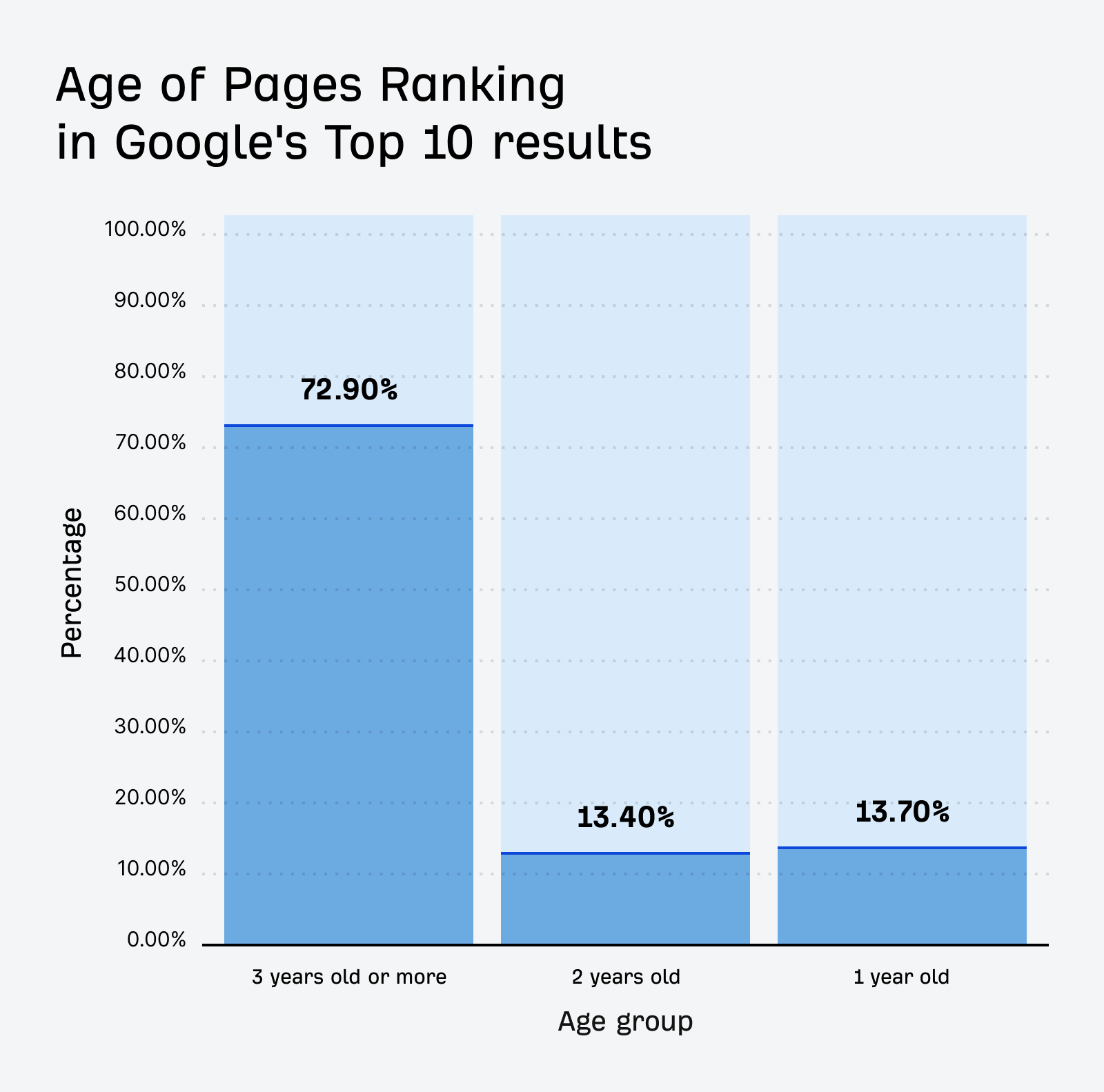
But if your competitors are also creating evergreen content, how do you make yours stand out?

Making Your Evergreen Content Stand Out from Competitors

It’s likely your competitors are also trying to create lasting blog content. So, how do you ensure your evergreen pieces get noticed and become the go-to resource? You need to add that extra something special.

Research methods to find content gaps in your market

Source: SERPninja

A content gap is a topic your target audience is searching for, but there isn’t enough high-quality content available, or existing content is missing key information.

  • Analyze competitor content: Look at top-ranking posts for your target keywords. What questions are they not answering fully? What perspectives are missing? You can often find these content gaps by reading comments on their blogs or social media.
  • Use SEO tools: Tools like Semrush and Ahrefs have features to identify keywords your competitors rank for that you don’t, or where their content might be thin. This helps identify content creation opportunities.
  • Listen to your audience: What questions do your clients or social media followers ask you repeatedly? These are prime candidates for evergreen content that fills a real need.

Techniques to add unique insights and personal expertise

This is where being a solopreneur can be a real advantage. Your unique experiences, voice, and perspective are things no one else can replicate. This is key for personal branding through content.

Some ways to weave in your unique insights and perspectives:

  • Share personal anecdotes: Illustrate points with your own stories.
  • Offer a contrarian view: If everyone says “X,” but your experience shows “Y” can also work, explain that. This can create thought leadership content.
  • Develop your own frameworks or models: Simplify complex topics by breaking them down in a unique way.

A survey by Demand Gen Report cites that customers are increasingly looking for content that offers new perspectives, not just rehashed information.

How to incorporate original data or research when possible

Even small-scale original research can make your content stand out. A few ways to conduct research:

  • Survey your audience or network: Collect data on a topic relevant to your niche via a poll or survey, and share the findings.
  • Conduct mini-experiments: If applicable to your field, document a process and its results.
  • Analyze publicly available data uniquely: Find a new way to interpret existing industry reports or statistics.

Say you’re a productivity coach, you could survey 50 fellow solopreneurs about their biggest time-wasting activities and publish the results. This becomes unique, citable data.

Refresh your approach to common topics

Many evergreen topics have been covered extensively. Your goal is to bring a fresh angle:

  • Target a more specific niche within the topic: Instead of “Content Marketing Basics,” try “Content Marketing Basics for Handmade Business Owners.”
  • Focus on a different outcome or benefit: If most articles on “time management” focus on productivity, perhaps yours could focus on how it reduces stress for solopreneurs.
  • Use a unique format: Could you present the information as an interactive quiz, a detailed checklist, or a series of short videos embedded in the post?

By finding those content gaps and injecting your unique value, your evergreen content will not only rank but also resonate deeply with your audience, building your authority. Now, let’s explore a powerful platform to amplify that authority: LinkedIn.

Why LinkedIn Should Be Part of Your Evergreen Strategy

Source: Sprout Social

You’ve crafted some fantastic evergreen blog content for your website. But did you know that LinkedIn can be a powerful ally in your content strategy, especially for solopreneurs? It’s more than just a professional networking site.

LinkedIn’s SEO advantages for solopreneurs with new websites

LinkedIn is a massive website with very high domain authority (DA). This means content published there often gets indexed by Google quickly and can rank well in search results, sometimes even outranking content on newer, less authoritative personal blogs.

  • Benefit: If your own website is new and still building its SEO strength, publishing evergreen articles on LinkedIn can give your ideas visibility in search results much faster. This is a great way to drive organic traffic indirectly.
  • Case study: Many solopreneurs report that their LinkedIn articles appear in Google searches for their name or key topics they write about, often within days of publishing.

LinkedIn articles often rank faster than new blog content

Source: Oryn

As mentioned, LinkedIn’s authority helps its content get noticed by search engines quickly. Your brand-new blog might take weeks or months to get similar traction for a competitive keyword.

Think of LinkedIn articles as a way to “test” the ranking potential of certain evergreen topics or to gain initial visibility while your website’s SEO builds.

The unique algorithm benefits LinkedIn provides for individual creators

LinkedIn encourages creators to publish content directly on its platform. Its algorithm tends to favor native content, including articles.

  • Engagement signals: When your connections and followers engage with your LinkedIn article (by likes, comments, and shares), it signals to the algorithm that your content is valuable, potentially increasing its reach within the LinkedIn ecosystem.
  • LinkedIn’s “Creator Mode: LinkedIn’s push for more original content means that individuals who consistently publish quality material, like evergreen thought leadership content, can see increased visibility on the platform.

Statistics showing LinkedIn’s content reach compared to personal blogs

While direct comparison stats are tricky and vary widely, LinkedIn offers a built-in audience.

  • Built-in network: When you publish an article, your connections are often notified, providing an immediate potential readership that a brand-new blog post might struggle to achieve without promotion.
  • Reach potential: According to data from Sprout Social (2023), LinkedIn is a top platform for B2B marketers, and well-crafted content can achieve significant organic reach among professionals, your likely target audience as a solopreneur. While your blog aims for global search reach, LinkedIn offers targeted professional reach.

Using LinkedIn as part of your evergreen content strategy doesn’t mean abandoning your blog. It’s about smart repurposing and leveraging LinkedIn’s strengths.

Anything can happen to a social media platform, but the content on your website is yours. So, how do you take your amazing blog posts and make them shine on LinkedIn?

Repurposing Evergreen Blog Content for LinkedIn Success

Source: Styled Stock Society

When you’ve got valuable evergreen blog posts on your website, don’t let them just sit there! Repurposing that content as LinkedIn articles can expand your reach and reinforce your expertise. Here’s how to adapt your content effectively.

Step-by-step process for adapting blog posts to LinkedIn articles

It’s not just a copy-paste job from your blog to LinkedIn—you need to tailor it.

  1. Choose the right posts: Select evergreen blog posts that are highly relevant to a professional audience, and align them with your LinkedIn personal branding.
  2. Condense and refocus: LinkedIn articles are often best when a bit shorter and more direct than a comprehensive blog post. Focus on the key takeaways or one core idea from your original post.
  3. Rewrite the introduction: Hook the LinkedIn reader immediately by addressing a pain point or a professional aspiration relevant to them.
  4. Adjust the body of the article: Keep paragraphs short. Use bullet points or numbered lists for readability.
  5. Craft a LinkedIn-specific call to action (CTA): What do you want LinkedIn readers to do? Comment with their experiences? Connect with you? Visit your website for a related resource?

How to modify content structure for LinkedIn’s specific format

LinkedIn’s article editor has its own nuances:

  • Shorter paragraphs: Use for 2 to 4 sentences per paragraph on LinkedIn. This improves scannability on both desktop and mobile.
  • Use LinkedIn’s formatting: Add bolding, italics, blockquotes, and bullet points to break up text and highlight key information.
  • Consider “native” feel: Even though this isn’t an original article only for LinkedIn, make it feel like it was written for LinkedIn. This might mean a slightly more direct or professionally conversational tone.
  • Link back to your site: Create your own backlink for SEO by including a hyperlink to the article back to the original blog post on your website

For example, a 3,000-word “ultimate guide” blog post could be broken down into two or three focused LinkedIn articles, each tackling a specific sub-topic from the original guide. Or you could just use a portion of the blog to make an abridged version for LinkedIn.

Tips for creating LinkedIn-specific headlines that gain traction

Headlines are crucial on LinkedIn. They need to stop the scroll.

  • Lead with a benefit: “How Solopreneurs Can Triple Their Leads with Evergreen Content” is stronger than just “Evergreen Content Guide.”
  • Use numbers and keywords: Similar to blog headlines, but ensure the keywords resonate with a professional searcher on LinkedIn.
  • Intrigue or urgency: “The One Evergreen Content Mistake Most Solopreneurs Make.”

LinkedIn’s own publishing guidelines often emphasize the importance of clear, compelling headlines that promise value to the reader.

Ways to enhance engagement through LinkedIn-specific features

LinkedIn isn’t just a publishing platform, it’s a social one. So don’t just post and run:

  • Ask questions: End your article with a question (as a CTA) to encourage comments and discussions.
  • Tag relevant people/companies as appropriate: If you mention a tool or an influencer respectfully, tagging them might increase visibility.
  • Share your article as a post: After publishing the article, create a separate LinkedIn post linking to it, adding some personal commentary or a key takeaway to encourage clicks and engagement.
  • Engage with comments: Respond to comments on your article to keep the conversation going and show you’re active.

Repurposing your evergreen content for your LinkedIn content strategy extends its life and impact, helping you build authority and drive traffic from multiple sources.

Of course, even “evergreen” content needs a little care over time.

Maintaining and Refreshing Your Evergreen Content

The beauty of evergreen content is its longevity. But “long-lasting” doesn’t mean “set it and forget it forever.” To keep your best pieces performing well and staying truly relevant, occasional maintenance is key.

How often to review and update evergreen posts

Source: Styled Stock Society

There’s no single magic number, but a good rule of thumb is to review your top-performing evergreen content at least once a year. For other pieces, every 18 to 24 months may be sufficient.

Also, set up Google alerts or regularly check if there’s been a significant industry change, a new major tool released, or if you notice a dip in traffic to a previously popular post.

According to Orbit Media Studios, bloggers who update older content are significantly more likely to report “strong results” from their content marketing.

Signs that your content needs refreshing

Source: Zeal Digital

Keep an eye out for these tell-tale signs:

  • Declining organic traffic: If a post that used to bring in steady visitors is slipping, it might be losing relevance or getting outranked.
  • Outdated information or statistics: Facts, figures, or examples that are clearly from years ago.
  • Broken links: Links to external resources or even internal pages that no longer work.
  • New, better competitor content: If others have published more comprehensive or up-to-date articles on the same topic.
  • Changes in your own offerings: If your services or products have evolved, your content should reflect that.

Simple updates that can boost existing content performance

Source: Styled Stock Society

Refreshing doesn’t always mean a complete rewrite. Often, small changes can make a big difference.

  • Update statistics and dates: Swap out old data for the latest available numbers.
  • Add new examples or case studies: Keep your illustrations fresh.
  • Improve readability: Break up long paragraphs, add more subheadings, or create bullet points.
  • Enhance visuals: Add new images, update screenshots, or create a simple infographic.
  • Expand a section: If a particular subtopic has gained more importance, add more detail.
  • Internal linking: Add links to newer relevant content on your site, and ensure older posts link to this refreshed piece. This helps with content with long-term value.

Tools to track content performance over time

Dashboard upward trending report

You need data to know what’s working and what needs attention.

  • Google Analytics: Track page views, bounce rate, time on page, and traffic sources for each blog post.
  • Google Search Console: See which keywords your posts are ranking for, their click-through rates, and any crawl errors.
  • SEO software (Semrush, Ahrefs, Moz): Monitor your positions for target keywords using their rank tracking features.

When you review and refresh your evergreen content regularly, you ensure it continues to be a valuable asset for your solopreneur business, driving organic traffic and reinforcing your authority for years to come. This commitment to content refresh strategies is vital. (And of course, I’m available to help with that!)

Now, how do you fit this all into your busy schedule?

Creating a Content Calendar That Balances Evergreen and Timely Content

Source: Styled Stock Society

As a solopreneur, your time is precious. A content calendar is essential to manage your content creation effectively, and ensure you consistently publish valuable pieces without feeling overwhelmed. It also helps you balance foundational evergreen articles with more timely posts.

Ideal ratio of evergreen to timely content for solopreneurs

Source: Breeze

While it varies by industry and audience, a good starting point for many solopreneurs is an 80/20 rule of 80% evergreen content and 20% timely content.

Evergreen content provides a stable foundation for traffic and authority. Timely content (like industry news commentary, responses to current trends, or seasonal promotions) can create buzz and show you’re current, but its value fades faster.

This ratio isn’t set in stone. If a major industry event happens, you might temporarily shift to more timely content. The key is having a strategic content planning approach.

Planning techniques for consistent content creation

Consistency is more important than frequency when creating content, especially when you’re just starting. A few ideas to help keep you stay consistent:

  • Theme months or quarters: Focus your content around a specific theme for one time period such as a month or a quarter.

    This can make brainstorming evergreen blog ideas easier and create a cohesive experience for your audience. For example, one quarter could focus on “Productivity for Solopreneurs,” with various how-to guides, resource lists, and FAQ posts on that theme.
  • Pillar content and topic clusters: Create a large, comprehensive evergreen “pillar post” on a broad topic, then create several smaller “cluster” posts that do a deep dive into specific subtopics, all linking back to the pillar post. This is great for SEO and provides a wealth of content ideas.

How to batch-create evergreen content efficiently

Source: Styled Stock Society

Batching in this context means dedicating blocks of time to specific stages of content creation. This can significantly boost your productivity.

  1. Brainstorming and outlining: Dedicate a few hours to brainstorm a list of evergreen topics and create rough outlines for several posts at once.
  2. Research and writing: Set aside dedicated days for writing multiple first drafts.
  3. Editing and visuals: Another block of time for editing those drafts, creating or sourcing images, and optimizing for SEO.

You could spend one Monday morning per month outlining four evergreen posts, then write one post each following Monday. This DIY content marketing approach makes the task less daunting.

Tips for managing content creation alongside other business tasks

Content creation is just one hat you wear as a solopreneur.

  • Time blocking: Schedule specific, non-negotiable time slots in your week for content creation, just like you would for client work.
  • Use a simple content calendar tool: Google Calendar, Trello, Asana, or even a spreadsheet can work. The goal is to have a visual plan.
  • Don’t aim for perfection immediately: Get the core ideas down. You can always refine and update later.
  • Repurpose aggressively: One evergreen blog post can become several social media updates, key points for a YouTube video, a LinkedIn article, and even part of an email newsletter. This maximizes your effort.

By strategically planning and batching your work, you can build a rich library of evergreen blog content without burning out. This content marketing approach is sustainable, supports long-term website traffic growth, and establishes you as a go-to expert.

Your Path to Lasting Online Presence

As a solopreneur, you need marketing strategies that work smarter, not harder. Evergreen blog content offers exactly that. It consistently attracts your ideal audience, builds your credibility, and generates leads long after you’ve hit the publish button. Think of it as building a valuable library of resources that works for your business around the clock.

Investing time in writing in high-quality, well-researched evergreen pieces has significant long-term traffic and authority benefits. These posts become foundational assets for your online presence, driving organic traffic and positioning you as a knowledgeable leader in your field. The effort you put in today continues to pay dividends for months—even years—creating a more stable and predictable flow of visitors to your website.

Source: Styled Stock Society

If you feel overwhelmed about where to start, begin with just one high-quality evergreen blog post that addresses a core need or question for your audience. Once it’s live on your blog, take the next step and repurpose its key insights into a LinkedIn article to expand its reach.

Your challenge this week? Start planning your evergreen content strategy. Identify some evergreen blog topics you can develop. You’ve got the knowledge; it’s time to share it in a way that brings enduring value to both your audience and your solo business.

References

2023 B2B Content Preferences Survey Report: Personalized, Data-Backed Content Enables B2B Teams to Fast Track Buyer Enablement, Speed Up Path to Purchase. (2023). Demand Gen Report. Retrieved from https://www1.demandgenreport.com/2023-content-preferences-survey-report-0323-dd/

Barnhart, B. (2025). Mastering LinkedIn content marketing: Strategies and examples. Sprout Social. Retrieved from https://sproutsocial.com/insights/linkedin-content-marketing

Creator update: New and improved tools now available. (2022). LinkedIn Pulse. Retrieved friom https://www.linkedin.com/pulse/creator-update-new-improved-tools-now-available-li4c/

Dean, B. (2019). We Analyzed 912 Million Blog Posts. Here’s What We Learned About Content Marketing. Backlinko. Retrieved from https://backlinko.com/content-study

Morkes, J & Nielsen, J. (1997). Concise, SCANNABLE, and Objective: How to Write for the Web. Nielsen Norman Group. Retrieved from https://www.nngroup.com/articles/concise-scannable-and-objective-how-to-write-for-the-web/

Parsons, J. (2024). Business Blogging vs LinkedIn Articles: Which is Better? Retrieved from https://www.contentpowered.com/blog/blogging-linkedin-articles-better/

Pros and Cons of Posting Articles on LinkedIn Instead of Your Blog. (2024). MeetEdgar. Retrieved from https://meetedgar.com/blog/pros-and-cons-of-posting-articles-on-linkedin-instead-of-your-blog

SERP Features: FAQ. (n.d.). Semrush. Retrieved from https://www.semrush.com/kb/1326-serp-features-faq

Soulo, T. (2021). Long-tail Keywords: What They Are and How to Get Search Traffic From Them. Ahrefs. Retrieved from https://ahrefs.com/blog/long-tail-keywords/

Stox, P. (2025). How Long Does It Take to Rank in Google? And How Old Are Top Ranking Pages? Ahrefs. Retrieved from https://ahrefs.com/blog/how-long-does-it-take-to-rank-in-google-and-how-old-are-top-ranking-pages/

The 2025 Sprout Social Index Edition XX. (2025). Sprout Social. Retrieved from https://sproutsocial.com/insights/index/