Do You Have Invisible Expertise? Showcase Your Professional Expertise and Make Your Knowledge Tangible Through Content

Do You Have Invisible Expertise? Showcase Your Professional Expertise and Make Your Knowledge Tangible Through Content

Content Marketing

Disclaimer: A few photos in this article have affiliate links. So if you sign up for Canva or Styled Stock Society using my links, I may receive a small commission at no cost to you. Thanks for your support.

You’ve spent years, even decades, honing your craft. As a consultant, coach, or voice actor, you’ve developed deep expertise that shifts your clients’ businesses and projects in the best way possible.

Yet, when someone asks “What exactly do you do?” or “Why should I hire you over someone charging half as much?,” you struggle to convey the full value of what you bring to the table.

The harder you’ve worked to develop sophisticated skills, the more difficult it becomes to communicate their value to those who need them most. Your expertise has become so natural that you can’t explain it. Meanwhile, less experienced competitors win clients with flashy websites and bold promises.

The problem isn’t your skills. It’s that nobody can see what makes you special. Your knowledge stays locked in your head while prospects compare you to cheaper options.

This “invisible expertise” is a problem costing solopreneurs like you thousands in profit every month. But what if you could show prospects exactly how you think? What if they could experience your expertise before hiring you?

Not just any content—strategic content that showcases your professional expertise, unique skills and process.

Contents

Why Expertise Becomes Invisible

The “curse” of knowledge makes your skills seem simple to you

Remember when you first started, and every project had challenges? Now you spot problems in seconds that others don’t even know exist.

The curse of knowledge is a cognitive bias where a person who has specialized knowledge assumes that others share in that knowledge.

Source: Common Craft

You’ve internalized so much knowledge that you forget how much you actually know. And the paradox of mastery is that the better you get at something, the more effortless it appears to outsiders. So when you:

  • Ask the exact coaching question that unlocks a breakthrough, it feels obvious.
  • Identify the root cause of a business problem in minutes, it seems like a no-brainer.
  • Deliver the perfect voiceover in one take that captures exactly the right emotion, it sounds natural and easy, like anyone could do it. (I’ve done this many times with cold reads, but it’s because I’ve worked on it for years.)

Clients can’t see the years of practice behind your work

Source: AZ Quotes

Your clients see the final result, not the journey. They don’t see the 10,000 hours of practice, the hundreds of books you’ve read, or the failed attempts that taught you what works.

Think about watching a master chef prepare a meal—they make it look effortless. The knife moves like an extension of their hand. They season without measuring. And it all comes together perfectly.

Source: The Daily Meal

But what you DON’T see are the burned dishes from culinary school. The cuts and scars from learning knife skills. The thousands of meals that came before this one.

The same is true for your expertise.

What clients don’t see are the thousands of hours of practice, the pattern recognition developed over hundreds of projects, or the intuitive leaps that come from deep experience. Your expertise has become so internalized that it’s hard to articulate all the micro-decisions and sophisticated judgments you make in your work.

Your internal mastery becomes harder to explain as you improve

The better you get, the more automatic your skills become. You don’t think about each step anymore—you just do it because that skill has become “second nature.”

This is called unconscious competence. It’s like trying to explain how you ride a bike or tie your shoes. You just… do it. Your brain has created shortcuts that work perfectly but are invisible to everyone else.

This unconscious competence is a sign of mastery. But it’s also a marketing nightmare.

Surface-level service comparisons lead to price shopping

The market compounds this problem. When prospects can’t see the difference between you and someone charging half your rate, they choose based on price. Why wouldn’t they?

Potential clients comparing services see surface-level similarities:

  • Your LinkedIn profile says “business consultant.” So does theirs.
  • Or your website offers “coaching services.” So does theirs.

Many industries don’t require a license or certification to practice that role. Anyone can call themselves a coach, claim to be a consultant, or put themselves out to be a pro voice actor. The market is flooded with people who took a weekend course and then hung out their shingle as an expert.

Source: Swift Media

As a voice actor, I remember a few times when a casting director or producer at an agency balked at my rates, saying that I was charging more than other talent. But I stuck to my guns because I know the value of what I do.

Outsiders doing comparisons between service providers think, “They all offer consulting,” “They’re all voice talent,” “They all provide coaching.” Without tangible proof of your unique expertise, you look the same on paper. So their purchasing decisions default to price, availability, or whoever has the flashiest website.

This isn’t their fault. They’re not experts in what you do. They can’t tell the difference between surface-level knowledge and deep expertise unless you show them.

The “Show, Don’t Tell” Framework for Solopreneurs

Source: The Marketing Sage

Instead of trying to tell people about your expertise, you need to show it.

Your content creation strategy should be to making your invisible expertise more visible through concrete examples, actionable insights, and tangible changes.

This framework has four components that work together to showcase your expertise naturally:

  1. Document your process
  2. Use before-and-after examples
  3. Share questions that help uncover issues
  4. Reveal the patterns that only a pro like you can spot

Document your process, not just your results

Most solopreneurs share success stories like, “I helped Company X increase revenue by 40%” or “I’ve booked 60% of my auditions this year and made over 6 figures.”

Stats like these may be impressive, but these results don’t help your prospects understand how you think or whether you can solve their specific challenges.

Instead, document your process. Thought leadership starts with revealing how you think, not just what you achieve. Show your approach, what questions you ask, which patterns you look for, how small changes create big results.

Source: Tango

For example, a management consultant might share a detailed case study walking through how they diagnosed a communication breakdown in a remote team, including the specific questions they asked, the behavioral patterns they observed, and the small interventions that created cascading improvements.

When you document your process, you’re showing prospects your analytical framework (how you approach script copy or challenging problems), and helps them recognize similar patterns in their own work.

Use before-and-after examples

Nothing shows expertise like a before-and-after example. But don’t just show the beginning and the end—people want to see the journey between them.

A few ideas:

  • Voice actors can share before-and-after recordings of the same script, showing how direction and technique transform a read. (But be sure to only share your reads online with permission. If the script you’re reading is confidential, don’t post it.)
  • Coaches can reveal (with permission) actual coaching conversations that led to breakthroughs. Note how your specific intervention created the shift to improve your client’s issue.
  • Consultants can share screenshots of the frameworks, worksheets, or analysis tools they’ve developed.

This transparency does 2 things:

  • It demonstrates your professionalism and systematic approach.
  • It educates your prospects about what working with you actually looks like, reducing anxiety about the unknown.

Develop diagnostic tools, sharing questions you ask and why

An amateur asks “What’s wrong?” An expert asks “When did you first notice this pattern, and what else changed around that time?”

Your questions reveal your expertise more than your answers.

So share your go-to diagnostic questions, explaining why you ask them and what the answers tell you. This shows prospects the depth of your analytical process.

Productize your expertise into interactive tools and programs that let prospects experience your value directly. Create assessment frameworks, audit checklists, diagnostic questions and courses that help potential clients understand their own situations better and improve them.

Examples:

  • A voice coach might create a “Voice Brand Alignment Assessment” that helps businesses identify gaps between their brand personality and their current voice talent.
  • A business consultant could develop a “Team Dysfunction Diagnostic” that reveals specific collaboration breakdowns.

These tools showcase your analytical frameworks while giving prospects immediate value.

Reveal the patterns only you can spot by teaching the “Why” behind the “What”

After hundreds of projects, you see patterns others miss.

Like the executive who says they need time management help but really needs better boundaries. Or the business that thinks they have a sales problem, but actually has a retention issue.

Source: Styled Stock Society

Document these patterns and share them publicly. This positions you as someone who sees beyond symptoms on the surface.

Share the principles and mental models that guide your work. Don’t just tell people what to do—explain the thinking behind your recommendations. This demonstrates depth of understanding that differentiates you from those simply following playbooks.

When you explain why certain voice inflections create specific emotional responses, why particular meeting structures improve decision-making, or why certain coaching questions unlock resistance, you show people a sophisticated understanding that only comes from true expertise.

Content Formats That Make Your Expertise Tangible

Different formats work for different types of expertise. Choose the formats that best showcase your unique skills.

Case study walk-throughs

Don’t just share a success story. Walk through your entire problem-solving process:

  1. Start with the initial problem.
  2. Show what you noticed that others missed.
  3. Explain each decision point.
  4. Include the small adjustments that made big differences.

Be sure to also include:

  • The presenting problem versus the real issue
  • Your process
  • Why you chose specific interventions
  • Unexpected discoveries along the way
  • Lessons that apply to other situations

Diagnostic tools and assessments

Woman writing in a pink notebook

Source: Styled Stock Society

Showcase your expertise with interactive tools prospects can use immediately.

Create:

  • Self-assessment checklists
  • Diagnostic questionnaires
  • Evaluation templates
  • Scoring rubrics
  • Decision trees

For instance, a voice coach could make a “Voice Brand Alignment Assessment” that helps businesses identify gaps between their brand personality and their current voice talent to generate leads.

Behind the scenes content

Daree is at desk and squinting at her computer screen

Pull back the curtain on your actual work process. This builds trust while educating prospects about what working with you looks like.

Record yourself analyzing a problem. Share your marked-up notes on a script or strategy document.

Whatever it is, show the messy middle part of your process, not just the polished final product. This humanizes you to foster connection with your audience.

Practical Strategies for Consultants

Your analytical process is your superpower. Make it visible using systematic content creation. Here are some ideas to add to your content strategy as a consultant.

Weekly diagnosis posts analyzing common business problems

Pick one problem you see repeatedly, and break down:

  • Warning signs or symptoms to look for
  • Questions you ask to confirm your hunches
  • Why it happens
  • Common wrong solutions
  • Your recommended approach

Professional consulting firms like McKinsey, BCG, and Bain demonstrate ROI through systematic case studies showing specific problem-solving approaches, diagnostic frameworks, and measurable business outcomes.

For example, transformation projects at major firms typically follow structured methodologies with clearly defined phases like:

  • problem identification
  • analytical framework development
  • solution design
  • implementation planning

Screen recordings of your analytical process

Record yourself reviewing actual data (anonymized). Describe your thought process as you spot patterns others miss, and connect seemingly unrelated issues.

This “thinking out loud” type of content is incredibly powerful for demonstrating your expertise.

Templates and frameworks from actual client work

Source: Canva

Turn your best tools and frameworks into downloadable resources like email templates, meeting agendas, project plans, and analysis frameworks—anything that shows your systematic approach.

According to government contract data, top-tier strategy consultants (McKinsey, BCG, Bain) charge premium rates averaging 2-3 times industry standard. These firms justify premium pricing through systematic methodologies, proven frameworks, and documented case studies showing measurable business impact. Their success comes from demonstrating expertise through detailed problem-solving processes, not free downloadable resources.

Email scripts that show your communication expertise

Share the exact emails you use to handle difficult situations. How you deliver bad news. How you push back on unreasonable requests. How you get buy-in from resistant stakeholders.

This shows your soft skills—often the most valuable part of consulting work.

Workshop agendas that reveal your facilitation skills

Don’t just say you run great workshops. Share the actual agenda. Include timing, exercises, and the psychology behind each section.

Content Approaches for Coaches

Your ability to create breakthroughs is valuable. Make it visible through story and pattern recognition. Your content marketing strategy works best when it shows a transformation in action.

Client stories

Source: Styled Stock Society

Share specific moments when a question or reframe created a breakthrough. Include:

  • The context and stuck point
  • What you noticed that prompted your intervention
  • The exact question or reframe you used
  • Why you chose that approach
  • The shift that happened

Common client patterns

You’ve seen the same issues hundreds of times. Create content around these patterns, along with pivotal coaching moments of specific scenarios where a particular question or reframe created a breakthrough for your client, without breaking confidentiality. This will help prospects understand your coaching philosophy and recognize their own stuck points.

Examples:

  • The entrepreneur whose “time management problem” is really a fear of delegation or a boundaries issue.
  • The executive whose “communication issues” stem from unprocessed grief about a merger.
  • The creative whose “motivation problem” is actually misaligned values.
  • The person who discovers their perfectionism actually stems from risk aversion.

These patterns showcase your ability to see beyond surface symptoms.

Executive coaching demonstrates substantial ROI:

  • SparkEffect’s healthtech client shaved their time-to-market by 2 months after receiving 6 months of executive coaching.
  • A Metrix Global study of a Fortune 500 company reported 788% ROI, while 86% of companies can calculate positive returns from coaching programs.

Visibility Tactics for Voice Actors

The author Daree recording a voiceover demo.

Your voice is your instrument, but your expertise goes far beyond just sound. Your voiceover content marketing should showcase your interpretive and technical skills.

Same script recorded five different ways with explanations

To demonstrate your range and technical skill, take one piece of copy and record it using five different approaches. Then explain:

  • The emotional target for each version
  • Technical adjustments you made
  • How you made your creative choice for each version
  • Why each approach works for different contexts
  • Which version you’d recommend and why

Content like this showcases not just your voice, but your interpretive skills and directability.

Script markup showing your analytical process

Source: Premium Beat

Share the process you go through to analyze a script.

Take a piece of commercial copy and mark it up with your notes:

  • Where you’ll breathe
  • Which words need emphasis
  • How your choice creates an emotional arc for the listener

This content shows the strategic thinking behind your performance that clients never see but always benefit from, and probably take for granted.

Technical breakdowns of voice techniques

Explain the mechanics behind different voice qualities and choices, such as:

  • Changing your tone to create warmth versus authority.
  • Performing different voices and then explain why you’d choose each approach for different brands or contexts.
  • Using physicality in your voice acting, including how you adjust based on the type of script or character you have.

Direction interpretation examples

Source: Flickside

During a recording session, clients often have a hard time explaining or describing how they want you to sound, or they don’t really know what they want, period. So this is a great opportunity for you to show how you translate vague direction into specific performance choices.

For instance, what does “Give me more energy, but not too pushy” actually mean? How do you interpret “Pretend you’re a storyteller”? Break it down.

If you can explain how to handle vague direction from a client, you show your professionalism and ability to work with almost anyone.

The Compound Effect of Visible Expertise

Source: Dreamstime

When you make expertise tangible with consistent demonstration, everything changes about how prospects interact with you:

  • Prospects begin to self-qualify. Your content helps them recognize whether their challenges match your expertise. You spend less time on dead-end discovery calls, and more time with potential clients who already understand your value and are likely a better fit.
  • Referrals become more targeted. When clients and colleagues can clearly articulate your unique expertise, they send you exactly the right opportunities.
  • Trust builds before the first conversation. By the time someone reaches out, they’ve already experienced your thinking and approach, so they feel like they already know you. The sales conversation shifts from proving your credibility to discussing specific ways you can help them.
  • Premium pricing becomes justifiable. When expertise is visible and tangible, price comparisons become less relevant. Clients aren’t buying a commodity service based on your time—they’re buying your specific talent, approach, and proven frameworks.

Moving from Invisible to Undeniable

Your invisible expertise is costing you. Every day, your ideal clients choose someone else because they can’t see what makes you special.

But you can change that!

The shift from invisible to visible expertise requires that you market yourself by creating content that shows the depth and sophistication of your work. Every piece should make someone think, “I never realized how much goes into this” or “I hadn’t thought about it that way.”

Source: Pikbest

Pick your most common client challenge or desire. Then create one piece of content that shows—not tells—how you solve it. Share your process. Reveal your frameworks. Document your thinking.

Don’t wait for perfect. Don’t overthink it. Just start showing what you know, and how well you do your thing.

Your expertise deserves to be seen, understood, and valued at the price it’s worth. The world needs what you know and what you do.

Your expertise is already extraordinary. It’s time to make it visible.

If you’re ready to make your expertise tangible and attract clients who truly value your work, let’s talk about your content strategy.

References

Unconscious Competence. (n.d.). Teachfloor. Retrieved from https://www.teachfloor.com/elearning-glossary/unconscious-competence

Hazard Kampmann, A. (2024). Management consulting fees: How Bain, BCG, and McKinsey price projects. Slideworks. Retrieved from https://slideworks.io/resources/management-consulting-fees-how-mc-kinsey-prices-projects

Matuson, R. Is Executive Coaching Really Worth the Money? (2023). Forbes. Retrieved from https://www.forbes.com/sites/robertamatuson/2023/07/27/is-executive-coaching-really-worth-the-money/

Smith-Allen, R. (2025). 32 Case Interview Examples for Consulting Interview Prep (2025). Retrieved from https://www.myconsultingoffer.org/case-study-interview-prep/examples/

Tate, J. (2025). How to Calculate the ROI of Executive Coaching for Your Organization. SparkEffect. Retrieved from https://sparkeffect.com/blog/executive-coaching-roi-calculate-your-leadership-investment-returns-2025-guide/

Tullis J.G., and Feder, B. The “curse of knowledge” when predicting others’ knowledge. (2022). Memory & Cognition; 51(5):1214-1234. doi:10.3758/s13421-022-01382-3

How to Create a Content Strategy as a Solopreneur to Build Authority and Grow Your Business

How to Create a Content Strategy as a Solopreneur to Build Authority and Grow Your Business

Content Marketing Copywriting SEO

Are you struggling with consistent content creation? Creating a content strategy as a solopreneur doesn’t have to be complicated.

While building a content strategy as a one-person business can feel overwhelming, you don’t need a big team or endless budget to create content that works.

With 72.7 million independent workers in the US in 2024, and 84% of businesses run by solopreneurs as of 2020, building a content strategy as a solopreneur is a must. This guide shows you exactly how to build a content strategy that fits your solo business, using simple steps to create content that connects with your audience and drives real results.

Contents

Why Solopreneurs Need a Content Strategy

Source: Content Hacker

What is content strategy?

Posting randomly and hoping for the best is NOT a content strategy. Creating a content strategy as a solopreneur means building a systematic approach that turns your expertise into trust, your knowledge into authority, and your consistency into customers.

A content strategy is your roadmap for creating content that builds relationships with your audience and supports your business goals. Unlike random posting, a strategic approach ensures every piece of content serves a purpose in your customer journey.

Content marketing generates 3x more leads per dollar than traditional advertising methods, making it valuable for solopreneurs working with limited budgets.

The key difference lies in having a documented plan: 80% of very successful content marketers have a documented content strategy, while only 52% of unsuccessful content marketers do.

Random posts vs. strategic content

Random posting is not a strategy—it’s like throwing darts blindfolded. Strategic content answers specific questions your audience has and guides them through their decision-making process.

Strategic content creation is the way. It involves:

  • understanding your audience
  • planning your topics
  • aligning your content with your business goals

Use high-quality content to build trust and authority

Source: Kapwing

Content marketing helps establish you as a thought leader in your industry, and quality content influences buying decisions. 58% of decision-makers spend an hour or more each week engaging with thought leadership content.

When you consistently provide valuable information, solve your audience’s problems, and share insights, you build credibility that builds their trust.

Consistent content creation has long-term benefits

Source: Shutterstock

Consistency builds familiarity and reliability. When your audience knows they can count on you for valuable insights, they’re more likely to turn to you when they need your services.

Consumers favor custom content, and businesses that create content consistently see better brand recognition and customer loyalty.

Common myths about content marketing for solopreneurs

Myth 1: You need viral content to succeed.

Reality: Evergreen content that consistently provides value outperforms one-hit wonders.

Myth 2: Content marketing only works for certain industries.

Reality: 90% of all organizations use content marketing. Every business can benefit from educational, helpful content.

Myth 3: More content equals more success.

Reality: Quality trumps quantity. It’s better to post high-quality content once a month than post mediocre content every week.

Know Your Audience Before You Create Content

Source: HubSpot

Identify your ideal customer profile

Start by creating detailed buyer personas that go beyond basic demographics. Your ideal customer profile should include pain points, goals, challenges, and how they consume information.

When you understand your audience’s behavior, needs, interests, and motivations, it helps you create content that resonates with them.

Research where your audience spends time online

Different audiences prefer different platforms. B2B audiences favor LinkedIn, while creatives prefer Instagram and TikTok. Use analytics tools to identify where your current customers spend their time online.

Create simple buyer personas without complex tools

You don’t need expensive software to create effective buyer personas. Start with basic questions:

  • What problems do they face?
  • What solutions are they seeking?
  • How do they prefer to consume content?

Free templates from HubSpot and Delve AI can help you get started.

Use social media insights to understand audience behavior

Platform analytics provide valuable data about your audience’s behavior. Check metrics like:

  • engagement rates
  • peak activity times
  • content preferences

This data helps you understand what resonates with your audience and when they’re most likely to engage.

Test content ideas with your existing network

Before investing heavily in content creation, test your ideas with your existing network. Share concepts with current clients, colleagues, or social media followers to gauge interest and gather feedback.

Define Your Brand Voice and Style

Source: brandloom

Define your unique perspective and personality

Your brand voice is what sets you apart from competitors. If your business were a person, how would you describe it? Are you approachable and friendly, or authoritative and professional?

Your voice should reflect your values and resonate with your target audience.

Create simple brand guidelines for consistency

Source: Aimtal

Document your brand voice characteristics, tone variations for different scenarios, and do’s and don’ts. Brand voice guidelines should include your brand’s personality traits, audience insights, and examples of appropriate messaging.

Create style guides for consistency

To maintain high-quality content, document your brand voice, writing style, and content standards for your internal team, freelancers and other vendors to follow. Following a style guide ensures consistency and reduces the time needed for revisions.

Use storytelling to connect with your audience

Source: Hubspot

Stories create emotional connections and make your content more memorable. Share your entrepreneurial journey, client success stories, and behind-the-scenes insights. People need to connect with you before they trust what you have to say.

Maintain authenticity while staying professional

Authenticity builds trust, but maintain professionalism appropriate for your industry. Share personal insights while keeping your business goals in mind. Balance personality with expertise to build credibility.

Adapt your voice for different platforms

While maintaining consistency, adapt your voice for platform-specific audiences and formats. LinkedIn content may be more professional, while Instagram content can be more casual and visual.

Pick the Right Content Types for Your Business

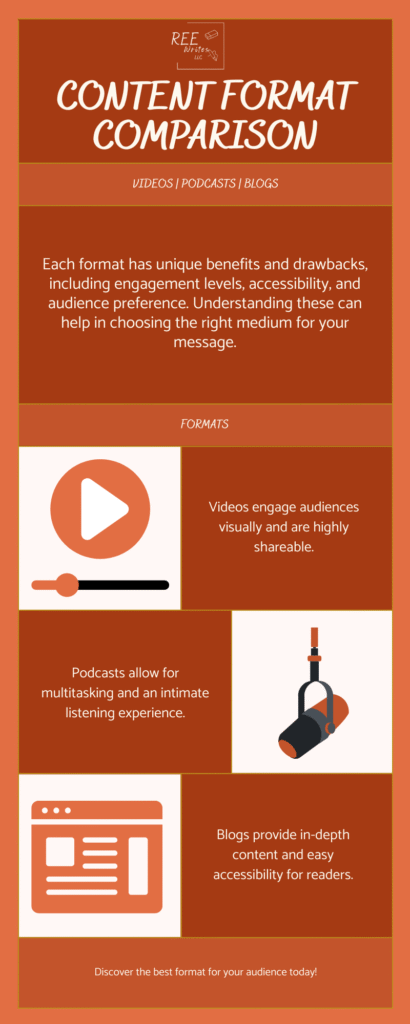
Compare blog posts, videos, podcasts, and social media content

The choices of how to distribute your content are endless:

  • Blog posts are SEO-friendly and help establish authority. They’re cost-effective and can be repurposed into other formats.
  • Videos are highly engaging and can succinctly deliver complex messages.
  • Podcasts offer convenience for busy audiences and provide intimacy through voice connection.
  • Social media content enables real-time engagement and community building.

Choose content formats that align with your skills and available time. If you’re a natural writer, start with blogging. If you’re comfortable on camera, consider video content.

Consider preferred content formats

Your audience’s preferences are another factor that should guide your content format choices. B2B audiences may prefer in-depth white papers, while consumer audiences may engage more with visual content. Use surveys or analytics to understand their preferences.

Start with one or two content types before expanding

Focus on mastering one or two content types before expanding. This approach prevents overwhelm and allows you to build systems and workflows that can scale. Quality execution of fewer formats beats mediocre execution across many.

Repurpose content across different platforms

One piece of core content can be adapted for multiple platforms. You could use a portion of a blog post in a video script, social media posts, and/or email newsletter content. This strategy maximizes your content investment while maintaining consistency across channels.

Create a Content Calendar That Works

Woman looking at calendar on her computer

Plan content themes around your business goals

Your content calendar should align with your business objectives. If you’re launching a new service, create content that educates your audience about related topics. Align your content marketing goals with your overall business goals like brand awareness, lead generation, and customer retention.

Use free tools to organize your content schedule

Content calendars

Tools like Google Sheets, Trello, and Notion (my favorite!) can help you organize your content calendar to help you visualize your content pipeline and maintain consistency. Many content creators on YouTube offer free content calendar templates on platforms like Gumroad and Etsy.

Balance promotional and educational content

Follow a content mix that provides value while promoting your services. One approach is the 80/20 rule: 80% educational/helpful content, 20% promotional. For example, you could do 2 educational posts, 2 storytelling posts, and 1 promotional post each month. (And if that seems like a lot, I’m here to help!)

Plan content around industry conferences, holidays, and seasonal trends relevant to your business. This approach helps you stay relevant and capitalize on increased interest in specific topics.

While planning is important, leave room for spontaneous content that responds to industry news or trending topics. This flexibility helps you stay current and engage in real-time conversations with your audience.

Batch Content Creation for Maximum Efficiency

Content batching can help you create multiple pieces efficiently by dedicating focused time blocks to create similar content types together.

Set up dedicated content creation blocks

Source: Plannerfly

Block out specific times for content creation rather than trying to create content daily. This approach reduces task-switching and helps you maintain focus and creative flow.

Develop templates for different content types

Templates speed up the creation process and ensure consistency across your content. Create templates for blog posts, social media content, email newsletters, or whatever content you produce. Include elements like headlines, introductions, and call-to-action (CTA) sections.

Create multiple pieces of content in single sessions

Content batching can help you create a month’s worth of content in just a few hours.

During batching sessions, create multiple pieces of similar content. Write several blog posts, record multiple videos, or create a week’s worth of social media content.

Use content pillars to generate ideas quickly

A central pillar with smaller topics connected to it

Content pillars are main themes/categories that guide your content creation. They may include industry insights, behind-the-scenes content, educational tutorials, and client success stories. The Breezy Company recommends 5 content pillars:

  • educational
  • personal
  • client-focused
  • industry insights
  • promotional

Establish an organized workflow to save time

Develop a repeatable process for content creation, from ideation to publication. This may include research, writing, editing, visual creation, and scheduling. A systematic approach ensures scalability, quality, and efficiency.

Distribute Content Across Multiple Channels

Source: Ahrefs

Choose platforms where your audience is most active

Instead of spreading yourself thin across all platforms, concentrate on those where your audience is most engaged and likely to convert. Focus your efforts on the one or two channels that bring you the best return.

Customize content for each platform’s requirements

Each platform has unique requirements and audience expectations. LinkedIn posts should be professional and industry-focused, while Instagram content should be visual and engaging. Adapt your content format and tone accordingly.

Use scheduling tools to maintain consistent posting

Source: Hootsuite

Social media planning tools like Buffer, Hootsuite, and Later help you maintain consistent posting schedules without being tied to your devices. Scheduling tools can maintain consistent posting and allow you to focus on content creation instead of daily posting.

Cross-promote content between different channels

Promote your blog posts on social media, mention your podcast in your newsletter, and share social media highlights in your blog. Cross-promotion maximizes the reach of your content across your entire audience.

Track which platforms drive the most engagement

Use analytics to identify which platforms generate the most engagement, traffic, and conversions. To compare ROI, divide sales by your time and resources.

Measure Your Content Success

Source: Wordable.io

Set up simple tracking for key metrics

You can’t scale your content marketing efforts effectively without seeing your analytics. Focus on engagement, traffic and lead generation.

The formula for content marketing ROI is (Return – Investment) / Investment × 100.

Key metrics to track include:

  • website traffic
  • social media engagement
  • email subscribers
  • lead generation

Use free analytics tools to monitor performance

Source: Ecwid

Google Analytics, social media insights, and email marketing analytics provide valuable data for free!

Google Analytics helps you understand website visitor behavior, goal tracking, and provides customizable reporting.

Track metrics that align with your business goals using Google Analytics for your website, and use platform-specific analytics for social media and email.

Adjust your strategy based on what works

Regularly review your analytics to identify high-performing content and successful strategies. 33% of marketers report difficulty measuring ROI due to integration issues, so start simple and build complexity over time.

Create monthly reviews to improve your approach

Schedule monthly reviews to assess content performance, adjust your strategy, and plan for the following month. Look for patterns in successful content and replicate those elements in future pieces.

Scale Your Content Strategy as You Grow

Source: Content Marketing Institute

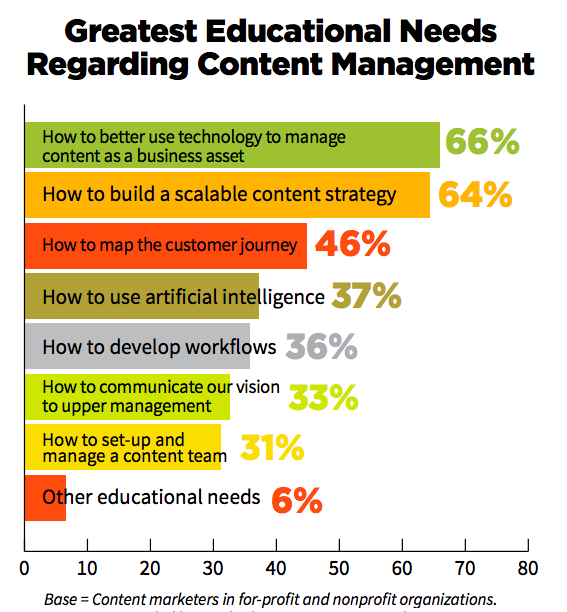
Content creation is often one of the first areas solopreneurs need to outsource. In a survey from Content Marketing Institute, 64% of content marketers say their greatest educational need is understanding how to create a scalable content strategy. Plan your content budget and identify tasks that can be delegated as your business grows.

Build systems and document your processes

Source: Similarweb

Create standardized processes for content creation, review, and approval.

Search engines prioritize valuable, relevant, high-quality content. Focus on creating systems that support quality while enabling increased production.

Delegate tasks outside your wheelhouse

Break down your writing process into small steps to identify which tasks to delegate while maintaining quality. Consider outsourcing the tasks that don’t require your direct expertise, which could be graphic design, editing, or content formatting.

Wrap Up

Your audience wants to hear from you, and they need to hear your unique perspective and expertise. Start with one platform, create valuable content for your audience, and gradually expand your efforts as you gain experience and resources.

Update your content strategy as your business grows. By implementing these strategies systematically, you’ll build a content marketing system that supports your business growth while establishing you as a trusted authority in your field.

The best content strategy is one you can actually stick with. Focus on progress over perfection, and watch your content strategy become a powerful engine for business growth.

References

2019 B2B Thought Leadership Impact Study. (2019). Edelman. Retrieved from https://www.edelman.com/research/2019-b2b-thought-leadership-impact-study

30+Interesting Solopreneur Statistics. (n.d.) Higo Creative. Retrieved from https://www.higocreative.com/blog/solopreneur-statistics

Content Marketing Infographic. (n.d.). Demand Metric. Retrieved from https://www.demandmetric.com/content/content-marketing-infographic

Heitzman, A. (2024). 30 Content Marketing Statistics for 2024 and Beyond. HigherVisibility. Retrieved from https://www.highervisibility.com/seo/learn/content-marketing-statistics-trends-data-strategy/

McCoy, J. (2024). ROI-driven content marketing: Aligning strategies with revenue goals. Search Engine Land. Retrieved from https://searchengineland.com/roi-driven-content-marketing-align-strategies-revenue-goals-439116

Miller, D. (2016). How Small Businesses Can Optimize Content Better for ROI. Entrepreneur. Retrived from https://www.entrepreneur.com/growing-a-business/how-small-businesses-can-optimize-content-for-better-roi/282470

Scaglione, J. (2020). The Ultimate List of Content Marketing Analytics Tools (+ Free Benchmark Report!). Media Shower. Retrieved from https://mediashower.com/blog/the-ultimate-list-of-content-marketing-analytics-tools/

Shehu, A. (2021). How to Measure the ROI of Content Marketing: A Step-by-Step Guide. CoSchedule. Retrieved from https://coschedule.com/content-marketing/content-marketing-roi

The Independent by Choice Movement: Authentic and Intentional State of Independence in America 2024. (2024). MBO partners. Retrieved from https://www.mbopartners.com/state-of-independence/

Whalen, H. (2024). 6 Tips for Scaling Up Content Production Without Sacrificing Quality. Single Grain. Retrieved from https://www.singlegrain.com/content-marketing-3/6-tips-for-scaling-up-content-production-without-sacrificing-quality/

Lead Generation Using LinkedIn Newsletters for Solopreneurs

Lead Generation Using LinkedIn Newsletters for Solopreneurs

Content Marketing Copywriting

How do you build trust and credibility when you’re a one-person show?

LinkedIn newsletters may be one way– they get 3 times more engagement than regular posts. That’s huge for solopreneurs who need every advantage to stand out.

But how do you use a LinkedIn newsletter for lead generation? And SHOULD it be a part of your content strategy?

It’s worth finding out. We’ll discuss how you can use a LinkedIn newsletter as a powerful tool to build your solo business by:

  • helping you attract high-quality clients
  • establishing thought leadership
  • growing your business without a marketing team

Contents

LinkedIn Newsletters vs. Articles

What’s the difference between LinkedIn newsletters and articles?

LinkedIn’s newsletters and articles are different, and they serve different purposes in your marketing toolkit:

  • Newsletter: a regular publication LinkedIn sends directly to your subscribers’ inboxes. They also get a LinkedIn notification every time you publish.
  • Article: a long-form piece of content that sits on your LinkedIn profile. This distinction matters more than you might think for your business growth. Articles sit on your profile with no built-in audience or automatic reach in the feed (although they’re excellent for SEO).

Source: Trevisan Consulting

How Creator Mode affects your content distribution options

LinkedIn’s quietly ended “Creator Mode” in 2024, but its features are still available to amplify your content reach.

When you enable it, your primary profile button switches from ‘Connect’ to ‘Follow’, making it easier for people to follow your content without needing your approval. You’ll also get enhanced analytics that show content performance up to a year prior, plus insights into your best-performing posts and follower growth patterns.

When to use newsletters versus articles for maximum impact

Use newsletters when you want to build a loyal, engaged audience that expects regular content from you. They’re perfect for sharing:

  • weekly business insights
  • industry updates
  • personal entrepreneurship stories

The consistent delivery of newsletters builds trust and keeps you top-of-mind with potential clients.

Articles work better for thought leadership pieces that you want to rank in search results, and serve as evergreen content on your profile. They’re ideal for:

  • in-depth case studies
  • comprehensive guides
  • content that showcases your expertise to new visitors discovering your profile

Engagement patterns show newsletters outperform articles for audience building

Newsletter subscribers are more likely to read and interact with your content, because they’ve actively chosen to receive it. The notification system ensures your content reaches people directly, bypassing the LinkedIn algorithm that limits visibility. This engagement advantage makes newsletters particularly valuable for solopreneurs who need consistent client touchpoints.

LinkedIn Newsletters vs Traditional Email: The Trade-offs

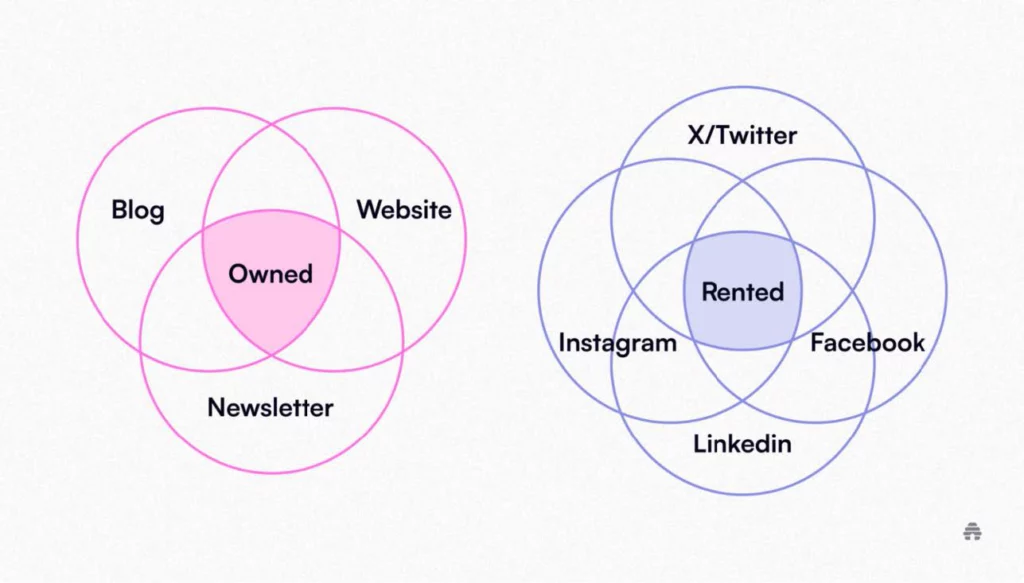
The ownership problem

Source: Thematic

You don’t own your LinkedIn subscriber list. LinkedIn controls the platform, and if they change how newsletters work or remove this feature entirely, you could lose access to all your subscribers in an instant. This platform dependency makes traditional email newsletters more secure for long-term business building.

Email newsletters give you complete control over your audience, with no algorithm standing between you and your readers. There’s no risk of platform changes affecting your ability to reach subscribers, making email a more reliable foundation for your marketing efforts.

Benefits of LinkedIn’s built-in audience provide immediate reach advantages

LinkedIn newsletters offer easy and instant distribution to your entire network when you publish your first edition. This immediate reach gives you a major head start that’s difficult to match with traditional email marketing, where you start with zero subscribers and must build from scratch.

The platform also provides automatic discoverability. Your newsletters get indexed by Google, helping people find your content without using LinkedIn.

Long-term business implications favor owned email lists for sustainability

While LinkedIn newsletters offer easier setup and immediate reach, email marketing provides better long-term security for your business. The analytics limitations on LinkedIn restrict your ability to deeply understand your audience, compared to standard email platforms that offer detailed subscriber insights.

However, in 2025, LinkedIn added two metrics for newsletters: email sends, and open rate.

Why LinkedIn Newsletters Still Work for Solopreneurs

Smart solopreneurs use both strategically—LinkedIn newsletters for reach and visibility, and email newsletters for owned audience development and deeper subscriber relationships. Here’s why you may want to follow suit.

Source: Orbit Media Studios

Direct access to your audience’s inbox creates consistent touchpoints

LinkedIn newsletters land directly in subscribers’ LinkedIn inboxes and trigger notifications, ensuring your content gets attention.

This direct access means you’re not competing with the LinkedIn algorithm that buries your regular posts in a feed among hundreds of other updates. You’re a trusted voice they choose to hear from regularly.

The notification system keeps you visible to your audience between their regular LinkedIn sessions, extending your reach beyond when people are actively browsing the platform. Newsletters are public for everyone to see.

Higher engagement rates compared to regular posts drive better business results

Source: Styled Stock Society

Subscribers who receive your newsletter are already interested in your content, leading to higher engagement rates than typical LinkedIn posts. This engaged audience is more likely to comment, share, and inquire about your services.

A consistent delivery schedule also trains your audience to expect and look for your content, building anticipation that regular posts can’t match.

Cost-effective marketing requires no additional tools or subscriptions

Unlike email marketing platforms that charge monthly fees, LinkedIn newsletters are completely free to use. You don’t need to learn new software, set up integrations, or manage technical aspects, because everything works within the LinkedIn interface you already know.

This zero-cost approach makes newsletters attractive for solopreneurs with tight marketing budgets while building their businesses.

Who Should Use LinkedIn Newsletters?

Source: Styled Stock Society

Consultants and freelancers benefit most from regular client touchpoints

If you’re a consultant or freelancer, newsletters help you stay visible to past, current, and potential clients. Delivering content regularly keeps your expertise front-of-mind when clients need services or referrals.

Service-based entrepreneurs can showcase expertise effectively

Coaches, trainers, and other service providers can use newsletters to demonstrate their knowledge and build trust with prospects. Sharing success stories, tips, and insights through newsletters positions you as an expert while nurturing potential client relationships.

B2B solo entrepreneurs find their ideal audience on LinkedIn

Source: Social Media Examiner (via David Moceri)

LinkedIn’s professional user base is perfect for business-to-business (B2B) solopreneurs who target other businesses. Whether you’re selling software, marketing services, or business consulting, your ideal clients are already active on the platform and receptive to business-focused content.

Can You Build Your Email List with LinkedIn Newsletters?

Of course you can, and it’s a great content strategy. You can balance LinkedIn engagement with list-building goals by providing value on LinkedIn, while encouraging deeper engagement through your owned channels. Here’s how.

Create lead magnets that work across both platforms for maximum impact

Source: Impulse Digital

Use your LinkedIn newsletter to promote valuable lead magnets that encourage email subscriptions. Embed links to relevant resources, guides, or tools that require email signup. This strategy lets you leverage LinkedIn’s reach while building your own email list simultaneously.

Be sure to also add your lead magnet to the Featured section of your LinkedIn profile (select the three dots on the top right, and click Feature on top of profile).

Drive newsletter readers to owned audiences

For long-term security, include calls-to-action (CTAs) in your LinkedIn newsletters that direct readers to your email list or website. This creates a funnel from LinkedIn’s platform to your owned channels, reducing platform dependency over time.

How to Set Up Your LinkedIn Newsletter for Business Growth

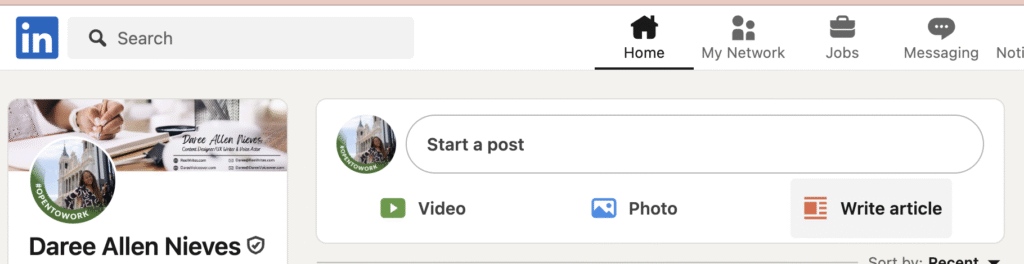
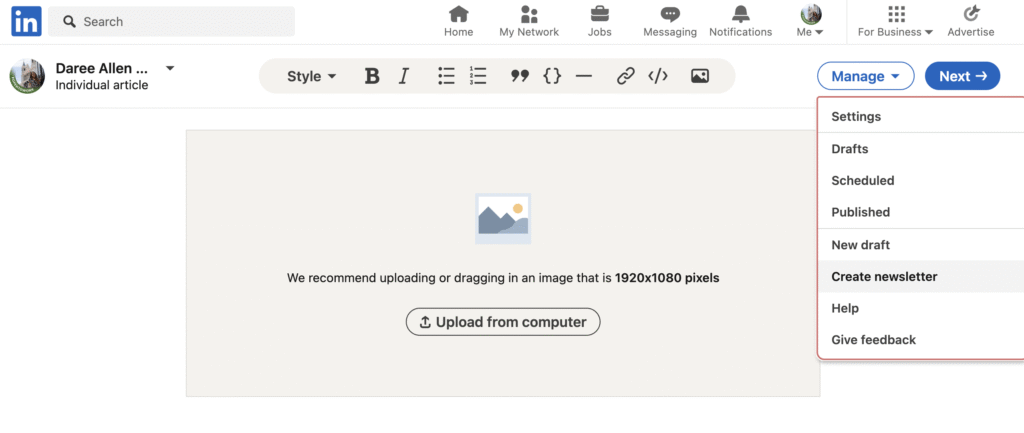
To create a LinkedIn newsletter, go to your feed and select Write article.

Then click Manage > Create newsletter.

Choose a business-focused name that clearly communicates value

Give your newsletter a descriptive name that immediately tells people what they’ll get. Avoid clever or branded names in favor of clear, specific titles that communicate obvious value. You only get 30 characters, so make them count.

Examples of effective newsletter names include “Digital Marketing Tips” rather than something clever but vague. Clear beats clever every time when it comes to subscriber conversion, because when you confuse them, you lose them.

Write a compelling description that attracts your ideal clients

Use your 120-character description to tell readers exactly why they should subscribe to your content. List the specific topics you’ll cover and the value they’ll receive. Be direct about who your content serves and what problems you’ll help solve.

Focus on benefits rather than features. Instead of using a generic phrase like “weekly newsletter,” explain “weekly strategies to grow your consulting business” or “actionable marketing tips for solopreneurs.”

LinkedIn doesn’t make it easy to find newsletters on the platform. So be sure to pin it to the Featured section of your profile.

Set a realistic publishing schedule you can maintain

Choose a daily, weekly, bi-weekly, or monthly publishing schedule. As a solopreneur, weekly or bi-weekly often works best, because it’s frequent enough to stay visible without overwhelming your content creation capacity.

Consistency matters more than frequency. It’s better to publish bi-weekly content reliably than to start weekly and burn out after a month.

Content Strategy for Solopreneur Newsletters

Balance personal stories with business insights to build connection

Share your entrepreneurship journey along with business tips and behind-the-scenes (BTS) content to create authentic connections with your audience. People want to work with solopreneurs they know, like and trust, and personal stories help build that relationship:

  • Challenges you’ve overcome
  • Lessons learned from client work
  • Insights and frameworks from building your business

Provide actionable tips that show your expertise

Each newsletter should include practical advice readers can implement immediately. This demonstrates your knowledge while providing real value that keeps subscribers engaged and looking forward to your next edition.

Focus on specific, tactical advice rather than high-level concepts. Readers should finish your newsletter with clear next steps they can take to improve their business or solve a problem.

Comment on industry developments through your unique lens as a solopreneur. This positions you as a thought leader while helping subscribers understand how broader trends affect their specific situations.

Your individual perspective as a solo business owner provides value that large companies can’t match. So leverage this authenticity in your content strategy.

Growing Your Newsletter Audience as a Solopreneur

Leverage existing client relationships for initial subscriber growth

Source: Styled Stock Society

Your current and past clients make ideal initial subscribers since they already know and trust your expertise. Personally invite them to subscribe, and ask for their feedback on early editions.

Use your existing network strategically. Reach out to colleagues, partners, and professional contacts who might find your content valuable and be willing to share it with their networks.

Cross-promote through your other marketing channels consistently

Every touchpoint should mention your newsletter as a way for people to stay connected with your expertise. Promote your LinkedIn newsletter:

  • in your email signature
  • on your website
  • on your other social media profiles
  • during networking conversations

Include newsletter subscription CTAs in your LinkedIn posts, comments, and direct messages when appropriate and valuable to the recipient.

Content Ideas That Convert Prospects to Clients

Here are a few content ideas for your newsletters.

Weekly business tips establish your expertise and provide ongoing value

Share practical advice that helps your ideal clients solve common problems. This positions you as a valuable resource while demonstrating the depth of your knowledge and experience.

Focus on tips that relate directly to services you offer, creating natural opportunities for readers to see how you might help them with bigger challenges. For more ideas, check out my guide to creating evergreen content.

Client success stories build credibility and showcase results

Source: Styled Stock Society

Share case studies that highlight challenges you’ve helped clients overcome. This social proof demonstrates your capabilities while giving prospects insight into how you work.

Include specific results when possible, showing the tangible value you provide to clients.

Tool reviews position you as a knowledgeable industry resource

Review software, books, or resources relevant to your audience. This type of content provides value, showing that you stay current with industry developments and can guide others to make smart choices in that space.

Measuring ROI and Business Impact

Track newsletter metrics that connect to actual business growth

It’s important to monitor metrics like subscriber growth, open rates, and engagement levels, but you should also track how newsletter content leads to client inquiries and business opportunities. Look for patterns in which content types generate the most business interest.

LinkedIn’s analytics show basic engagement data, but you’ll need to track business outcomes separately to understand your newsletter’s true ROI. Keep simple records of which newsletter topics or formats generate the most business inquiries to refine your content strategy over time.

Connect newsletter engagement to client acquisition for clearer ROI

Take note when newsletter subscribers reach out about services, mention your content in sales conversations, or refer others to your business. This connection between content and revenue helps justify the time investment in newsletter creation.

Wrap-up

LinkedIn newsletters offer solo entrepreneurs a unique opportunity to build relationships, showcase expertise, and grow their business organically. However, they shouldn’t be your only marketing strategy. The biggest limitation is that you don’t own your subscriber list, which creates platform dependency risks.

The smart approach? Use LinkedIn newsletters to build authority and attract your ideal clients, while simultaneously driving readers to your owned email list. This gives you the best of both worlds: LinkedIn’s built-in audience and discovery power, plus the security of an owned audience you can reach anytime.

Start with one LinkedIn newsletter focused on your ideal client’s biggest challenges. Share your knowledge generously, tell your story authentically, and always include gentle CTAs that move people to your owned platforms. Your expertise deserves to be heard. LinkedIn newsletters give you the platform to make that happen, while email marketing ensures you keep that audience long-term.

References

Crestodina, A. (2023). How to Start Your Own LinkedIn Newsletter: 10 Best Practices. LinkedIn. Retrieved from https://www.linkedin.com/pulse/how-start-your-own-linkedin-newsletter-10-best-andy-crestodina/

Difference between LinkedIn newsletter, article and post. (2023). Manifest Infotech Pvt. Ltd. Retrieved from https://www.linkedin.com/pulse/difference-between-linkedin-newsletter-article-post/

Eeckhout, J. (2024). Why I Shut Down My LinkedIn Newsletter to Focus on Email. Retrieved from https://www.thesciencemarketer.com/linkedin-newsletter-pros-cons/

Granger, J. (2024). LinkedIn newsletters: are they what they are cracked up to be? Marten Publishing Ltd. Retrieved from https://www.journalism.co.uk/news/linkedin-newsletters-are-they-all-they-are-cracked-up-to-be-/s2/a1165074/

Ingram, L. (2024). You Can’t Activate Creator Mode on LinkedIn Anymore – Here’s What You Can Do Instead. Guiding Tech. Retrieved from https://www.guidingtech.com/you-cant-activate-creator-mode-on-linkedin-anymore-heres-what-you-can-do-instead/

LinkedIn Help. (2025). Newsletter analytics. Retrieved from https://www.linkedin.com/help/linkedin/answer/a1658525

Horvat, T. (2024). LinkedIn Newsletter vs Email Newsletter: Which is Better? THM Agency. Retrieved from https://tomislavhorvat.com/linkedin-newsletter-vs-email-newsletter-which-is-better/

Hutchinson, A. (2025). LinkedIn Rolls Out New Newsletter Metrics. SocialMediaToday. Retrieved from https://www.socialmediatoday.com/news/linkedin-adds-more-newsletter-metrics/740594/

Martinez, D. (2025). LinkedIn vs. Email Newsletters: Which Should You Choose (and Why Not Both)? Solid Digital. Retrieved from https://www.soliddigital.com/blog/linkedin-vs-email-newsletters-which-should-you-choose-and-why-not-both

Oddy, S. (2025). How to Build an Email List from LinkedIn Connections. ScoreApp. Retrieved from https://www.scoreapp.com/build-email-list-linkedin-connections/