What Patients and Caregivers Need to Know About Hospital at Home vs. Traditional Hospital

What Patients and Caregivers Need to Know About Hospital at Home vs. Traditional Hospital

Caregiving Health Tech Med Tech

Hospital-at-home programs have expanded rapidly across the U.S., but most patients have no idea this option exists when facing admission.

When my husband George was cycling through hospital stays every month for his end-stage renal disease and cancer in 2018, nobody told us there might be another way. We assumed the hospital was our only option. Month after month, we dealt with the ER waits, the uncomfortable chairs, the sleepless nights, and the parade of specialists who never seemed to talk to each other.

Things have changed since then. Hospital-at-home care has gone from experimental to mainstream. Medicare now covers it permanently. Your insurance probably covers it too.

But you have to know to ask for it.

Let’s break down everything you need to know about hospital-at-home versus traditional hospitalization, including:

  • a comparison of clinical outcomes
  • the hidden costs nobody talks about
  • how to decide which option makes sense for your situation

Contents

What Is Hospital at Home Care?

Hospital-at-home means exactly what it sounds like: you receive acute-level medical care in your own home instead of in a hospital facility. This isn’t the same as regular home healthcare or skilled nursing. We’re talking about the same intensity of care you’d get if you were admitted to a hospital bed.

What conditions qualify for hospital-at-home care?

You can receive hospital-at-home care for conditions like pneumonia, COPD flare-ups, heart failure, serious infections, and certain post-surgical recoveries. A 2023 study in the Annals of Internal Medicine found that hospital-at-home programs safely treated patients with cellulitis, urinary tract infections, and heart failure exacerbations.

The key word here is “acute.” You need to be sick enough to require hospitalization, but stable enough to be safely monitored at home.

What does hospital-level care actually include?

Nurse helps someone with a cane

Your care team visits you at home daily, and sometimes twice a day. This includes physicians, nurses, physical therapists, and care coordinators. You’ll get IV medications if you need them. You’ll wear devices that monitor your vital signs and send data to your medical team in real-time. It’s like having a hospital room set up in your living room, but without the hospital smell and terrible food.

When George was using his Dexcom continuous glucose monitor, I got alerts on my phone whenever his blood sugar spiked or dropped dangerously low. That technology exists for heart rate, oxygen levels, blood pressure, and more. Your care team watches these numbers from their computers and can intervene before small problems become emergencies.

Who provides the care?

A dedicated hospital-at-home team manages your case. You’ll have a primary physician who oversees your treatment plan. Nurses visit to check on you, administer medications, and assess your condition. The big difference from traditional home health? These visits happen daily, and you have 24/7 access to your care team by phone or video.

The shift from experimental to mainstream happened fast. Before COVID-19, only a handful of health systems offered hospital-at-home programs. The pandemic forced rapid expansion, and in 2025, the Hospital Inpatient Services Modernization Act extended the CMS waiver to continue providing hospital-at-home care.

How Traditional Hospital Care Works

ER and urgent care entrance

When you’re admitted to a traditional hospital, you check in through the emergency department or for a scheduled admission. A nurse takes your vitals, you change into a hospital gown, and you’re assigned to a room (if one’s available—sometimes you wait for hours).

The hospital routine

Nurses check your vitals every few hours, day and night. Yes, even at 3 a.m. Doctors round in the morning, usually between 7 and 10 AM. If you’re asleep when they come by, too bad. Meals arrive on a fixed schedule whether you’re hungry or not.

With George’s 10 different specialists, we never knew who would walk through the door or when. His nephrologist didn’t talk to his oncologist. His endocrinologist had no idea what his cardiologist prescribed. I became the central hub of information, keeping my own spreadsheet because the hospital’s electronic records didn’t seem to connect the dots.

Family involvement and visiting limitations

Even before COVID-19 restrictions, hospitals limited visiting hours. During the pandemic, many hospitals banned visitors entirely. In 2025, most facilities still have restrictions like limited hours, limited number of visitors, no children under 12.

If you want to be there when doctors round to ask questions, you’d better arrive early and stay all day.

Need to go home to shower or check on your kids? You might miss critical conversations about your loved one’s treatment plan.

The discharge process often feels rushed. A nurse reviews a stack of papers, hands you prescriptions, and sends you on your way. Studies show 20% of patients don’t understand their discharge instructions.

Clinical Outcomes: Which Delivers Better Results?

Does hospital-at-home actually work as well as traditional hospitalization?

Yes—and sometimes better.

Patient satisfaction scores

A 2024 meta-analysis in JAMA Network Open reviewed 25 studies comparing hospital-at-home care to traditional care. Patient satisfaction scores were consistently higher for hospital-at-home, with 87% of patients rating their experience as “excellent” compared to 62% for traditional hospitalization.

That’s not surprising. People sleep better when they’re in their own beds. They get to eat their own food, and see their family members whenever they want.

The medical care is just as good, but the experience is dramatically better.

Hospital readmission rates

Getting sent back to the hospital within 30 days of discharge is a sign something went wrong.

For traditional hospitalizations, the 30-day readmission rate hovers around 15% to 20% depending on the condition. Hospital-at-home programs report readmission rates of 8% to 12%.

That’s because closer monitoring catches problems earlier. Patients understand their care plan better because they’re not overwhelmed and sleep-deprived. The transition from acute care to regular life is smoother when you’re already home.

Infection risk and recovery time

Hospital-acquired infections affect 1 in 31 hospital patients on any given day, according to the CDC. At home, you’re not exposed to antibiotic-resistant bacteria floating around hospital wards. You’re not sharing air with other sick people.

Recovery happens faster when you’re comfortable and less stressed. A 2023 study found that elderly patients receiving hospital-at-home care regained their ability to perform daily activities 40% faster than those in traditional hospitals.

The mortality rates? Comparable. For appropriate patients, hospital-at-home is just as safe as traditional hospital care.

The Hidden Costs Nobody Tells You About

The hospital bill is just the beginning. Let’s talk about what you’ll actually pay and what costs don’t show up on an invoice.

Out-of-pocket expenses for traditional hospitalization

Even with good insurance, a three-day hospital stay can cost you $1,500 to $3,000 in co-pays and deductibles. That’s the baseline. Then come the surprise charges.

Facility fees can add hundreds of dollars:

And let’s not forget parking. $15 per day adds up when you’re visiting daily for weeks. Hospital cafeteria meals for family members is $10 to $15 each.

These “small” costs can easily hit $500 to $1,000 for a typical hospital stay.

Out-of-pocket expenses for hospital at home

Medicare card and Rx closeup

Medicare covers hospital-at-home the same way it covers traditional hospitalization. You pay the standard hospital deductible and any applicable co-pays. Most private insurers follow Medicare’s lead, but coverage varies.

The surprise? Hospital-at-home often costs you less out-of-pocket because there’s no:

  • parking fees
  • expensive hospital cafeteria meals
  • co-pays for separate facility charges

A 2021 analysis found that patients in hospital-at-home programs saved an average of $2,400 in out-of-pocket costs compared to traditional hospitalization.

You might need to buy a few things—maybe a shower chair or grab bars if you don’t have them. But the program provides equipment like IV poles and monitoring devices.

The invisible costs for caregivers

The economic impact on caregivers is often overlooked. I burned through my vacation days and sick leave taking George to appointments and managing his care, even while working remotely. Many caregivers do the same.

The financial burden is more than just lost wages. A 2023 AARP study found that family caregivers spend an average of $7,200 per year of their own money on caregiving expenses (like medications, medical supplies, home modifications, transportation).

The emotional toll is impossible to measure, but very real. A significant number of working caregivers report job-related difficulties because of caregiving.

What the Caregiver Experience Actually Looks Like

Both hospital settings require serious caregiver involvement, just in different ways.

Caregiving during traditional hospitalization

You become an advocate and information manager. When doctors round at 8 a.m. and you can’t be there because you have a job, you miss critical conversations. So you take time off. You show up early. You stay late.

I kept notes from every specialist visit, cross-referenced medications, and flagged contradictions. The nutritionist told George to eat high-protein foods for his kidney disease. The renal dietitian told him to eat low-protein foods for his kidney disease. Guess who had to figure that out?

You’re also managing communication with the rest of the family. Who’s visiting when? Who needs updates? Coordinating schedules becomes a part-time job.

Caregiving with hospital at home

At home, you’re more hands-on with daily care:

  • You help your loved one to the bathroom.
  • You make sure they eat.
  • You learn to manage medications (when to give them, and spot side effects)

The medical team trains you. They don’t just hand you a list of tasks and disappear. They show you how to help with care, what to watch for, and when to call for help.

When I was managing George’s peritoneal dialysis at home, his nephrologist’s team trained me thoroughly. I set up the machine every night, monitored the process, troubleshot issues.

It was a big responsibility, but I wasn’t alone. I had 24/7 access to the dialysis team by phone.

The benefits of hospital-at-home care:

  • You have more control over the environment
  • You can maintain some routine
  • You sleep in your own bed

The stress of feeling “on call” is real, but many caregivers prefer it to feeling helpless in a hospital where they can’t be present all the time.

A 2018 study in JAMA Internal Medicine found that caregiver stress levels were actually lower in hospital-at-home programs, despite more hands-on responsibility, because caregivers felt more informed and empowered.

How to Know if Hospital at Home is Right for Your Situation

Hospital-at-home isn’t for everyone. Here’s how to figure out if it makes sense for you.

Medical eligibility criteria

Senior woman with leg pain in chair

Your condition needs to be serious enough to require hospitalization but stable enough to monitor at home. This includes conditions like:

  • Pneumonia (non-ICU level)
  • Heart failure exacerbations
  • COPD flare-ups
  • Cellulitis and other serious infections
  • Certain post-surgical recoveries

You don’t qualify if you need ICU-level care, constant monitoring, or procedures that can only be done in a hospital. You also need to live within 30 minutes of the hospital in case you need emergency transfer.

Home environment assessment

Man with sarcopenia and a cane

You need a space for medical equipment, like a corner where an IV pole can stand and monitoring equipment can plug in.

If you’re taking advantage of telehealth, you’ll also need reliable internet for video visits and data transmission and a phone.

Safety matters too. Can you get to the bathroom safely? Are there trip hazards that could cause falls? A nurse will assess your home before admission to make sure it’s appropriate.

Insurance coverage check

Call your insurance company and ask these specific questions:

  • Do you cover hospital-at-home programs?
  • “What’s my co-pay compared to traditional hospitalization?”
  • “Do I need pre-authorization?”
  • “Which hospitals in my area participate in your hospital-at-home network?”

Get the answers in writing. Insurance representatives make mistakes, and you don’t want surprises later.

Family readiness factors

Someone needs to be home or nearby. Not necessarily 24/7, but available. The medical team handles the clinical care, but you need a person there to help with activities of daily living and to be present during visits.

Consider your other responsibilities:

  • Do you have young kids?
  • Other family members who need care?
  • A job with no flexibility?

Be honest about your capacity. There’s no shame in saying traditional hospitalization is the better fit for your situation.

How to Access Hospital-at-Home Programs

Most doctors won’t automatically offer this option. You have to ask for it.

When your doctor says you need to be admitted, ask: “Am I eligible for a hospital-at-home program?” If they say they don’t know or haven’t heard of it, ask them to check. Many physicians are still learning about these programs.

Call your insurance company before admission if possible. Verify coverage and get any necessary pre-authorizations. Some programs accept patients directly from the emergency department, which can save you hours in the ER waiting room.

To find hospitals offering hospital-at-home in your area, check the Medicare website’s Hospital Compare tool or call hospitals directly and ask if they participate in hospital-at-home programs.

Questions to Ask Before You Decide

Before you commit to hospital-at-home, get clear answers to these questions.

For your medical team:

  • “Am I medically stable enough for hospital-at-home?”
  • “What happens if my condition gets worse at night or on weekends?”
  • “How quickly can I be transferred to the hospital if needed?”

For the program coordinator:

  • “How many times per day will someone visit me?”
  • “Will I see the same nurses and doctors, or will it change?”
  • “What equipment will be in my home, and who maintains it?”

For your insurance:

  • “What will my total out-of-pocket cost be?”
  • “How many days of hospital-at-home care are covered?”
  • “Is there a limit to how many times I can use this benefit?”

For your family:

  • “What will I be responsible for as a caregiver?”
  • “What training will I receive?”
  • “Who can I call when I’m overwhelmed or unsure?”

Get these answers before you decide. Understanding what you’re signing up for prevents surprises and helps you plan.


Making the Right Choice for Your Family

Hospital-at-home delivers the same quality of clinical care as traditional hospitalization—sometimes better.

But the right choice depends on your medical situation, your home environment, your insurance coverage, and your family’s capacity to help with care.

If George had the option for hospital-at-home care during his treatment, would it have changed the outcome? Probably not. His conditions were too complex and unstable.

But it would have changed our experience. Fewer nights in uncomfortable hospital chairs. More time in our own home. Better sleep for both of us. For the right patient and the right family, those differences matter tremendously.

Know that you have options. Ask questions and advocate for yourself. Don’t assume the hospital is the only place to receive acute care, because it’s not.

If you’re facing hospitalization decisions for yourself or a loved one, share this information with your family. Ask your doctor about hospital-at-home before admission. You might be surprised by what’s possible.


References

Bruce, G. (2025). House passes 5-year hospital-at-home extension. Becker’s Health IT. Retrieved from https://www.beckershospitalreview.com/healthcare-information-technology/digital-health/house-passes-5-year-hospital-at-home-extension/

Cryer, L., Shannon, S. B., Van Amsterdam, M., & Leff, B. (2023). Costs for Hospital at Home Patients Were 19 Percent Lower, With Equal or Better Outcomes Compared to Similar Inpatients. Health Affairs, 42(6), 861-868. Retrieved from https://pubmed.ncbi.nlm.nih.gov/22665835/

Dhaliwal, J.S., & Dang, A.K. (2024). Reducing Hospital Readmissions. StatPearls. Retrieved from https://www.ncbi.nlm.nih.gov/books/NBK606114/

Edgar, K., Iliffe, S., Doll, H. A., Clarke, M.J., Gonçalves-Bradley, D.C., Wong E., & Shepperd, S. (2024). Admission avoidance hospital at home. Cochrane Database of Systematic Reviews. Mar 5;3(3):CD007491. doi: 10.1002/14651858.CD007491.pub3. Retrieved from https://pubmed.ncbi.nlm.nih.gov/38438116/

Federman, A. D., Soones, T., DeCherrie, L. V., Leff, B., & Siu, A. L. (2018). Association of a Bundled Hospital-at-Home and 30-Day Postacute Transitional Care Program With Clinical Outcomes and Patient Experiences. JAMA Internal Medicine. Aug 1;178(8):1033-1040. doi: 10.1001/jamainternmed.2018.2562. Retrieved from https://pubmed.ncbi.nlm.nih.gov/29946693/

HAI and Antimicrobial Use Prevalence Surveys. (2024). Centers for Disease Control. Retrieved from https://www.cdc.gov/healthcare-associated-infections/php/haic-eip/antibiotic-use.html

Horwitz, L. I., Moriarty, J. P., Chen, C., et al. (2020). Quality of discharge practices and patient understanding at an academic medical center. JAMA Internal Medicine, 180(8), 1125-1131. Retrieved from https://pubmed.ncbi.nlm.nih.gov/23958851/

Levine, D. M., Ouchi, K., Blanchfield, B., et al. (2023). Hospital-Level Care at Home for Acutely Ill Adults: A Randomized Controlled Trial. Annals of Internal Medicine, 176(11), 1455-1466. Retrieved from https://pubmed.ncbi.nlm.nih.gov/31842232/

Pollitz, K., Lopes, L., Kearney, A., Rae, M., Cox, C., Fehr, R., & Rousseau, D. (2019). An Examination of Surprise Medical Bills and Proposals to Protect Consumers from Them. Kaiser Family Foundation. Retrieved from https://www.kff.org/health-costs/an-examination-of-surprise-medical-bills-and-proposals-to-protect-consumers-from-them/

Reinhard, S. C., Caldera, S., Houser, A., & Choula, R. B. (2023). Valuing the Invaluable 2023 Update: Strengthening Supports for Family Caregivers. AARP. Retrieved from https://www.aarp.org/content/dam/aarp/ppi/2023/3/valuing-the-invaluable-2023-update.doi.10.26419-2Fppi.00082.006.pdf


Hospital at Home Waiver Extension: Your 5-Year Technology Roadmap

AI Health Tech Med Tech

The House spending bill dropped a bombshell for digital health companies: a proposed 5-year extension for hospital-at-home waivers and 2-year extension for Medicare telehealth flexibilities.

Five years sounds like forever in tech time. But it’s actually a strategic planning nightmare.

Do you build for temporary policy, or bet everything on permanence?

I spent 2 years managing care for my terminally ill husband across 10 different doctors. Every month, he landed back in the hospital with high A1C, low hemoglobin, unbearable pain. If hospital-at-home programs had existed in 2016 with the right technology backing them, he could have avoided dozens of ER visits.

Hospital at home is the future. The question is, what should Series A, B and C health tech founders build in the next 24 months that creates value regardless of what Congress does in 2030?

This isn’t about policy speculation. It’s about strategic planning with incomplete information—which is exactly what building a health tech company requires.

Let’s break down the roadmap.

Contents

What the Proposed Funding Package Actually Changes

Source: Modern Healthcare

The proposed House spending bill extends two critical Medicare programs—but on very different timelines. Understanding these differences matters if you’re building technology in this space.

The 5-year hospital-at-home timeline explained

The proposed legislation would extend the hospital-at-home waiver through 2030. This isn’t just another short-term patch. Previous extensions gave health systems and tech companies 12-18 months of runway at best.

The current acute hospital care at home initiative lets Medicare pay for hospital-level services delivered in patients’ homes. Without the extension, this program expires in 2025. That’s not enough time to build, validate, and scale meaningful technology infrastructure.

Five years gives you real planning horizon. You can make legitimate platform investments. You can hire engineering teams. You can sign multi-year contracts with health systems.

But—and this is critical—5 years isn’t permanent. It’s a policy experiment with a longer fuse.

What’s still uncertain despite the extension

Even with a 5-year extension, huge questions remain unanswered. CMS hasn’t committed to specific reimbursement rates beyond the waiver period. Will hospital-at-home payments match facility-based acute care, or will they drop to home health rates?

State regulations vary wildly. Some states embrace home-based acute care. Others have licensing requirements that make it nearly impossible. Federal waivers don’t override state-level barriers.

Commercial payers watch Medicare but don’t automatically follow. Your hospital-at-home technology needs Medicare coverage to scale, but commercial adoption determines whether you build a sustainable business.

Technology requirements could shift too. CMS might mandate specific monitoring capabilities, interoperability standards, or quality reporting metrics that don’t exist yet.

Planning for 5 years means planning for uncertainty, not betting on stability.

Most Founders Are Asking the Wrong Question

When the House bill news broke, founder group chats exploded with one question: “Does this mean hospital-at-home is permanent?” That’s the wrong question. It reveals a misunderstanding of how health tech businesses actually succeed or fail.

“Is this permanent?” misses the strategic point

Policy permanence has never guaranteed health tech success. Remote patient monitoring has had Medicare coverage since 2019. Chronic care management codes have existed for years. Both have clear reimbursement pathways. Both have policy stability.

Yet most RPM companies struggle to achieve profitability. Many CCM platforms shut down despite favorable policy.

The real risk isn’t policy reversal. It’s building something nobody needs or can’t afford to operate. Investors price in regulatory risk and execution challenges unique to healthcare.

Your business model needs to create value across multiple scenarios. If hospital-at-home waivers expire in 2030, can your technology pivot to post-acute care? Skilled nursing facilities? Palliative care at home? If you’ve built exclusively for one reimbursement code, you’ve built a fragile company.

The trap of building exclusively for waivers

Female doctor waving to female patient on Zoom

Remember the telehealth boom of 2020-2021? Some telehealth companies that scaled to thousands of employees during COVID laid off half their staff by 2023.

They weren’t bad companies. They built for a policy moment, not a durable market need.

VCs learned an expensive lesson: waiver-dependent revenue is risky revenue. When I talk to Series B investors now, they ask pointed questions. What percentage of your revenue requires temporary policy? If that policy changes, what’s your Plan B? Can you operate profitably under traditional Medicare rates?

If you can’t answer those questions convincingly, your valuation suffers—even if current policy looks favorable.

What “5 years” really means for your product roadmap

Five years is approximately two technology development cycles for complex healthcare platforms. You can ship an MVP, gather real-world evidence, iterate based on feedback, and launch a mature v2.0 product in that timeframe.

But 5 years isn’t enough time to build everything. You need to prioritize ruthlessly.

Your 24-month window is critical. This is when you validate product-market fit, prove unit economics, and establish your competitive moat. If you can’t demonstrate margin-positive cohorts by month 24, the next 3 years won’t save you.

Years 3 to 5 should assume policy uncertainty, not stability. Build optionality into your architecture. Make sure your platform can serve multiple care settings. Design your data infrastructure to support different payment models.

One scenario planning exercise: map out what your business looks like if hospital-at-home waivers expire in 2030 versus extend another 5 years vs. become permanent. If all three scenarios require fundamentally different strategies, you’re not building a durable company. You’re building a policy bet.

Your 24-Month Minimum Viable Stack

The next 2 years determine everything. You need to build technology that proves value quickly while laying foundation for longer-term expansion. Here’s where to focus your engineering resources and capital.

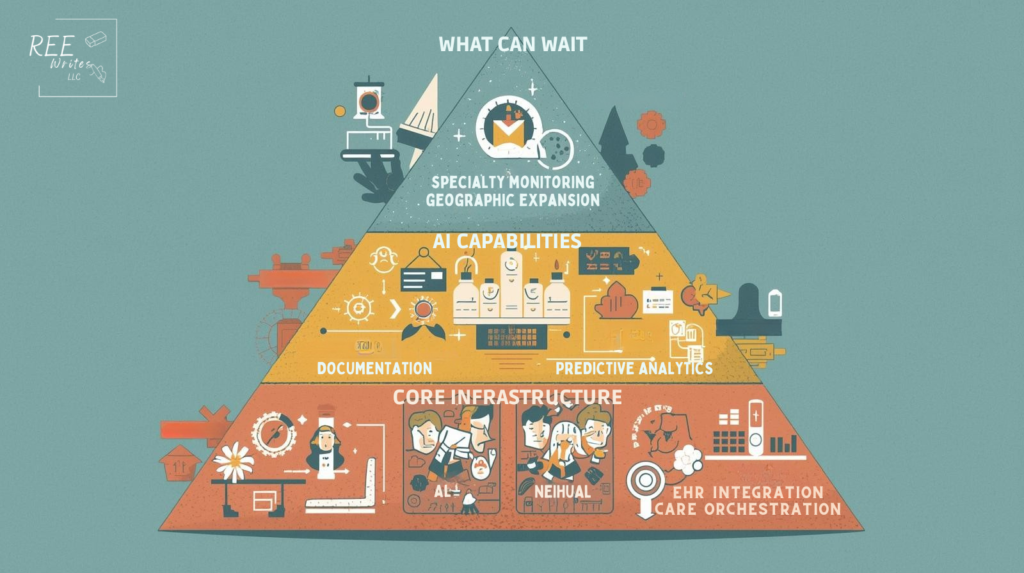
Core infrastructure that works across reimbursement models

Start with the basics that every home-based care model needs, regardless of how Medicare pays for it.

Remote patient monitoring devices need to integrate seamlessly with your platform. But don’t overbuild here. Start with FDA-cleared devices for vital signs (blood pressure, pulse ox, weight, glucose). Specialty monitoring for rare conditions can wait until you’ve proven your core model works.

Virtual triage and clinical communication platforms matter more than most founders realize. When a patient’s oxygen saturation drops at 3 a.m., someone needs to decide: send an ambulance, dispatch a nurse, or coach the patient through the moment remotely? That decision-making capability is what health systems pay for, not just the device data.

Care orchestration is the unsexy backbone nobody wants to build but everyone needs. Who schedules the nurse visit? Who orders medical supplies? Who coordinates with the patient’s primary care doctor? These back-office functions represent over half of the $1 trillion in annual U.S. healthcare waste. Automating them creates immediate ROI.

EHR integration isn’t optional. Payers demand it. Health systems require it. Your platform needs to pull patient data from Epic, Cerner, and other major EHRs, then push back visit notes, monitoring data, and care plans. Budget 20 to 30% of your engineering resources just for integration work.

Where to invest in AI right now

Source: Health Care Code

Ambient clinical intelligence (ACI) has reached near-universal adoption: 92% of health systems are piloting or deploying AI scribes. These tools improve documentation accuracy, leading to 10 to 15% revenue capture improvement through better coding and billing.

For hospital-at-home programs, this matters enormously. Nurses and paramedics doing home visits often struggle with documentation. They’re managing complex patients in unpredictable environments. AI that turns their verbal notes into structured clinical documentation saves 30 to 45 minutes per visit.

Predictive analytics should focus on preventing acute episodes that require hospitalization. Machine learning models can analyze vital sign trends, medication adherence patterns, and social determinants data to flag patients at risk of decompensation. One health system using predictive monitoring reduced readmissions by 23% in their hospital-at-home cohort—that’s the difference between a margin-positive program and one that loses money on every patient.

Don’t sleep on care coordination automation. If family caregivers spend 15-20 hours per week on caregiving tasks (as CareYaya Health Technologies data shows), your AI should reduce that burden. Automated medication reminders, appointment scheduling, and supply ordering aren’t flashy features, but they’re what caregivers desperately need.

The unsexy AI that saves money: Back-office automation in revenue cycle management, prior authorization, and claims integrity. These AI applications can reach 70-80% profit margins and generate $500K-$1M in annual recurring revenue per full-time employee. That cash flow funds your clinical AI development.

The Margin Math That Actually Matters

Most hospital-at-home programs lose money. Your technology needs to change that equation, or you don’t have a sustainable business.

Why most hospital-at-home programs lose money

Medicare pays $1,000 to $1,500 per day for hospital-at-home. Most programs spend $1,200 to $1,600 per patient daily on nurse visits, supplies, coordination, and tech. They’re underwater from Day 1.

The hidden costs kill you. Logistics and care orchestration require significant labor. Someone schedules visits, manages the supply chain, and coordinates with the patient’s other providers. Traditional staffing models don’t scale—you can’t apply facility-based nursing ratios to home care and expect it to work economically.

Technology that creates work instead of reducing it makes the problem worse. I’ve seen hospital-at-home platforms that require nurses to log into five different systems per visit. The documentation burden exceeds what they’d do in a hospital setting.

How AI makes care at home programs profitable

Revenue cycle optimization through better documentation can improve revenue capture by 10-15%. When a nurse describes a patient’s condition verbally and AI generates accurate, complete clinical notes with proper billing codes, you get paid more for the same work.

Source: MDhelpTEK

Reduced readmissions drive CMS quality bonuses. The hospital-at-home model already shows lower readmission rates than traditional acute care—adding predictive monitoring amplifies that advantage. Every readmission you prevent saves $10,000 to $15,000 in costs and protects against CMS penalties.

Labor cost reduction matters most. AI triage can cut nurse workload by 40%+ in pilot programs. Instead of nurses manually reviewing monitoring data for every patient, AI flags only the patients who need clinical attention. A nurse who previously managed 5-6 hospital-at-home patients can now manage 8 to 10.

The “unsexy” AI that CFOs love but VCs overlook: billing, coding, claims integrity. Administrative AI can reduce operational costs by 30-40%. That’s real margin improvement hitting your income statement immediately.

Proving ROI to your board in the next 6 months

Source: ScribeMD

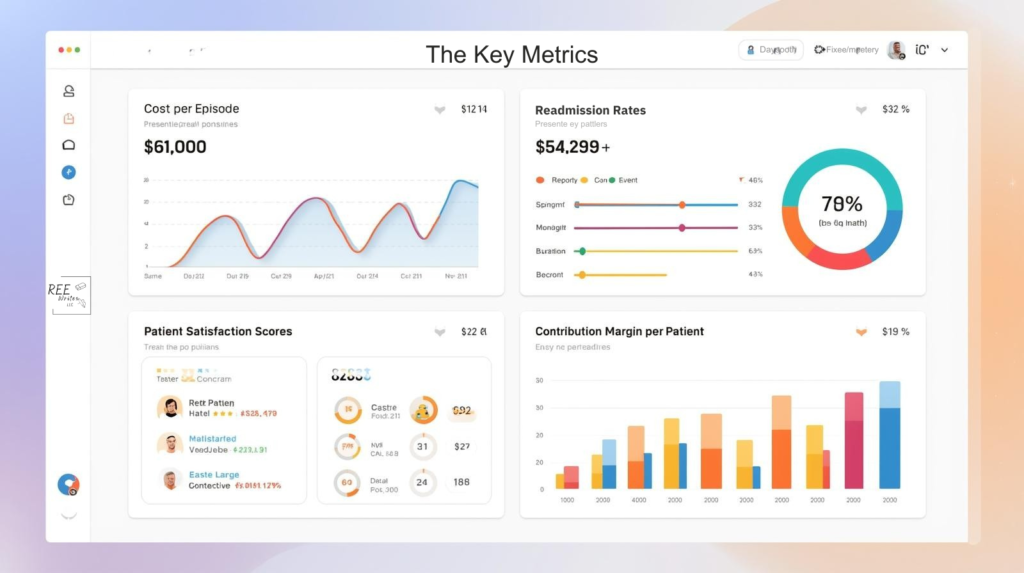
Your board doesn’t care about utilization growth if you’re losing money on every patient. They care about these metrics:

  • Cost per episode: What does it actually cost you to manage one hospital-at-home patient from admission to discharge? Track this ruthlessly. Break it down by component: labor, supplies, technology, overhead.
  • Readmission rates: Hospital-at-home programs typically achieve 8 to 12% 30-day readmission rates versus 15 to 18% for traditional hospital care. If your program doesn’t beat facility-based benchmarks, you have a quality problem.
  • Patient satisfaction: CMS increasingly ties reimbursement to patient experience scores. Hospital-at-home programs score 15-20 points higher on patient satisfaction versus facility care. That’s your competitive advantage.

Structure pilot programs that generate defensible data. Work with 2 to 3 health systems willing to share financial and outcomes data transparently. You need to prove your technology improves margins, not just clinical outcomes.

The difference between utilization metrics and profitability metrics: lots of patients using your platform means nothing if each one loses money. Focus on contribution margin per patient. When does that number go positive? What’s the path to 40 to 50% gross margins?

The 3 to 5 Year Platform Expansion Strategy

Once you’ve proven your core model works and generates positive margins, you can think bigger. The next phase is about expanding beyond your initial use case.

From point solution to platform

Bessemer’s State of Health AI report describes “supernova” companies that achieve 6-10x growth trajectories by expanding from single point solutions into comprehensive platforms. Ambient scribes became full clinical documentation suites. Prior authorization tools became complete utilization management platforms.

The pattern:

  1. Start with a painful, well-defined problem.
  2. Solve it better than anyone else.
  3. Expand into adjacent workflows that touch the same users.

For hospital-at-home technology, that might mean starting with post-surgical patients recovering at home. Prove you can manage that population safely and profitably. Then expand to heart failure management, COPD exacerbations, cellulitis treatment, chemotherapy administration.

Each expansion requires clinical validation and new reimbursement navigation. But your core technology infrastructure of monitoring, triage, care coordination, documentation stays largely the same.

Value-based care integration timeline

Source: Activated Insights

Hospital-at-home is a wedge into value-based care contracts, not just fee-for-service reimbursement. Accountable Care Organizations (ACOs) and Medicare Advantage plans care deeply about reducing avoidable hospitalizations. If your platform keeps patients out of expensive facility-based care, ACOs will pay for it.

But commercial adoption lags Medicare by 18 to 24 months historically. Don’t expect widespread MA plan adoption until 2027 to 2028, even with favorable hospital-at-home policy.

Self-insured employers represent a faster path to commercial revenue. Large employers pay directly for employee healthcare. When they see data showing hospital-at-home reduces costs by 30-40% versus facility admissions, they’ll write checks. Companies like Cubby, who secured $63 million in Series A funding led by Guggenheim Partners, are targeting this employer market specifically for in-home care solutions.

To position for risk-bearing contracts in years 3 to 5, you need data infrastructure now. Start collecting outcomes data, cost data, and patient experience data from day one. Value-based contracts require you to prove your intervention changes total cost of care—not just that patients like your service.

Decision Framework for Health Tech Boards

If you’re a founder presenting hospital-at-home strategy to your board, or a board member evaluating your company’s approach, here are the right questions to ask.

5 questions your board should ask right now

  1. What percentage of our revenue depends on waiver-specific reimbursement? If it’s above 50%, you have concentration risk. Diversify your payer mix and care settings.
  2. If the waiver expires in 5 years, what’s our Plan B business model? You should have a concrete answer. Can you pivot to post-acute care? Palliative care? Chronic disease management? If the answer is “we’re screwed without waivers,” you’re not building a durable company.
  3. Are we building technology that creates value in multiple care settings? The best health tech platforms work across hospital-at-home, skilled nursing, home health, and ambulatory settings. Flexibility equals durability.
  4. How quickly can we prove margin-positive unit economics? If you can’t show positive contribution margin by month 24, extending the timeline to month 36 won’t magically fix the problem. You have a business model issue, not a scale issue.
  5. What’s our competitive moat if 10 other startups get this same 5-year runway? Policy tailwinds create competition. What’s your defensible advantage? Clinical outcomes data? Payer relationships? Technology that’s genuinely better, not just first to market?

Investor perspective on policy-dependent businesses

Source: WallStreetMojo

VCs underwrite regulatory risk by discounting valuations and requiring faster paths to profitability. A pure software company might get 7-10 years to reach profitability. A health tech company with policy dependency gets 3-5 years maximum.

The valuation discount for waiver-dependent revenue can be brutal. Health tech companies trade at 10-20% below cloud software comparables—and that’s before factoring in temporary policy risk.

Some investors love policy tailwinds. They want to ride the wave while it’s building. Others avoid policy-dependent businesses entirely, no matter how attractive the market opportunity looks.

Position your pitch carefully. Are you policy-enabled (taking advantage of favorable reimbursement to scale faster) or policy-dependent (can’t exist without specific waivers)? The former gets funded at reasonable valuations. The latter struggles.

What I Wish Existed When I Was a Caregiver

Let me bring this back to why any of this matters. The technology decisions health tech founders make over the next 24 months will determine what tools families like mine have access to in 2026 and beyond.

The gap between technology capability and real-world reliability

Source: Aptiva Medical

My husband’s Dexcom continuous glucose monitor worked beautifully—when it synced properly. The app sent alerts to my phone whenever his blood sugar went dangerously high or low. That device probably saved his life multiple times.

But it only worked because the technology was reliable:

  • The sensor stayed attached.
  • The Bluetooth connection held.
  • The app didn’t crash.

I’ve seen hospital-at-home platforms that look impressive in demos but break under real caregiver stress. The dashboard shows beautiful data visualizations—but requires three different logins to access. The monitoring devices pair easily in the clinic—but fail when WiFi is weak in rural areas.

Care coordination platforms often assume 24/7 nurse availability. They don’t account for the reality that small hospital-at-home programs can’t staff round-the-clock coverage.

Build for the worst-case scenario, not the ideal one.

Building for the sandwich generation managing multiple conditions

Source: Graying with Grace

My husband had 10 doctors. Ten! A primary care physician, nephrologist, endocrinologist, oncologist, cardiologist, and five other specialists. Your platform needs the capability to handle that complexity.

Nobody coordinated between them. I was the coordination layer. I maintained a spreadsheet with all his medications—drug names, dosages, prescribing doctors, reasons for taking them, refill schedules. The nurses loved my spreadsheet because their systems couldn’t give them the same view.

Insurance coordination created endless frustration. My employer’s insurance was primary while Medicare was secondary. Every billing department called me multiple times to confirm this. I explained the same thing to the hospital billing office, the lab, the imaging center, the pharmacy.

Your hospital-at-home platform should automate this nightmare. Pull medication lists from multiple prescribers. Flag potential drug interactions. Coordinate insurance claims automatically. Don’t make family caregivers become project managers.

Why I care about this 5-year window

Families like mine in 2026 deserve better than what I had in 2016.

The technology exists now, and the clinical models work. The question is implementation and sustainability.

Health tech founders have a moral obligation beyond shareholder returns. Yes, you need to build a profitable business and generate returns for your investors. But you’re also building tools that will serve people during the most vulnerable moments of their lives.

This isn’t about making a quick buck off temporary Medicare waivers then exiting before they expire. It’s about building something that lasts. Something that works. Something that actually helps families manage impossible complexity.

When you’re making technology decisions over the next 24 months, remember: real people will rely on what you build. Build something worthy of that trust.

The Path Forward

The proposed 5-year extension for hospital-at-home waivers isn’t a guarantee. It’s a window.

What you build in the next 24 months determines whether your company survives beyond 2030—regardless of what happens with federal policy.

The smartest founders build technology that creates value across multiple reimbursement scenarios. Focus on margin-positive unit economics. Solve real problems for real families—the kind of problems I faced as a caregiver managing impossible complexity across disconnected systems.

  • Start with the unsexy AI that makes programs profitable: revenue cycle management, clinical documentation, coding accuracy. These aren’t sexy pitch deck slides, but they generate cash flow.
  • Build your minimum viable stack around care orchestration and monitoring that works when human resources are constrained. Health systems can’t hire infinite nurses. Your technology needs to make existing staff dramatically more productive.
  • Structure pilot programs that generate defensible ROI data within 6 months. You need proof points for your next fundraise and for health system expansion.
  • Stress-test your business model. If hospital-at-home waivers expire in 2030, what’s Plan B? If you don’t have a good answer, you’re building on quicksand.

Five years is enough time to build something durable if you start with the right foundation. It’s not nearly enough time if you’re building for a policy moment instead of a market need.

The families who need hospital-at-home can’t wait for perfect policy clarity. They need technology that works today and keeps working tomorrow. So build for that reality.

Want to discuss your hospital-at-home technology strategy? Connect with me on LinkedIn or explore more health tech analysis at reewrites.com.


References

Bessemer Venture Partners. (2026). State of Health AI 2026. Retrieved from https://www.bvp.com/atlas/state-of-health-ai-2026

Fox, A. (2026). 2026 House spending bill proposes 2-year telehealth and 5-year hospital-at-home waiver extensions. Healthcare IT News. Retrieved from https://www.healthcareitnews.com/news/2026-house-spending-bill-proposes-2-year-telehealth-and-5-year-hospital-home-waiver-extensions

Gardner, S. & Hooper, K. (2026). Health tech panel to reboot after a long break. Politico Pulse. Retrieved from https://www.politico.com/newsletters/politico-pulse/2026/01/21/health-tech-panel-to-reboot-after-a-long-break-00737790

Gonzales, M. (2026). Proposed Funding Package Would Extend Hospital-at-Home Program, Medicare Telehealth Flexibilities. Home Health Care News. Retrieved from https://homehealthcarenews.com/2026/01/proposed-funding-package-would-extend-hospital-at-home-program-medicare-telehealth-flexibilities/

Stock Titan. (2026). Cubby secures $63 million in Series A funding round led by Growth. Retrieved from https://www.stocktitan.net/news/GS/cubby-secures-63-million-in-series-a-funding-round-led-by-growth-ikgye2ab40md.html

Zanchi, M. G. (2026). AI Journal. The “unsexy” revolution within healthcare AI. Retrieved from https://aijourn.com/the-unsexy-revolution-within-healthcare-ai/