
Epic and Oracle Both Launched AI Patient Portals. So Why Does the Buyer/User Gap Still Exist?
Epic and Oracle Health shipped consumer-grade AI patient interfaces within a year of each other: Epic’s Emmie launched in 2025, and Oracle’s AI-powered patient portal followed in August 2026.
That resets the baseline for what “good” patient communication looks like, and it raises the bar for every smaller healthtech SaaS vendor still selling to the buyer instead of building for the user.
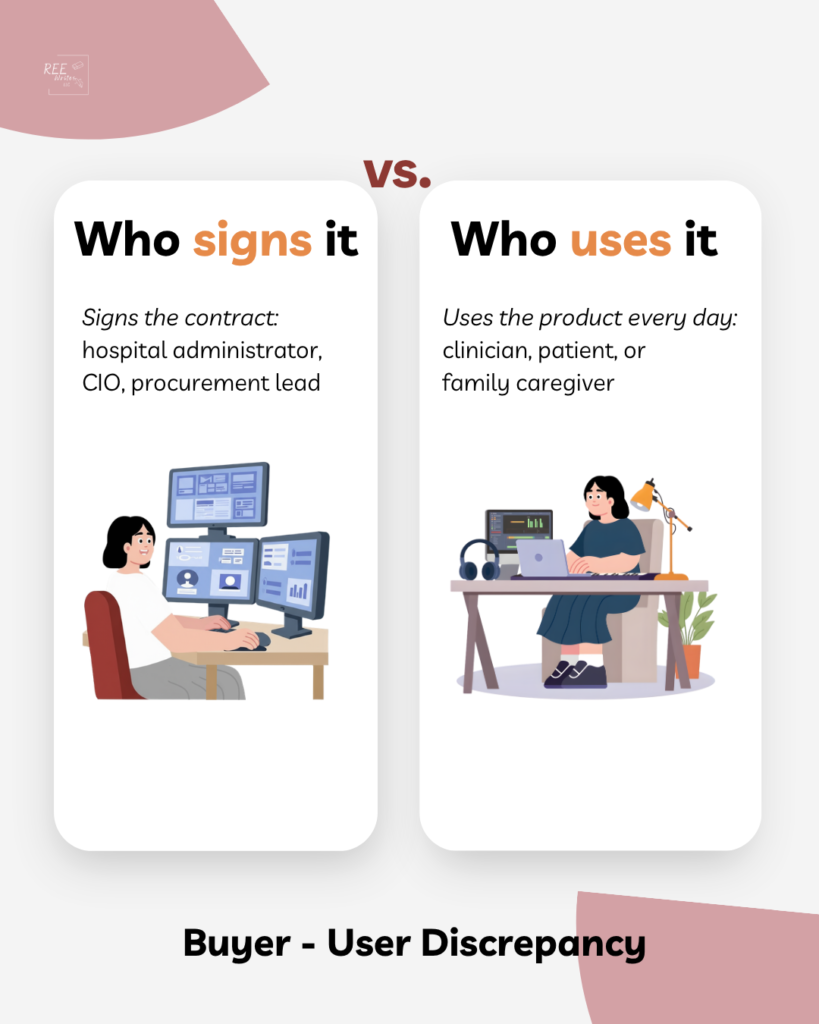
They still need to address the buyer/user gap, the distance between who signs the contract, and who actually has to use the thing.
What did Oracle and Epic build?
Oracle Health made their AI-powered Patient Portal available across the U.S. in August 2026, built on the EHR platform the company designed after its $28 billion Cerner acquisition.
The embedded assistant:
- Explains a patient’s medical record back to them in plain language
- Cites its sources
- Answers direct questions like “how am I managing my diabetes?” grounded in that patient’s chart
- Handles appointment scheduling using natural language processing (NLP)
- Redirects diagnosis or treatment questions to the care team or 911 instead of answering them itself
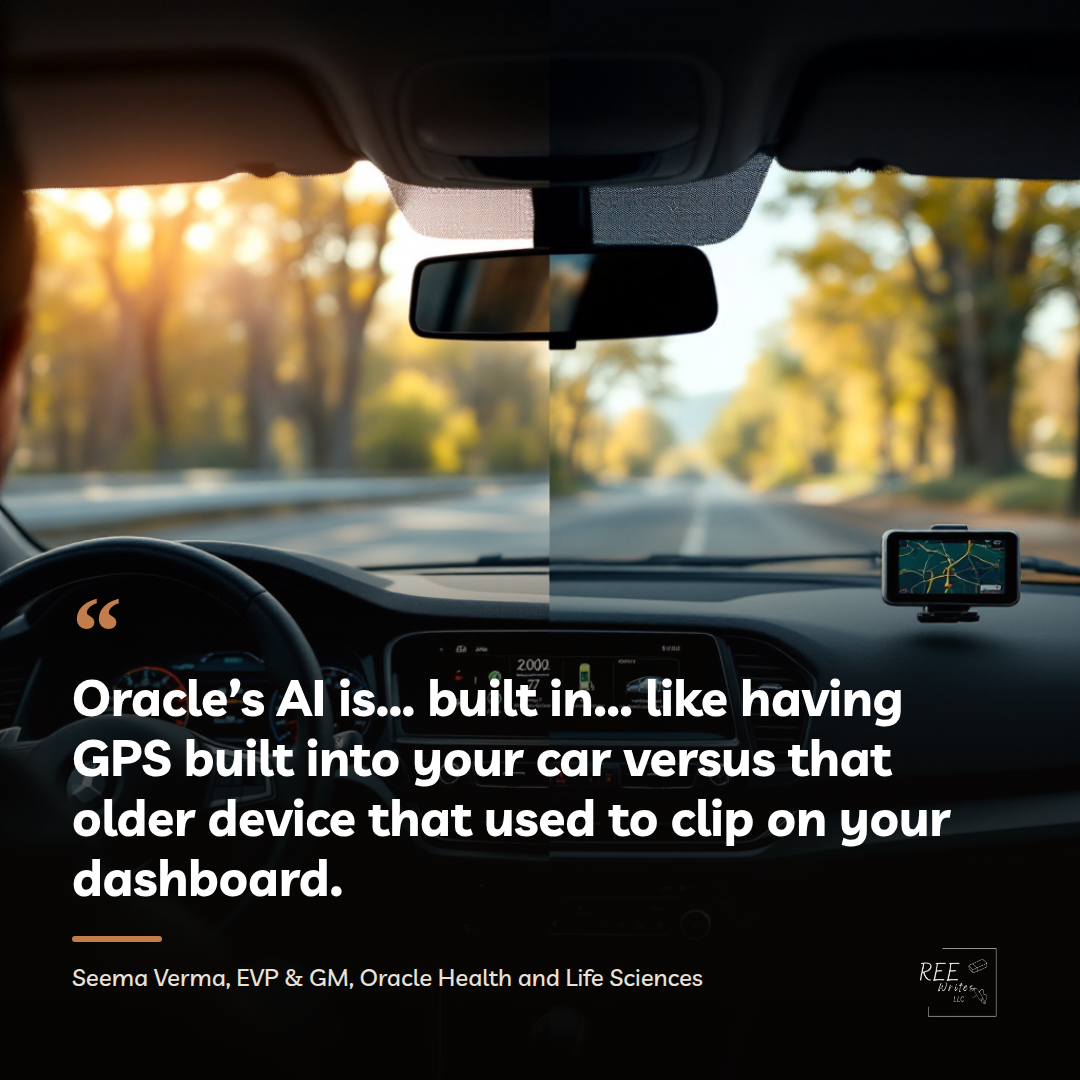
Seema Verma, EVP and GM of Oracle Health and Life Sciences, described the positioning: “Oracle’s AI isn’t bolted on, it’s built in. So it’s like having GPS built into your car versus that older device that used to clip on your dashboard.”
That’s a direct shot at Epic, whose own patient-facing AI tool, Emmie, launched roughly a year earlier and does the same job: scheduling and visit prep.
Two things to pay attention to:
- The 2 largest EHR vendors in the country have both decided a plain-language, source-cited AI layer belongs inside the patient’s primary record system, not bolted on as a third-party add-on.
- They did so almost simultaneously, which means this wasn’t a one-off bet by a single company chasing a headline.
It’s now a category baseline.
If you don’t sell to Epic or Oracle’s customers, why should you care?
This dynamic created the buyer/user gap in healthtech content and product design, not a startup: platforms and vendors build for the person who signs the contract, while the person who has to log in, read the message, and act on it gets whatever’s left over.
I lived on the user side of that gap for years, coordinating care for my husband across 10 specialists, RPM devices and more portals than I could ever count. I used his credentials to act on his behalf in secure messaging systems that were built for a single patient managing their own care, not a spouse coordinating someone else’s.
When the systems didn’t talk to each other, I built my own spreadsheet, and later a Notion workspace, because none of the vendor platforms agreed on formatting or gave me a way to see the whole picture at once.
That workaround is the tell. Every time a caregiver or patient builds their own system to route around a product, it means the education and communication layer inside that product doesn’t exist.
Oracle and Epic can absorb the cost of closing part of that gap because they’re the two largest EHR companies in the country with the engineering budget to do it. Series A or B healthtech SaaS vendors selling point solutions into the same health systems don’t have that budget, and now has a buyer who’s seen what “built in, not bolted on” looks like at the platform level.
The standard moved. Every smaller vendor now has to answer, before the demo and not during it, what their product does for the actual user that the EHR’s own AI won’t.
What does Rock Health’s H1 2026 data reveal about how vendors are responding?
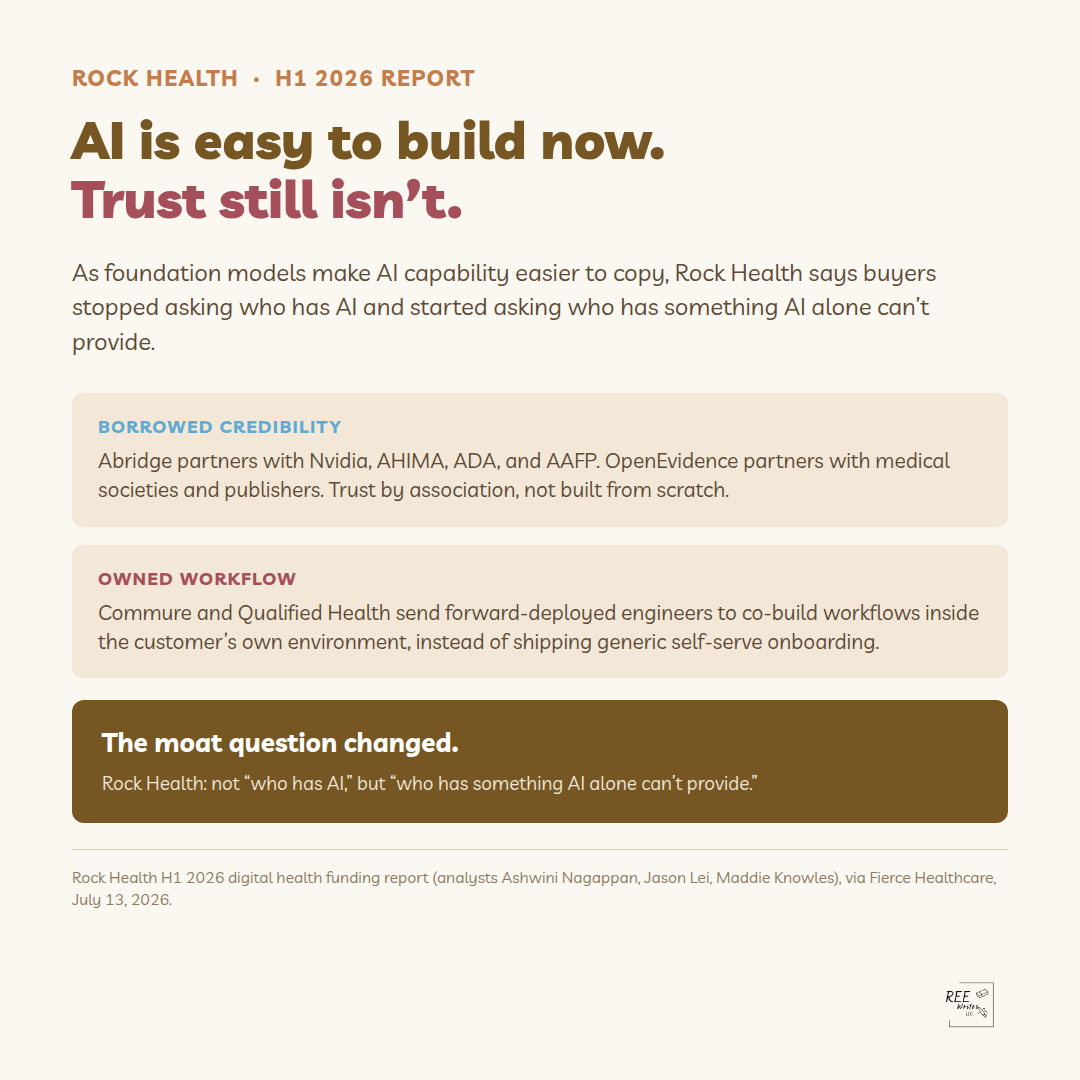
Rock Health’s first-half 2026 digital health funding report calls out two patterns here, because both are responses to the same pressure Oracle and Epic just applied.
The first is borrowed credibility through partnership.
- Abridge’s partnerships with Nvidia, American Health Information Management Association (AHIMA), the American Diabetes Association (ADA), and the American Academy of Family Physicians (AAFP)
- OpenEvidence’s partnerships with medical societies and publishers, as a strategy for building trust without spending years earning it through content alone.
A partnership with the AAFP is a shortcut past the “why should I trust you” conversation (the same conversation many vendors try and fail to have through their content).
The second is the forward-deployed engineer, or FDE, model.
- Companies like Commure and Qualified Health are building go-to-market motions around engineers who work directly inside a customer’s environment to co-develop workflows. They don’t rely on a standard onboarding flow and hope it sticks. You don’t need to hire engineers to embed on-site to learn from that.
High-touch onboarding has to follow one principle: Build it around the specific workflow your buyer has.
An education sequence has to follow that same principle if it’s going to shorten the distance between the person who bought the product and the person who has to run it.
What should a healthtech SaaS company do differently?
Three things, in order:
- Say what your product does that the EHR’s AI won’t. If your pitch is “plain-language patient communication” or “explains the record back to the patient,” Oracle and Epic just did that at the platform level. Your differentiation has to sit somewhere more specific, in a workflow, a population, or a moment in care they’re not built to reach.
- Check whether your content is still written for the signer instead of the user. A demo deck built for a CIO, and an onboarding sequence built for the clinician or patient who has to live inside the product every day, are two different documents. Most companies only have the first one.
- Borrow trust deliberately (like Abridge and OpenEvidence). If you don’t have a partnership with an institution your buyer already trusts, your content has to do all of that trust-building work by itself. Know which job it’s doing before you write it.
You have to be honest about who opens and uses the product after the contract is signed, and then build the education for them.
Sources
- Oracle Health Debuts Revamped AI-Powered Patient Portal — Fierce Healthcare, Heather Landi, August 12, 2026
- Oracle Health Debuts AI-Powered Patient Portal — Becker’s Hospital Review, Naomi Diaz, August 12, 2026 (corroborating same-day coverage)
- Digital Health Brought In $7.4B in VC Funding as AI-Powered Rebound Fuels Market — Fierce Healthcare, Heather Landi, July 13, 2026 (Rock Health H1 2026 data, partnership and FDE examples)
FAQ
What is the “buyer/user gap” in healthtech?
The buyer/user gap describes the distance between the person who signs a healthtech contract, usually a hospital administrator, CIO, or procurement lead, and the person who actually has to use the product day to day, whether that’s a clinician, a patient, or a family caregiver.
Vendors that build and market for the buyer while ignoring the user see stalled deals and quiet churn even when the product itself works.
What did Oracle Health’s AI patient portal launch in August 2026?
Oracle Health released a generally available, AI-powered patient portal across the U.S. in August 2026. The embedded assistant explains a patient’s own medical record in plain language, cites its sources, answers direct questions grounded in that patient’s chart, and handles natural-language appointment scheduling.
Instead of giving a diagnosis or treatment advice, it redirects those questions to the care team or emergency services.
How is Oracle’s AI patient portal different from Epic’s Emmie?
Both tools handle scheduling and visit prep through an AI layer built directly into the EHR rather than added on top. Epic’s Emmie launched roughly a year before Oracle’s equivalent.
Oracle has positioned its version explicitly against Epic’s, describing its approach as “built in, not bolted on.”
Why does a platform-level AI feature affect smaller healthtech SaaS vendors?
When the two largest EHR vendors in the country both ship the same category of feature, they reset what health system buyers expect “good” patient communication to look like.
A smaller vendor selling a point solution into the same health systems now has to explain, in plain language and before the demo, what their product does that the platform’s own AI does not.
What does Rock Health’s H1 2026 report say about building buyer trust?
Rock Health’s first-half 2026 funding report highlights two strategies:
1- Borrowing credibility through partnerships with institutions the buyer already trusts (Abridge with the AAFP and ADA, OpenEvidence with medical societies and publishers)
2- Using forward-deployed engineers who work inside a customer’s actual environment instead of a standard onboarding flow, as seen at Commure and Qualified Health.
How can a healthtech company tell if it’s still selling to the wrong person?
Check whether the demo deck and the onboarding sequence are the same document with different formatting. If the content built for the CIO who signs the contract is the same content handed to the clinician or patient who has to use the product, it was written for one audience and is being asked to do a second job it was never built for.
Health Tech